
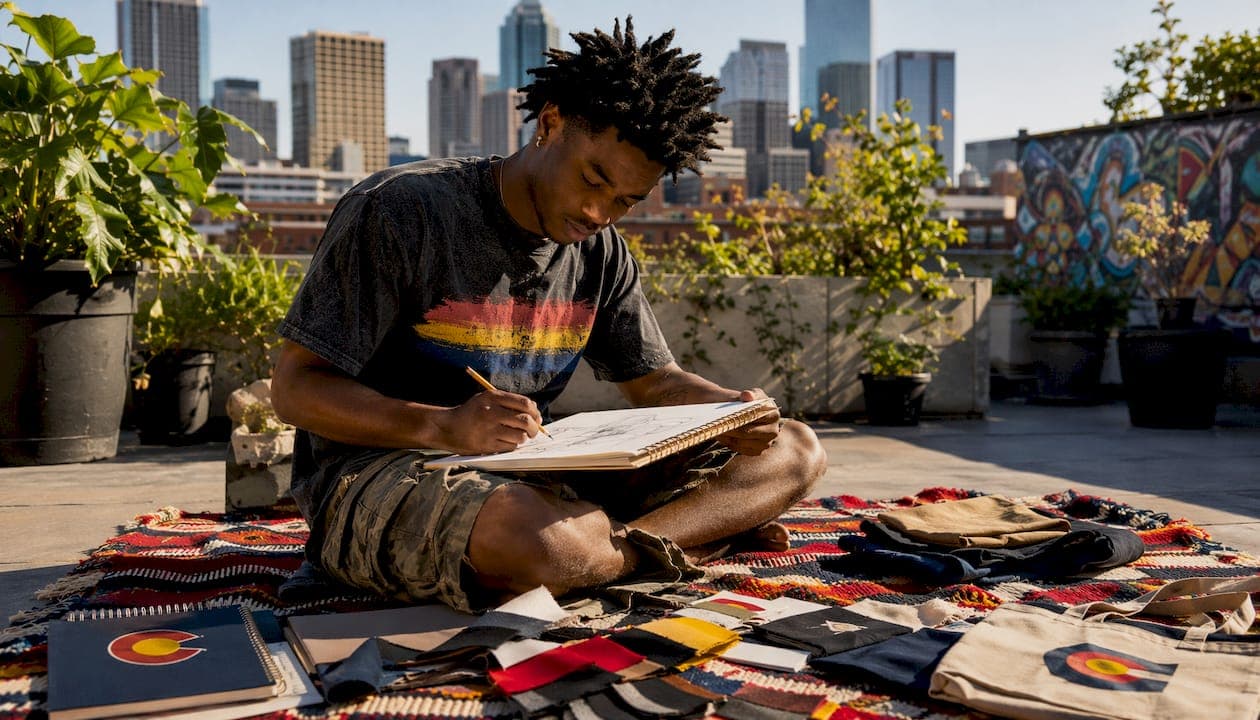
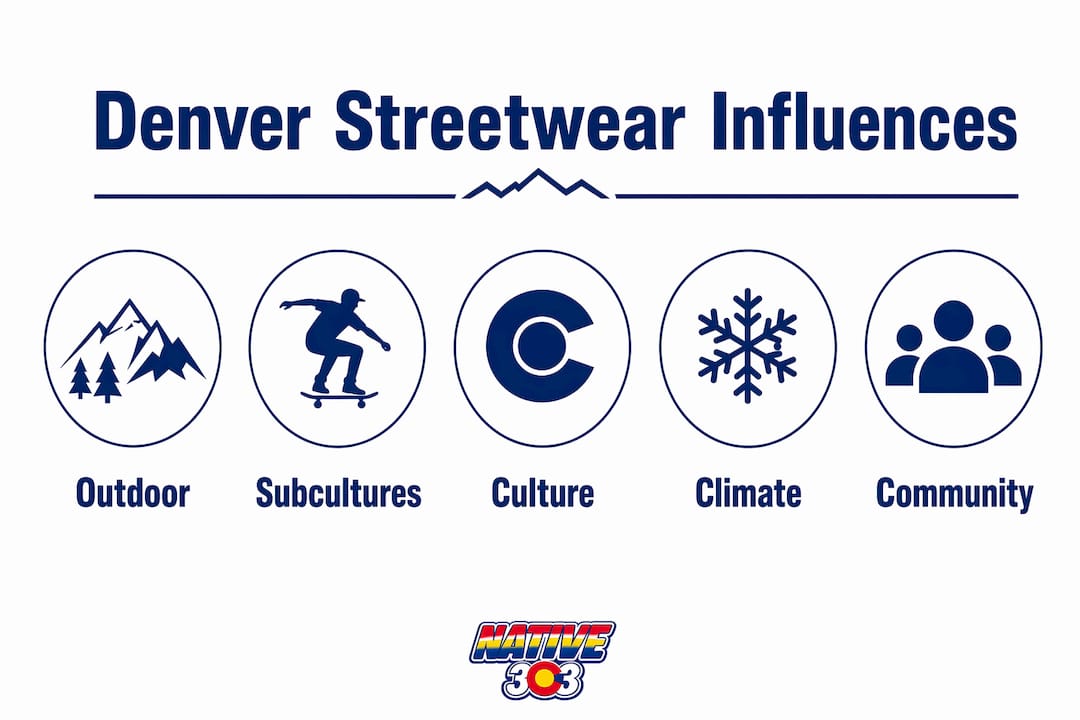
Denver streetwear is shaped by a rare combination of outdoor practicality, vintage thrift culture, local mythology, and a creative community that actively resists coastal fashion norms. The city's style, often called "Colorado cool," blends functionality with deep individuality, favoring worn-in denim, trail-ready footwear, and graphic tees rooted in real Denver stories over polished, trend-chasing looks. What are Denver streetwear influences, exactly? They are the mountains, the murals, the music venues, the mythology, and the neighborhoods that make this city unlike anywhere else.
Here is what drives Denver's urban style in 2026:
- Outdoor lifestyle and utility wear woven into everyday outfits, not just weekend gear
- Vintage and thrift culture centered on sustainability and personal storytelling
- Local art and music scenes that feed directly into graphic design and brand identity
- Denver's folklore and landmarks turned into wearable cultural symbols
- A diverse, community-first fashion ecosystem that values authenticity over image
How Denver's art and music scenes drive streetwear aesthetics
Local creative culture is probably the single biggest driver of Denver streetwear trends. The city's muralists, musicians, and independent artists do not just inspire clothing. They often make it. Brands like Abstract Denver, founded by Dave Roggeman and Aaron Cohrs, grew directly out of a desire to give local artists a platform, pivoting from gallery sales to graphic tees when wearable art proved far more accessible to the community.
The punk rock ethos runs deep here. INDYINK, one of Denver's foundational streetwear operations, was built in the 1990s by two Denver natives who rejected the city's "Cow Town" reputation and decided to create the culture they wanted to see. Their philosophy is direct: every garment is a platform for expression, not a promotional item.
"If the culture didn't exist, they would create it. What began as a small clothing venture quickly developed into a brand rooted in independence, creativity, and a refusal to follow the expected path." — 303 Magazine on INDYINK
Denver Fashion Week's streetwear show reinforces this creative energy each year. The event features performances by local artists and musicians, and the crowd itself becomes part of the spectacle, with attendees encouraged to wear their own street-style outfits. It is less runway, more cultural gathering.
- Graphic art inspired by local muralists appears on limited-run tees
- Music subcultures, from grunge to hip-hop, shape silhouette and color choices
- Collaborative drops between brands and artists keep designs tied to real community stories
How Denver's outdoor lifestyle shapes practical, functional streetwear
Denver sits at 5,280 feet, and the weather proves it. A single day can move from 70-degree sunshine to a sudden downpour to a cold snap by evening. That reality shapes what people actually wear, and it shows up in Colorado outdoor apparel choices across the city.
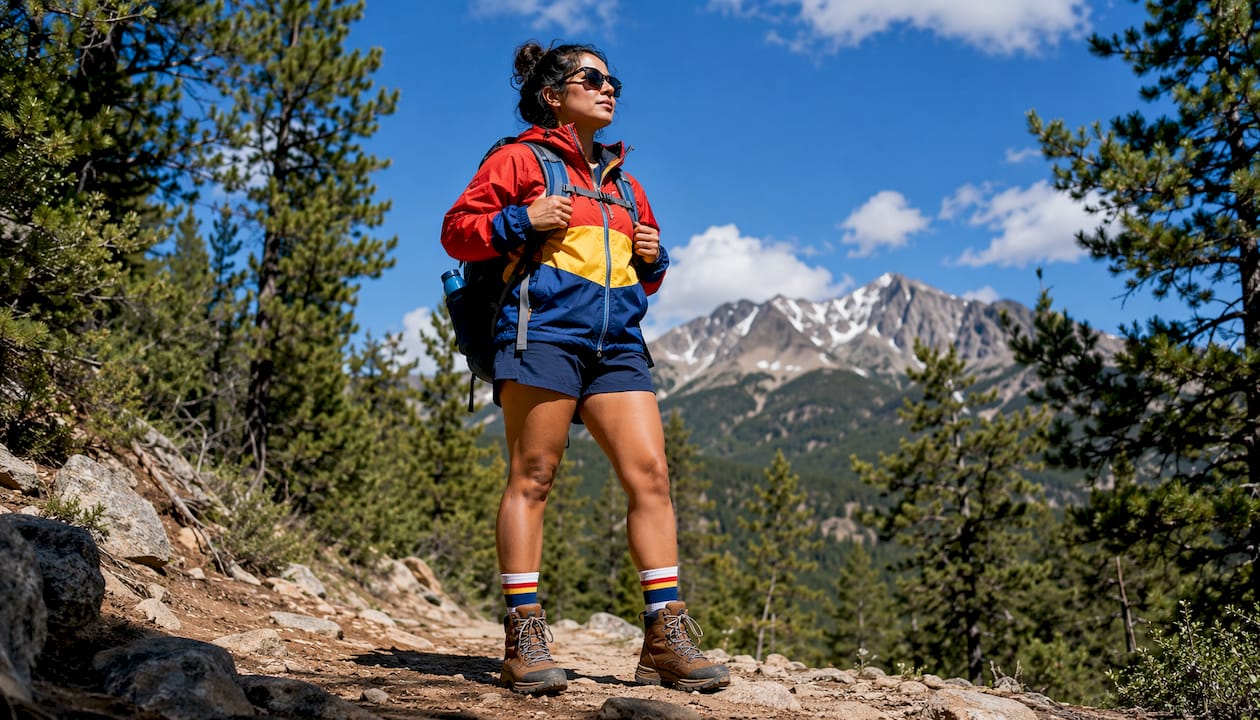
The "gorpcore" trend, technical outdoor gear worn as everyday fashion, did not arrive in Denver from an editorial page. It evolved organically because it makes practical sense here. Trail runners from Salomon and Hoka are styled with wide-leg jeans or maxi skirts. GORE-TEX shells appear at coffee shops. Utility vests with zippered pockets show up at gallery openings.
| Gear Type | Urban Streetwear Application |
|---|---|
| Trail runners (Hoka, Salomon) | Paired with wide-leg denim or bike shorts |
| Technical puffer vests | Layered over hoodies for city and trail |
| GORE-TEX shells | Worn into coffee shops and co-working spaces |
| Tevas and Chacos | Styled with slouchy socks or oversized trousers |
| Waterproof layering pieces | Transitioned from workday to trailhead outings |
How this plays out in practice:
- Footwear doubles as both performance gear and streetwear statement
- Layering is a signature move, mixing eras and textures rather than matching sets
- Utility pockets and weather-ready fabrics are chosen for function, not irony
- Outdoor brands cross into the style conversation without losing their technical credibility
What historical and cultural symbols show up in Denver streetwear designs
Denver has a genuinely strange and specific history, and local brands mine it deliberately. Abstract Denver's catalog reads like a folklore archive. One design reimagines the Blue Mustang statue (widely known as "Blucifer" for its glowing red eyes) as a werewolf in a metal band tee style. Another captures Roger the Elephant, who famously escaped the Denver Zoo in 1963 and wandered the city before being tranquilized and returned. A third memorializes the 2004 Granby Killdozer incident, when Marvin Heemeyer drove a fortified bulldozer through the town of Granby in a one-man rampage that became Colorado legend.
Colorado folklore gets the same treatment. The Slide-Rock Bolter, a mythical whale-like creature said to slide down mountain slopes and swallow unsuspecting hikers, appears on a shirt that only locals immediately recognize. That insider quality is the point.
- Blue Mustang (Blucifer): reimagined as a werewolf, leaning into the statue's controversial mythology
- Sloan's Lake: depicted with a Kraken attacking a historic riverboat, referencing the actual amusement park that once stood there
- Slide-Rock Bolter: Colorado's lesser-known folk legend, captured in graphic form for those who know the story
- Roger the Elephant: a quirky, beloved piece of Denver Zoo history turned into wearable nostalgia
| Design Theme | Cultural Reference | Brand |
|---|---|---|
| Blucifer Werewolf | Denver's controversial Blue Mustang statue | Abstract Denver |
| Slide-Rock Bolter | Colorado mountain folklore | Abstract Denver |
| Roger the Elephant | 1963 Denver Zoo escape | Abstract Denver |
| Granby Killdozer | 2004 Colorado incident | Abstract Denver |
Pro Tip: If you want to spot genuine Denver-inspired designs versus generic Colorado mountain merch, look for insider cultural references that only locals recognize. That specificity is the mark of a brand actually rooted in the city.
How Denver streetwear events and local community shape trends
Denver's sneaker and streetwear community centers physically around LoDo's Coors Field corridor. Rare Pair at 2030 Blake Street and Premium Goods at 2028 Blake Street operate with the kind of seriousness about exclusive drops and brand relationships that rivals shops in much larger cities. On release days, the line at Rare Pair stretches down the block regardless of weather.
"Denver's streetwear culture doesn't get the national coverage of Chicago or Atlanta, but it's legitimate and it's growing." — Denver's Best
Denver Fashion Week's streetwear show has become a genuine community institution, not just a showcase. It prioritizes real and adaptive design over image-obsessed trends, and it actively platforms designers from Black, Latino, and Indigenous backgrounds.
- Rare Pair and Premium Goods anchor the city's sneaker culture on Blake Street
- Denver Fashion Week streetwear shows feature diverse, emerging, and boundary-pushing designers
- Pop-ups and gallery collaborations blur the line between retail and cultural programming
- Community spaces like Adult Entertainment's Five Points café host poetry nights, comedy shows, and writers' workshops alongside clothing drops
Expert perspectives on Denver's distinctive streetwear identity
Denver's fashion identity is democratic and inclusive in a way that coastal cities rarely manage. The city's designers consistently frame sustainability as a creative advantage rather than a constraint, working with upcycled textiles and naturally dyed fabrics to produce limited runs that feel considered rather than disposable.
"It's about purpose-driven design, community-rooted commerce and garments that reflect both individual identity and shared values." — 303 Magazine
INDYINK's "anti-promotion" philosophy captures the broader Denver ethos well. The brand rejects generic merchandise in favor of garments that carry meaning, treating every project as a collaboration where the client's vision drives the outcome. Abstract Denver, INDYINK's in-house streetwear arm, now operates four storefronts across the city, each functioning as a community hub for art events and local collaborations.
- Local brands prioritize craftsmanship and limited runs over mass production
- Sustainability is treated as a design constraint that produces better work, not a marketing angle
- Community-rooted commerce means retail spaces double as cultural venues
- Denver style resists the "image-obsessed" polish of coastal fashion capitals by design
Pro Tip: When mixing thrift finds with Denver streetwear pieces, lean into the mismatched layering that defines the city's aesthetic. A vintage band tee under a technical vest is more Denver than any coordinated outfit.
How Denver's diverse ethnic communities shape streetwear
Denver's streetwear scene reflects the city's genuine demographic diversity. Denver Fashion Week's streetwear shows consistently feature designers drawing from Middle Eastern, Mexican, Japanese, Black, and Indigenous cultural backgrounds, weaving those references into collections that feel specific rather than generic. The result is a scene where cultural identity is a design asset, not an afterthought.
Adult Entertainment, the Five Points brand led by Pines and his team, frames this directly. Their takeover of Coffee at the Point was explicitly about extending the neighborhood's Black and Brown cultural legacy, not capitalizing on it. "We are the underrepresented voices," Pines said, "and this space is a platform to make that known." That kind of intentional cultural ownership shapes what the brand makes and how it presents itself.
How skate and hip-hop subcultures influence Denver's style
Skate culture and hip-hop have shaped Denver streetwear from the ground up, not as imported trends but as local realities. The city's skaters and hip-hop artists have long overlapped with its muralists and independent designers, creating a creative ecosystem where graphic tees, oversized silhouettes, and limited drops feel natural rather than performative.
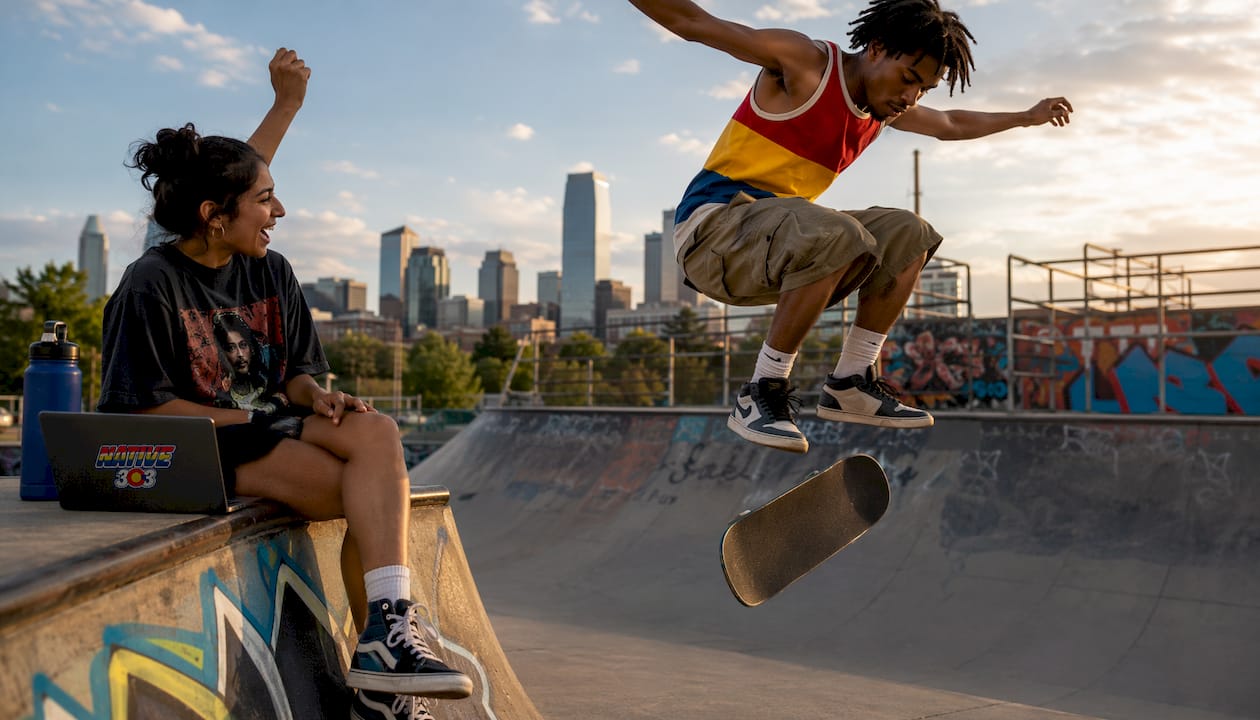
The vintage and thrift culture that defines so much of Denver's style has deep roots in both subcultures. Worn-in Levi's, vintage band tees, and oversized flannels connect directly to the city's grunge and hip-hop history. Skaters in particular drive demand for graphic-driven streetwear that carries a specific point of view, which is exactly what brands like Abstract Denver and INDYINK built their reputations on.
How socioeconomic factors shape Denver streetwear trends
Thrift and vintage culture in Denver is not purely aesthetic. It reflects a real economic reality for many of the city's young creatives, musicians, skaters, and artists who want expressive clothing without fast-fashion price points or mass-production ethics. South Broadway and RiNo are lined with vintage stores precisely because the demand is genuine.
The democratic nature of Denver's fashion scene, mixing thrifted pieces with technical outdoor gear and locally made graphic tees, means that personal style does not require a large budget. A $12 flannel from Goldmine Vintage on Capitol Hill sits comfortably next to a $150 Salomon trail runner in the same outfit. That mix is not accidental. It reflects a community that values authenticity over spending power.
How Denver's climate drives clothing choices year-round
Denver has a climate characterized by frequent sunshine but rapidly changing weather patterns, including early snow, warm winter days, and summer thunderstorms. That unpredictability is not a background fact. It is an active design constraint that shapes what people buy and wear every single day.
Layering is the practical answer, and it has become a signature aesthetic move. A vintage Broncos sweatshirt under a puffer vest, paired with trail runners and chunky silver jewelry, is not a styled look assembled for a photo. It is what someone wore because the morning was cold, the afternoon was warm, and the evening might go either way. Denver's climate turns functional dressing into personal expression by necessity.
Native303apparel: Denver stories you can wear
Native303apparel captures exactly this spirit. Every design draws from the memories of metro Denver's iconic eateries, clubs, and classic shops, turning local nostalgia into apparel that tells a real story. If you want clothing that carries a piece of Denver's actual history, not generic mountain graphics, explore Native303apparel's collections and find the piece that connects you to the city.
Key Takeaways
Denver streetwear is defined by outdoor practicality, vintage culture, local mythology, and a community-first ethos that consistently prioritizes authenticity over image.
| Point | Details |
|---|---|
| "Colorado cool" defines the aesthetic | Functionality, individuality, and vintage culture combine to create Denver's distinct streetwear identity. |
| Outdoor gear is worn with genuine intent | Trail runners, puffer vests, and GORE-TEX shells appear in daily outfits because Denver's climate demands them. |
| Local mythology fuels graphic design | Brands like Abstract Denver build designs around Denver folklore, landmarks, and real historical events. |
| Community spaces anchor the scene | Boutiques like Rare Pair and Premium Goods, plus pop-ups and gallery events, drive trend formation locally. |
| Diversity shapes every collection | Denver Fashion Week and brands like Adult Entertainment actively platform Black, Latino, and Indigenous designers. |