
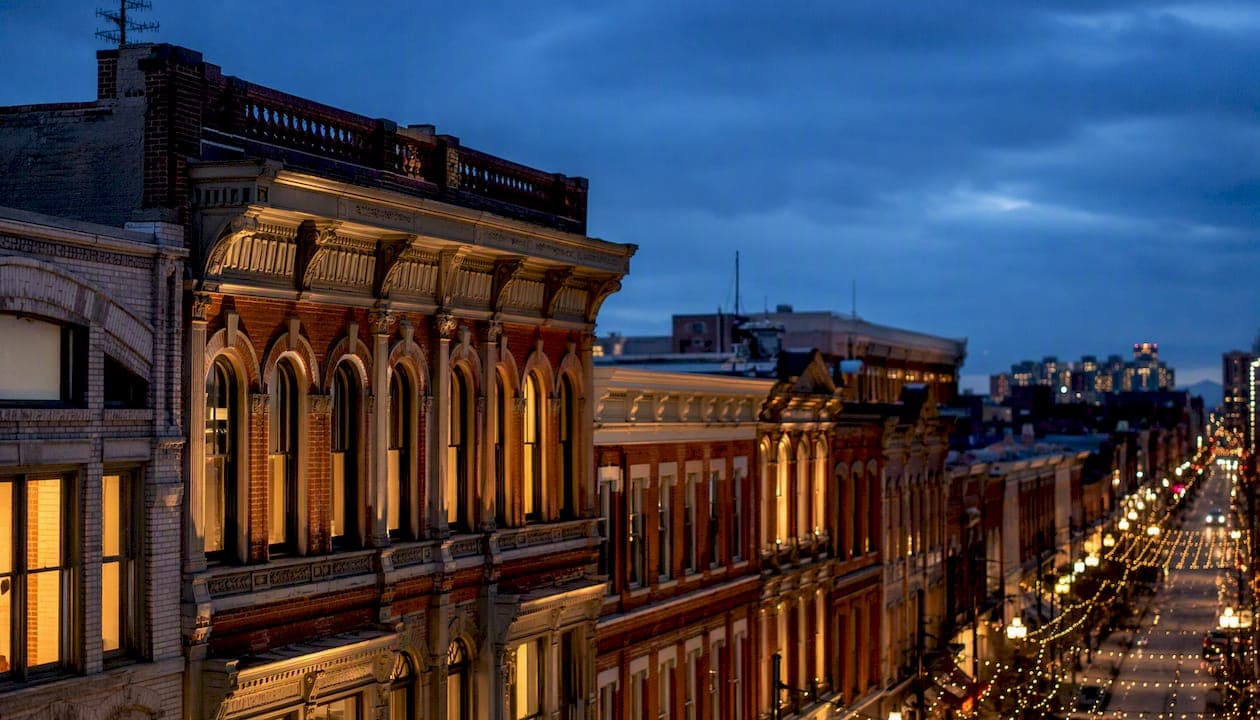
Larimer Square is Denver's original commercial block, founded in 1858 by General William Larimer and saved from demolition in the 1960s to become a model of adaptive reuse. It sits on the 1400 block of Larimer Street, and it holds the distinction of being Denver's first designated historic district. Its rescue by Dana Crawford and Larimer Square Associates changed how the entire city thinks about old buildings.
TL;DR:
- During Denver’s urban renewal era, Larimer Square was threatened with demolition, but private investor Dana Crawford acquired and restored the buildings, proving preservation could be profitable.
- Restorations included modern internal updates, pedestrian courtyards, and outdoor seating areas, transforming the district into a vibrant retail and dining destination.
- The success of Larimer Square shifted Denver’s urban development philosophy from demolition to preservation, influencing later projects like Union Station and the warehouse district revival.
- The district’s tenant mix of restaurants, boutiques, and galleries creates a unique scale that sustains independent retail and attracts cultural and tourist traffic to downtown Denver.
Table of Contents
- The Founding and Rise of Larimer Square (1858–1890s)
- Decline of Denver's First Commercial Street (1890s–1950s)
- The Urban Renewal Threat and Dana Crawford's Rescue
- Restoring the Block: How the Rehabilitation Worked
- Historic Designation: 1971 Landmark Status and the 1973 National Register Listing
- Larimer Square's Legacy in Denver Preservation
- Why This History Still Shapes Denver's Retail Streets
- How Larimer Square Powered Denver's Downtown Economy
- The Businesses and Tenants That Defined the Block
- From Private Rescue to Modern Ownership
- How Denver Residents Responded to the Preservation Fight
- What Larimer Square Teaches Us About Saving a City's Memory
- Wear a Piece of the Block's History
- Where to Read More About Larimer Square's History
- Sources
The Founding and Rise of Larimer Square (1858–1890s)
General William Larimer Jr. didn't buy this land so much as claim it. In November 1858, he staked out a townsite on a bluff across Cherry Creek from the existing settlement of Auraria, naming it Denver City after Kansas Territory governor James W. Denver. It was, by most accounts, an act of speculation dressed up as civic founding. Larimer named the main artery running through his new town after himself, and that decision still shows up on street signs today.
The timing mattered more than the audacity. The Pike's Peak gold rush was drawing prospectors and merchants west by the thousands, and Larimer Street quickly became the commercial spine of the new settlement. Within a year, dozens of structures, including Denver's early civic institutions, had clustered along the street, according to Visit Denver's account of the city's early history. Those first buildings were log cabins and simple wood frames, thrown up fast to serve a boomtown economy.
That first generation of construction didn't survive. Fires in 1863 and floods in 1864 wiped out much of early Larimer Street, forcing merchants to rebuild in something sturdier. What went up in the following decades was brick, and it's largely what still stands today.
Most of the buildings you'd recognize on Larimer Square now date from the 1870s through the 1890s, built during Denver's transformation from mining outpost to genuine city. The National Register nomination for the district documents a cluster of late-Victorian commercial architecture that includes:
- Italianate storefronts with tall, arched windows and decorative cornices
- High Victorian Gothic detailing on several facades
- Renaissance Revival elements borrowed from the era's fashionable East Coast commercial buildings
- Cast-iron storefront columns, a hallmark of 1880s American retail construction
A few blocks away, the Daniels & Fisher Tower rose in 1911 as a symbol of how far downtown Denver's ambitions had grown since Larimer's original claim. It wasn't part of Larimer Square itself, but it marked the same commercial corridor's evolution from frontier trading post to a city with real architectural aspirations. The variety of styles packed into one block gives Larimer Square a visual rhythm that's rare for a downtown this compact, and it's a big part of why the district reads as cohesive rather than accidental.
Decline of Denver's First Commercial Street (1890s–1950s)
Larimer Street's dominance didn't last. As Denver grew, retail and civic energy migrated toward 16th Street, and the original commercial corridor started losing tenants it could never quite replace.
The economic shocks of the era accelerated the slide. Here's roughly how the decline unfolded:
- The Panic of 1893, triggered by a silver market collapse, hit Colorado's economy hard and drained investment from older commercial districts like Larimer Street.
- Businesses that could afford to relocate did, following foot traffic toward the newer retail core forming around 16th Street.
- Landlords on the old block, facing falling rents, began subdividing storefronts and upper floors into cheaper, lower-grade rentals.
- By the mid-twentieth century, Larimer Street had earned a reputation as Denver's skid row, home to pawn shops, flophouses, and vacant storefronts.
It's a strange kind of irony that neglect is what saved these buildings. Nobody had the capital or the motivation to tear them down and build something new, so the Victorian brick facades sat largely untouched for decades. When Denver finally did have the money to redevelop the area, in the form of federal urban renewal funding, the block's biggest liability suddenly looked like an asset to the right person.
The Urban Renewal Threat and Dana Crawford's Rescue
By the 1960s, Denver had both the funding and the appetite to bulldoze its way into modernity. The Denver Urban Renewal Authority, known as DURA, launched the Skyline Urban Renewal Project, a plan that targeted roughly thirty blocks of downtown for demolition and redevelopment, according to Historic Denver's account of the block's rescue. Larimer Street sat squarely inside the demolition zone.
The Skyline plan reflected the era's dominant planning philosophy: old meant obsolete, and obsolete meant it should come down. Denver voters had approved renewal funding mechanisms that gave DURA real power to acquire and clear property throughout the decade, and the agency moved with a sense of purpose that left little room for preservation arguments.
Dana Crawford saw something different in the same block. A Denver preservationist with no formal architecture credential but a sharp eye for what the city was about to lose, Crawford walked the 1400 block of Larimer Street and recognized a rare thing: a nearly intact run of pre-1900 commercial buildings, still standing because nobody had bothered to replace them.
Crawford formed Larimer Square Associates, a private company structured to acquire the buildings outright and rehabilitate them for commercial use, according to the same Historic Denver account. That structure was the unusual part. Most preservation efforts of the era leaned on nonprofit advocacy or government intervention. Crawford bet on a for-profit model, arguing that restored historic buildings could out-earn a demolish-and-rebuild approach if they were filled with the right mix of tenants.
That was a hard sell in 1965. Convincing investors that Victorian facades were worth more standing than cleared required Crawford to make an explicitly financial case, not just a sentimental one.
- DURA's Skyline plan threatened roughly thirty downtown blocks with demolition
- Larimer Square Associates acquired the 1400 block buildings directly, sidestepping DURA's clearance plans
- The for-profit structure meant the project had to prove itself economically, not just culturally
Pro Tip: If you're trying to understand why Larimer Square succeeded where so many other historic blocks nationwide got flattened, look at the financing, not the architecture. Crawford's real innovation was proving preservation could turn a profit, which is the argument that actually stops a wrecking ball.
Restoring the Block: How the Rehabilitation Worked
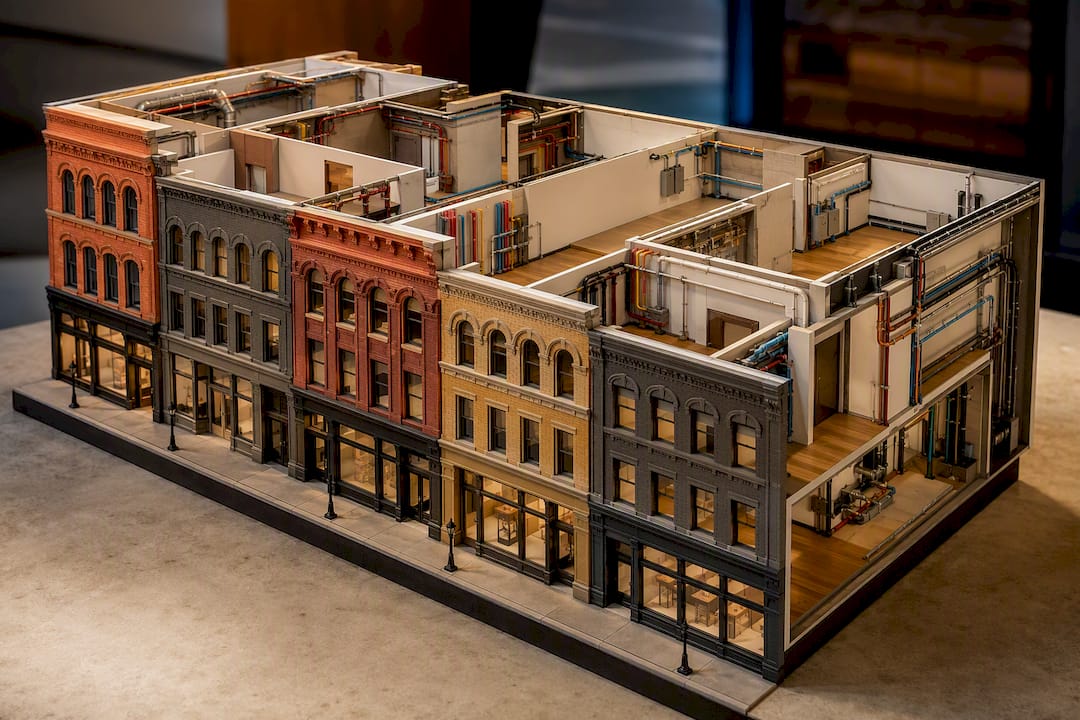
Rehabilitating a nineteenth century commercial building for 1960s retail meant solving a puzzle: keep the historic exterior intact while making the interior functional for modern tenants. Crawford's team modernized wiring, plumbing, and interior layouts on nearly every building on the block, while preserving the street-facing facades that gave the district its character.
The restoration wasn't purely cosmetic. Architect Langdon Morris Jr. worked on the project, helping translate Crawford's vision into structural reality without erasing the Victorian detailing that made the block worth saving in the first place.
Several design decisions shaped how the finished district would actually function as public space:
- Courtyards were carved out between buildings, creating pedestrian gathering spots that hadn't existed in the original commercial layout
- Arcades and covered walkways gave shoppers protection from Denver's weather while preserving sightlines to the historic storefronts
- Storefront setbacks created small plazas that softened the block's density and gave restaurants room for outdoor seating
None of this was risk-free. History Colorado's overview of the project frames the rehabilitation as an experiment in an era when federal urban renewal money almost always flowed toward demolition, not restoration. Crawford's team had to prove that modernized interiors under historic facades could generate enough retail and restaurant revenue to justify the private capital involved. It worked, and the block's 50th anniversary as a restored district arrived in 2015, a milestone that would have seemed unlikely to anyone looking at the block's skid row reputation a decade before restoration began.
Historic Designation: 1971 Landmark Status and the 1973 National Register Listing
Two dates anchor Larimer Square's legal protection. In 1971, Denver's Landmark Preservation Commission designated the block as the city's first historic district, a formal recognition that came just a few years after Crawford's restoration work began, according to Historic Denver.
Two years later, in 1973, the district was listed on the National Register of Historic Places. The nomination documented something specific: the 1400 block is the only downtown Denver block of pre-1900 buildings still standing intact, and the NRHP listing detail notes the block was among the first sites nationally identified as historically significant by preservation scholar Dr. Edward P. Alexander.
What that designation actually does:
- Requires review of exterior alterations, protecting facades from incompatible renovation
- Establishes a formal record used by preservationists, historians, and city planners
- Gives the district standing that influenced how Denver approached later redevelopment decisions
The paperwork mattered because it locked in protections before the next wave of downtown development could threaten the block again.
Larimer Square's Legacy in Denver Preservation
Larimer Square's real legacy isn't the block itself. It's what the block proved was possible. Historic Denver's research credits the project with shifting the city's planning philosophy away from demolition-first urban renewal and toward treating historic architecture as an economic asset worth protecting.
That shift shows up directly in later Denver projects. Lower Downtown's warehouse district revival and the restoration of Union Station both followed a version of the playbook Crawford wrote in the 1960s: keep the historic shell, modernize the inside, and let curated tenants make the economics work.
Today the block functions as it was designed to: restaurants, boutiques, and seasonal events fill space inside buildings built well over a century ago. Larimer Square's own description of the district calls it the creative heart of downtown Denver, and that framing holds up because the historic fabric is still doing the work of drawing people in.
- Influenced Lower Downtown's warehouse district preservation approach
- Set a precedent later applied to Union Station's restoration
- Remains one of the most cited adaptive-reuse case studies in American urban planning
Why This History Still Shapes Denver's Retail Streets
Preserved streetscapes don't just protect old bricks. They protect the kind of small, independent retail that a glass office tower never makes room for. Larimer Square's continued mix of boutiques and restaurants exists because the building stock forces a certain scale, storefronts sized for individual businesses rather than chain footprints.
"The beating heart and creative soul of downtown Denver" is how the block describes itself, and that phrase captures something real: a place that survived by staying small when the city around it kept building bigger.
We've written about how Denver's preserved eateries and streetscapes continue to shape local fashion, and Larimer Square sits at the center of that influence. The same forces that shape Denver's broader streetwear identity trace back to blocks like this one, where independent retail survived long enough to become a design reference point rather than a demolished memory.
How Larimer Square Powered Denver's Downtown Economy
Larimer Square's restoration didn't just save buildings. It reintroduced foot traffic and tax revenue to a stretch of downtown that had been economically dead for decades. By the late 1960s, the block's restaurants and shops were pulling shoppers and diners back into an area DURA had written off as fit only for clearance.
The economic case Crawford built turned out to matter beyond the block itself. Once restored buildings started generating retail revenue that rivaled or beat new construction, other property owners and city officials had a working model to point to. That precedent fed directly into how Denver approached the far larger Lower Downtown warehouse district a couple of decades later, where a similar bet on preserved brick over demolition paid off at a much bigger scale.
Larimer Square also became one of downtown Denver's earliest tourist draws tied specifically to history rather than to a single attraction or event. Visitors came to see restored Victorian storefronts, not a stadium or a museum, and that pulled in hospitality spending that fed hotels, parking, and adjacent retail. The block proved that a city's own architectural history could function as an economic engine, not just a preservation talking point.
The Businesses and Tenants That Defined the Block
Larimer Square's economic revival depended on which tenants Crawford's team chose to fill the restored buildings. The curated mix leaned toward restaurants, art galleries, and specialty boutiques, businesses that could draw repeat visitors and justify the block's identity as a destination rather than a discount retail strip.
Restaurants in particular did heavy lifting. Dining establishments gave the block evening and weekend traffic that pure retail couldn't generate on its own, and that extended-hours activity became part of what separated Larimer Square from a standard shopping block. The courtyards and storefront setbacks built during restoration existed partly to give these restaurants room for outdoor seating, a design choice that shaped the tenant mix as much as the tenant mix shaped the design.

Specialty shops and galleries rounded out the block, offering goods and experiences that chain retailers of the era weren't built to provide. That combination of dining, art, and boutique retail created a self-reinforcing loop: unique tenants attracted visitors, visitors sustained rents high enough to justify the restoration costs, and stable rents let Larimer Square Associates keep the buildings in preservation-grade condition instead of deferring maintenance the way earlier owners had for decades.
From Private Rescue to Modern Ownership
Larimer Square Associates controlled the block for decades after the 1960s restoration, managing it as the private entity Crawford built to acquire and rehabilitate the buildings in the first place. That continuity of ownership mattered. A single entity overseeing tenant selection and building maintenance kept the district's character consistent instead of letting it fragment across dozens of individual landlords with competing priorities.
Ownership of the block has changed hands since Crawford's original venture, as is typical for a commercially valuable historic property nearly seven decades removed from its restoration. Each transition has carried the weight of the 1971 landmark designation and the 1973 National Register listing, both of which constrain what any owner can alter on the block's exterior regardless of who holds the title.
That legal framework is arguably more important to Larimer Square's continuity than any single owner. Whoever manages the block today operates inside protections established two generations ago, which means the character Crawford fought to preserve survives independent of any particular management company's priorities. The revitalization that began in 1965 didn't end with one restoration project. It became a standing set of rules that every subsequent owner has had to work within.
How Denver Residents Responded to the Preservation Fight
Crawford's preservation campaign wasn't universally popular when it launched. DURA's Skyline Urban Renewal Project had genuine public and political momentum behind it in the early 1960s, backed by voters who'd approved funding mechanisms specifically to enable large-scale downtown clearance and redevelopment.
Convincing Denver that a skid-row block of Victorian storefronts deserved saving, rather than the clean slate demolition promised, took real persuasion. Crawford's for-profit structure was itself a response to skepticism: pure preservation advocacy hadn't been enough to stop demolition elsewhere, so making an economic argument gave the campaign a language that developers, investors, and city officials could actually engage with.
Community reaction shifted as the restoration progressed and the block began drawing visitors back downtown. What started as a contested alternative to DURA's clearance plans gradually became a point of civic pride, reinforced when the 1971 landmark designation and 1973 National Register listing gave the preservation effort formal, permanent standing. By the time later projects like Lower Downtown's revival came around, the public argument had already flipped: demolition, not preservation, had become the harder sell in Denver.
What Larimer Square Teaches Us About Saving a City's Memory
The conventional preservation story treats saving old buildings as a purely sentimental act, something communities do out of nostalgia rather than strategy. Larimer Square's history argues the opposite. Crawford's for-profit structure is the detail most retellings skip past, and it's the one that actually explains why this block survived when so many comparable ones nationwide didn't.
What gets underestimated is how much of Denver's current identity, the boutiques, the restaurant scenes, the neighborhoods people now consider essential to the city, exists because someone made preservation pay for itself instead of asking the public to save a building out of guilt. That's a harder, less romantic story than the usual heritage narrative, and it's the more useful one for anyone trying to understand why some historic districts thrive while others get bulldozed for parking lots.
— Rob
Wear a Piece of the Block's History
Larimer Square's Victorian storefronts and curated retail mix are the same forces behind why Denver's preserved eateries keep shaping local fashion, and Native303apparel exists to put that history somewhere you can actually wear it. Instead of hunting vintage shops for a faded shirt referencing a Denver landmark, you get a design built specifically around the city's preserved streetscapes, sized and printed to order rather than pulled from a random thrift bin.

Every design draws on real Denver landmarks and the neighborhoods that survived because someone fought to save them, the same story that runs through this article. If a specific fit matters to you, check the size guide before you order, then browse the full Native303apparel collection and pick a design tied to the Denver block you know best.
Where to Read More About Larimer Square's History
For readers who want the primary sources behind this history: Historic Denver's blog covers the block's ownership and rescue in detail, the Colorado Encyclopedia entry lays out the restoration timeline, the National Register nomination text documents architectural significance, and History Colorado's location page details the rehabilitation approach. Larimer Square's own about page rounds out the contemporary picture, and the Denver Public Library's archive holds original news clippings and drawings for anyone digging deeper.
Sources
- Larimer Square: Iconic Block Has New Owners — Historic Denver
- Larimer Square — Colorado Encyclopedia
- NRHP nomination text — Larimer Square Historic District (NPS)
- About — Larimer Square