
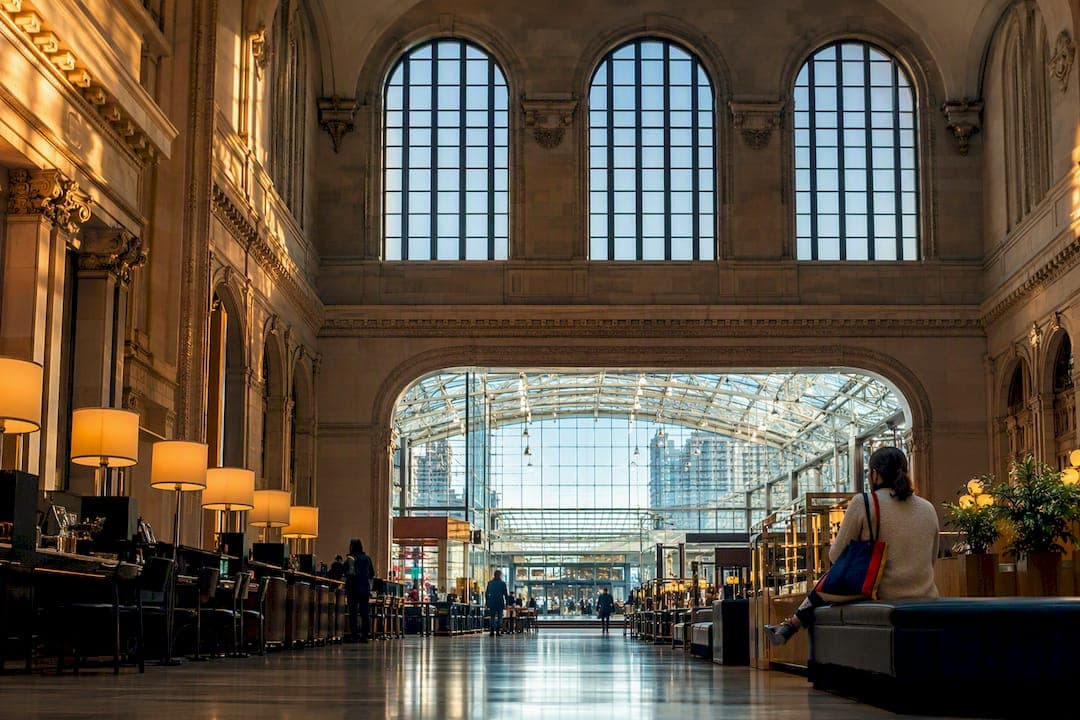
Denver Union Station opened on June 1, 1881, survived a devastating fire in 1894, emerged in 1914 as the Beaux-Arts landmark that still anchors the skyline, and reopened in 2014 after a decade-long overhaul as Denver's intermodal transit hub. Today it houses Amtrak, RTD light rail and commuter lines, The Crawford Hotel, and a Great Hall full of shops and restaurants at the heart of Lower Downtown.
TL;DR:
- The 1914 rebuild integrated the original 1881 wings into a grand Beaux-Arts central block, creating a layered historical structure rather than a unified design.
- The station experienced its wartime peak during World War II with high daily passenger volumes, then declined sharply in the postwar years due to automobile and air travel.
- Its listing on the National Register of Historic Places in 1974 helped prevent demolition and preserved its historic fabric through subsequent renovations.
- The 2002 RTD master plan revitalized Union Station as a multimodal hub, combining historic preservation with modern transit infrastructure, completed in 2014.
- The building's survival relied on its ongoing functional utility for Denver's transportation needs, not just historic preservation efforts.
Table of Contents
- Why Denver Needed a Union Depot in the First Place
- The Original Depot, the 1894 Fire, and What Came After
- How the 1914 Rebuild Created the Landmark Facade You See Today
- The Wartime Peak and the Long Slide That Followed
- Landmark Status and the Fight to Keep the Building Standing
- The RTD Master Plan That Rebuilt Union Station for the 21st Century
- What You're Actually Looking At When You Visit Today
- Why This Building Still Matters to Denver
- What the Station's Architecture Means for Native303's Designs
- Take a Piece of Denver's Rail History Home
- Union Station's History Was a Series of Near-Losses, Not a Straight Line
- Sources
Why Denver Needed a Union Depot in the First Place
Before 1881, arriving in Denver by rail meant hauling your luggage across town between competing depots. The Denver Union Station — Colorado Encyclopedia entry lays out the mess clearly: separate lines operated their own stations scattered around the city, and none of them talked to each other.
The lines converging on Denver in the 1870s included the Denver Pacific, the Kansas Pacific, the Colorado Central, the Denver & Rio Grande, and later the Denver, South Park & Pacific. Each had built its own terminal. Passengers and freight had to physically transfer between stations, which slowed commerce right as Denver was trying to position itself as the commercial capital of the Rocky Mountain region.
Railroad financier Jay Gould pushed consolidation forward, and in 1879 the Union Depot & Railroad Company formed specifically to solve the transfer problem. UDR chose a site at Seventeenth and Wynkoop Streets, at the edge of the developing downtown grid, and construction ran from 1880 into 1881.
The result was an Italian Romanesque building built with materials sourced close to home:
- Sandstone and granite pulled from Colorado quarries, keeping the project regional rather than dependent on imported stone
- A design language borrowed from Romanesque civic architecture, popular for American railroad terminals of the era
- A footprint large enough to consolidate what had been several competing depots into one facility
By the time it opened, Union Depot represented something new for Denver: proof the city had graduated from mining outpost to rail hub.
The Original Depot, the 1894 Fire, and What Came After
The 1881 depot stretched roughly 500 feet along Wynkoop Street, a scale meant to signal permanence and ambition. A prominent clock tower topped the structure, giving the building a civic presence that matched its role as Denver's front door for arriving travelers.
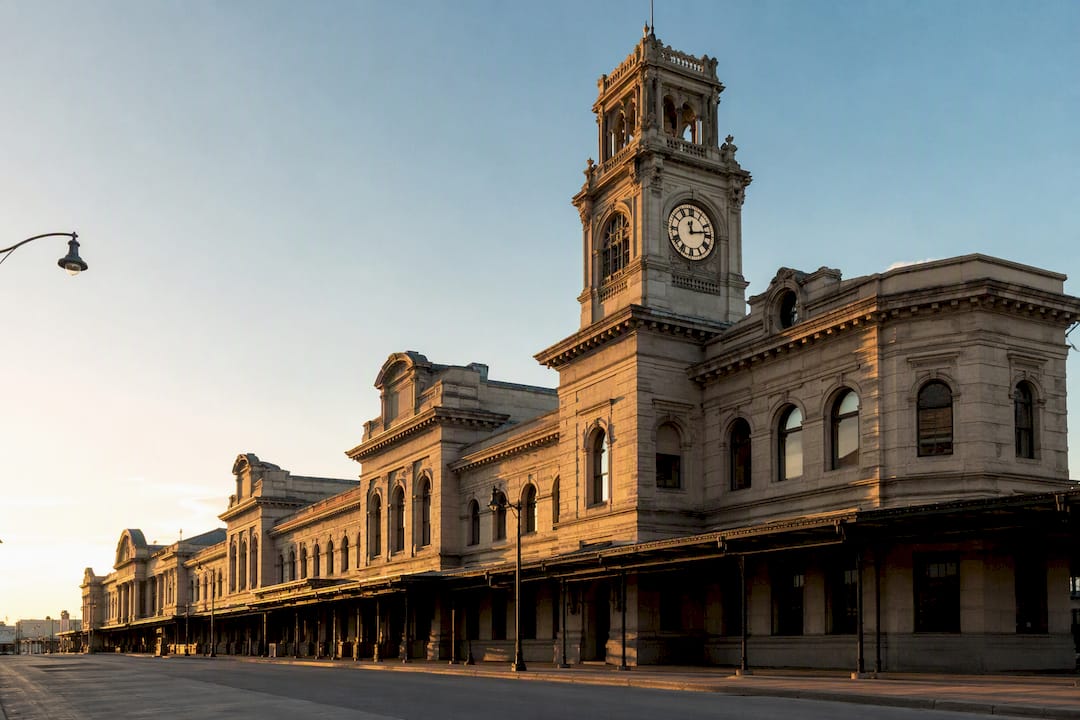
That original building didn't last intact for long. In 1894, an electrical fire tore through the central section of the depot. Electrical wiring was still a relatively new and unreliable technology in American buildings at the time, and Union Depot paid the price.
What happened next tells you something about how the city viewed the station:
- Crews moved fast, reopening usable sections of the depot even before full reconstruction was complete, because Denver couldn't afford to lose its rail hub for long.
- The central portion was rebuilt with a new tower, restoring the depot's visual anchor on the Wynkoop Street facade.
- Railroad companies used the rebuild as an opportunity to expand capacity, since passenger and freight volumes had grown substantially since 1881.
- Additional wings and platform space were added through the later 1890s as Denver's rail traffic kept climbing.
The Colorado Encyclopedia account frames this period less as a single disaster and more as the first of several iterative rebuilds. The station has never really stopped adapting.
How the 1914 Rebuild Created the Landmark Facade You See Today
By the early 1910s, the 1894 tower and central block couldn't keep pace with Denver's rail traffic. Passenger volumes had grown well beyond what the Victorian-era design could comfortably handle, and the city wanted a station that reflected its growing regional importance. The Denver Union Station Wikipedia entry confirms the enlarged central portion was completed in 1914, replacing the older tower with a new architectural language entirely.
Out went the Romanesque tower. In came a Beaux-Arts and Neoclassical central block, the style favored for grand civic buildings across the country at the time. The change gave Denver a station that looked like it belonged next to Chicago's or Washington's great terminals rather than a frontier depot.
The 1914 facade brought several distinct features that still define the building:
- Carved granite detailing across the central entrance and cornice lines
- Tall arched windows that flood the interior with natural light
- Decorative panels and formal inscriptions across the facade, typical Beaux-Arts flourishes meant to project civic weight
- A symmetrical, columned entrance replacing the older tower-and-clock composition
Here's the part most visitors miss: the 1881 wings on either side of the new central block were never torn down. They were absorbed into the larger composition, which is why the building still reads as three distinct eras stitched together rather than one unified design. That patchwork quality, old wings flanking a grander center, is part of what makes Union Station architecturally unusual among American depots.
The Wartime Peak and the Long Slide That Followed
Union Station's busiest years arrived during World War II, when troop movements and wartime travel restrictions pushed rail traffic to levels the building had never seen.
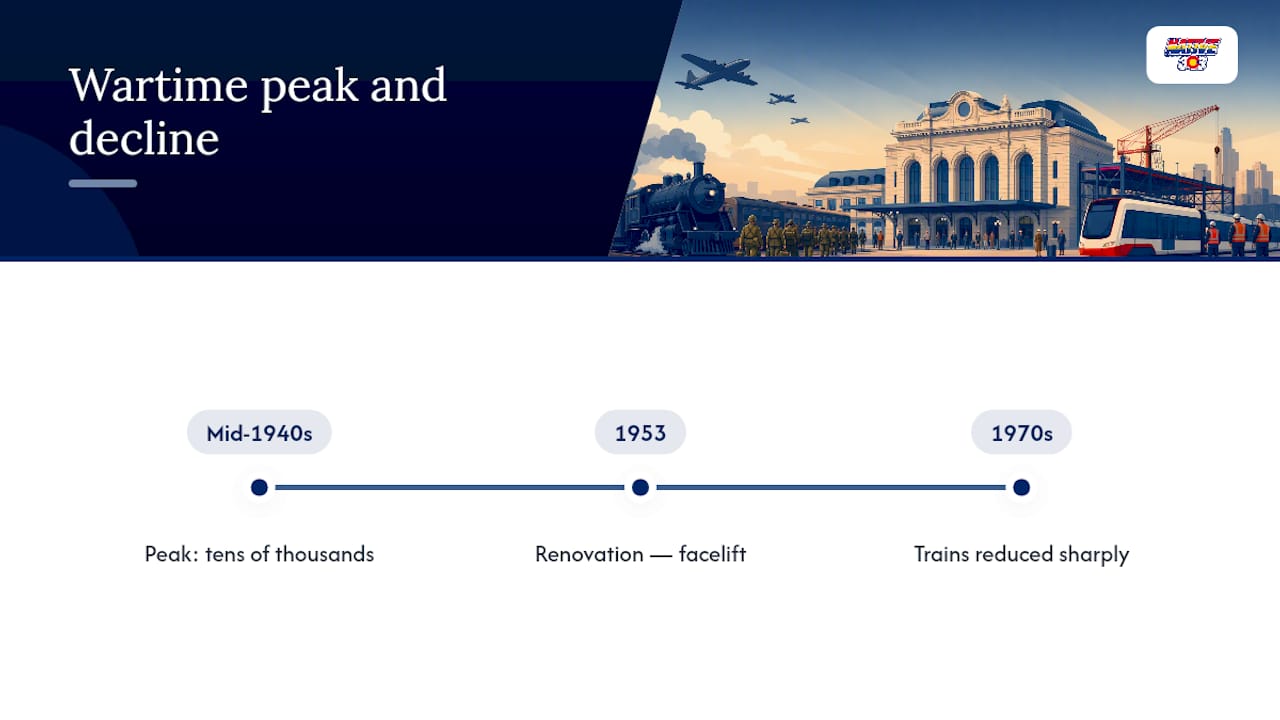
During its mid-1940s peak, Union Station passed through a very high volume of daily visitors, according to the official history published by Denver Union Station. That figure is staggering for a building designed decades earlier for a much smaller city. Soldiers, families, and freight all funneled through the same Great Hall that hosts coffee shops and hotel guests today.
The postwar decades told the opposite story. Automobiles and commercial air travel pulled riders away from passenger rail across the entire country, and Denver was no exception. Rail companies cut routes, reduced staff, and deferred maintenance on a building that had been running near capacity just a few years earlier.
A 1953 renovation attempted to modernize the station's interior and keep it relevant, but it amounted to a facelift rather than a fix. By the 1970s, the number of daily trains had dropped to a fraction of the wartime peak, and Union Station had settled into a long, quiet decline. The building that once moved tens of thousands of people a day was, by then, serving a shrinking handful of Amtrak routes in a mostly empty Great Hall.
Landmark Status and the Fight to Keep the Building Standing
Union Station earned a listing on the National Register of Historic Places in 1974, a designation that mattered far beyond ceremony. It meant future redevelopment couldn't simply demolish or radically alter the historic fabric without review, which shaped every renovation decision that came afterward.
That protection arrived at a critical moment. Lower Downtown, the neighborhood surrounding the station, was still decades away from the loft conversions and brewery culture that define LoDo today. Preservation advocates saw Union Station as an anchor worth saving even while the surrounding warehouses sat mostly vacant.
A few things came out of that era of advocacy:
- Formal recognition as one of Denver's historic landmarks, tying the building's fate to broader LoDo preservation efforts
- Pressure on the city and property owners to maintain the structure even as passenger rail use kept shrinking
- A framework that later redevelopment planners had to work within, since any 2000s-era overhaul needed to respect the 1881, 1894, and 1914 fabric rather than erase it
Without the 1974 listing, there's a real chance the building that eventually underwent an extensive multimillion-dollar renovation project wouldn't have survived long enough to see one.
The RTD Master Plan That Rebuilt Union Station for the 21st Century
The modern Union Station you see now exists because the Regional Transportation District bought the property and folded it into a much larger transit expansion plan. RTD's FasTracks initiative, a regional push to build out light rail and commuter rail across metro Denver, needed a central hub, and Union Station was the obvious site.
Planning kicked off in earnest in 2002, when RTD partnered with the City and County of Denver, the Colorado Department of Transportation, and the Denver Regional Council of Governments on a master plan and environmental impact statement. That interagency coordination, four separate government bodies aligning on one project, is part of why the redevelopment took over a decade to finish. The RTD facts and figures page documents the full scope of that planning process.
The Union Station Alliance, working alongside master developers Continuum Partners and East West Partners, led the private side of the project. According to Lodo, the Alliance invested more than $54 million specifically in renovating the historic building, separate from the larger public infrastructure spending on rail and bus facilities.
Construction unfolded in visible stages over more than a decade:
| Year | Milestone |
|---|---|
| 2002 | Master plan and environmental review begin |
| — | Light rail service launches at the redeveloped station |
| 2014 | Union Station Alliance leads historic building renovation |
| 2014 | Open-air train hall completed; Amtrak returns; underground bus concourse opens |
| — | Commuter rail line to Denver International Airport begins service |
The payoff was a station that finally reconciled its 19th-century bones with 21st-century transit demand. The Crawford Hotel took over the upper floors of the historic building, retail and restaurants filled the Great Hall, and a genuinely modern multimodal hub emerged underneath and behind the historic facade.
What You're Actually Looking At When You Visit Today
Walking into Union Station now means walking through three distinct construction eras stacked on top of each other, plus a fourth layer added in the 2010s. The Wikipedia entry on Denver Union Station describes this layered structure directly: 1881 wings, a 1914 central block, and a modern train hall that doesn't try to imitate either.
Here's how the pieces fit together:
- The 1881 Romanesque wings flank the building and still carry the older stonework, even though they were absorbed into the 1914 redesign
- The 1914 Beaux-Arts central block, the Great Hall, is what most visitors photograph, with its arched windows and granite detailing
- Behind the historic building sits an open-air train hall built during the 2010s redevelopment, deliberately modern rather than a historic replica
- Below ground, a 22-gate bus concourse handles regional and local bus service, connecting seamlessly to the light rail and commuter rail platforms above
Passenger flow moves from the historic Great Hall, where the hotel lobby, shops, and restaurants sit, back through the train hall to the platforms. It's an easy building to navigate once you understand you're crossing between eras rather than through one continuous structure.
Why This Building Still Matters to Denver
Union Station did more than move passengers. It physically linked Denver's mining and cattle economy to national capital markets, which is a big part of why the city grew into a regional commercial center rather than staying a mining camp. Scholarship from the National Endowment for the Humanities frames the station as a strategic economic instrument, not just a transit building. Rail access, not river access, is what built Denver's trajectory.
That same building later became the catalyst for LoDo's revival. When Union Station sat half-empty in the 1980s and 1990s, the surrounding warehouse district was one of Denver's least glamorous neighborhoods. The station's redevelopment helped anchor transit-oriented development across the area, and LoDo is now one of the most walkable, densely used neighborhoods in the city.
The station's cultural footprint runs deeper than architecture and transit policy. It has hosted public gatherings, political visits, and countless film and television appearances that trade on its Beaux-Arts facade. Even the station's midcentury "Travel by Train" rooftop signage, a marketing addition meant to rekindle ridership during rail's decline, has become an unofficial civic symbol in its own right, more recognizable to most Denverites than the building's actual architectural pedigree.
Pro Tip: If you want to see all three construction eras at once, stand at the center of the Great Hall and look up. The 1914 arched windows, the older stonework near the side wings, and the modern train hall glass beyond the far doors are all visible from roughly the same spot.
What the Station's Architecture Means for Native303's Designs
Union Station's arches, granite lettering, and layered construction eras are exactly the kind of visual history we build apparel around at Native303apparel. The Beaux-Arts facade and the old Travel by Train signage aren't just landmarks. They're graphic elements with real Denver provenance, the same instinct behind how Denver's art scene shapes our design choices across the LoDo streetscape more broadly.
Native303apparel exists to translate exactly this kind of place-based memory into something wearable. If a walk through the Great Hall gets you thinking about the Denver you grew up with, or the LoDo that used to be warehouses instead of breweries, that instinct is worth taking home in a form you'll actually wear.
Take a Piece of Denver's Rail History Home
Union Station's Beaux-Arts arches and its century of reinvention are baked into the design language behind Native303apparel, where every piece draws on the eateries, landmarks, and streets that built this city's identity. Browse the size guide before you order, and pick up something that carries a little of that LoDo history with you.
Union Station's History Was a Series of Near-Losses, Not a Straight Line
The tidy version of this story goes: opened, rebuilt, declined, revived. Fine as a summary, but it flattens something worth sitting with. At almost every stage, Union Station could have simply disappeared. The 1894 fire could have ended the building instead of prompting a rebuild. The 1970s decline could have led to demolition rather than a National Register listing. The 2002 master plan could have collapsed under the weight of four government agencies failing to agree on anything, which, given how these things usually go, would have been the more likely outcome.
What actually saved the station wasn't nostalgia. It was that enough people, at each critical juncture, treated the building as infrastructure worth fighting for rather than a museum piece worth preserving for its own sake. That's a distinction Denver's civic leaders got right more than once, and it's why the 1881 wings still stand next to a 2014 train hall instead of a parking lot.
The lesson for anyone interested in local history is that preservation rarely happens because a building is beautiful. It happens because someone finds a functional reason to keep using it. Union Station survived because RTD needed a rail hub, not because anyone was sentimental about a clock tower that had already been replaced twice.
— Rob
Sources
- Denver Union Station — Wikipedia
- The History & Legacy Of Union Station — Denver Union Station
- Union Station — Colorado Encyclopedia
- Denver Union Station — RTD (Facts and figures)
- Lodo