
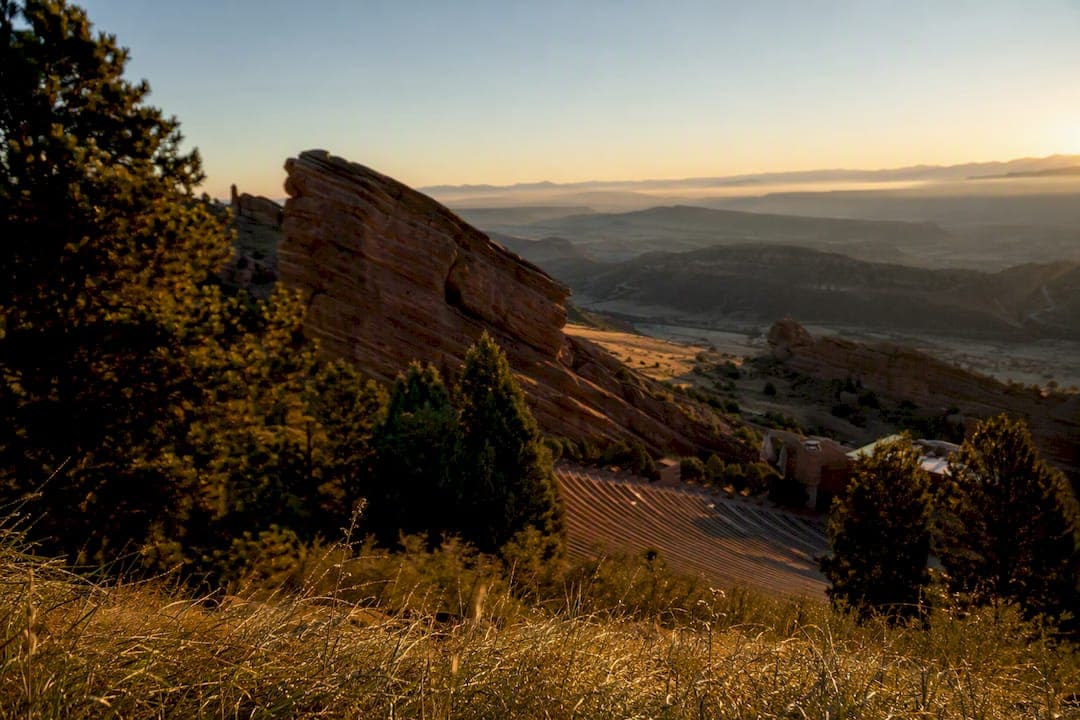
Red Rocks Park and Amphitheatre is a naturally formed sandstone amphitheater carved from the Fountain Formation and completed as a constructed concert venue on June 15, 1941. Sitting at 6,450 feet above sea level, the venue holds roughly 9,525 people inside a 738 acre park, and it carries National Historic Landmark status as part of the Denver Mountain Parks system. This is the short version of Red Rocks history: 300 million years of geology, thousands of years of Indigenous presence, a Gilded Age entrepreneur's failed amusement park, and a Depression-era public works crew that built one of the most acoustically famous stages in the country.
Here's what you'll find below:
- How the Fountain Formation and the Laramide Orogeny built the rocks themselves
- Who used and shaped the land before it became a concert venue
- Why the Civilian Conservation Corps gets credit for the amphitheatre you see today
- What happened in 1971 that got rock music banned from the stage for five years
TL;DR:
- The formation of Red Rocks was shaped by sediment from the ancestral Rockies and tilted nearly vertical during the Laramide Orogeny, creating its distinctive cliffs.
- The Civilian Conservation Corps built the amphitheatre between 1936 and 1941, fitting sandstone seating into the natural bowl despite the site's irregular landscape.
- The 1971 Jethro Tull riot led to a multi-year ban on rock concerts, but the venue recovered and became famous for performances by U2, the Grateful Dead, and others.
- Preservation efforts under the National Historic Landmark status ensure that changes to the site respect its geological and cultural heritage amid over a million annual visitors.
Table of Contents
- What Is the History of Red Rocks, and Why Does It Matter?
- How Did the Fountain Formation Create Red Rocks?
- Who Lived at Red Rocks Before It Became a Park?
- How Was the Amphitheatre Built, and Who Designed It?
- What Are the Most Notable Concerts in Red Rocks History?
- Red Rocks Timeline: Key Dates and Fast Facts
- How Is Red Rocks Preserved and Used Today?
- What Do the Rocks Mean to Indigenous Communities Today?
- How Has Tourism Changed Red Rocks and Its Surroundings?
- What Environmental Challenges Does Red Rocks Face?
- Key Takeaways
- Sources
What Is the History of Red Rocks, and Why Does It Matter?
Red Rocks history splits cleanly into two stories that happen to share the same ground. One is geologic, running back roughly 300 million years. The other is human, and it's really three overlapping chapters: Indigenous stewardship, early 20th century tourism, and a New Deal construction project that turned a scenic overlook into a world-class stage.
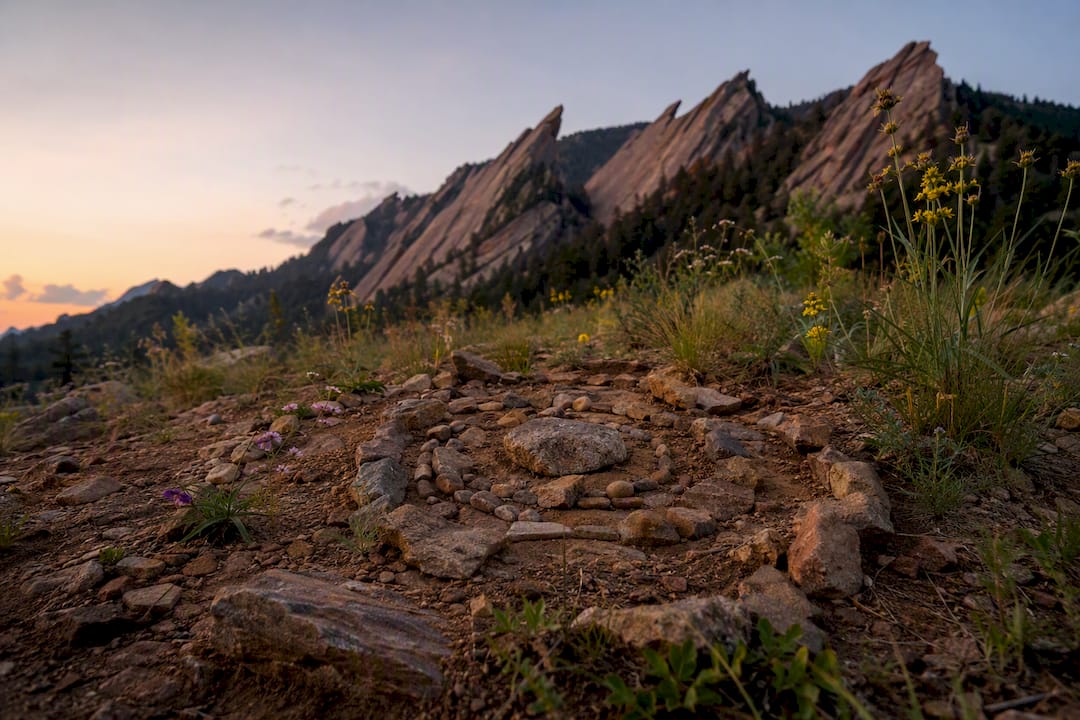
The sandstone monoliths known today as Creation Rock and Ship Rock started as sediment washed down from the ancestral Rocky Mountains, compressed into stone, then tilted nearly vertical by the same tectonic forces that raised the Rockies themselves. Humans arrived far later, but they arrived early by American standards. Archaeological and oral history evidence places Ute, Cheyenne, and Arapaho peoples in the area for centuries before European contact, using the red sandstone corridor as a travel route and gathering ground between the plains and the mountains.
- Ownership changed hands three times in the 1870s and 1880s before the land settled into private tourism development. Rancher Marion Burts held early title, followed by Leonard H. Eicholtz, before the property reached John Brisben Walker.
- Walker rebranded it "Garden of the Titans" around 1906, building a funicular railway up the rock formations and staging the first documented public concert at the site on May 31, 1906.
- The City of Denver bought the land in 1927, moving it from private amusement venture to public park.
Walker was a restless promoter, the kind of Gilded Age figure who tried mining, ran a magazine, and dabbled in early automobile manufacturing before landing on Red Rocks as his next big idea. His incline railway didn't last, and neither did most of his amusement-park ambitions, but the 1906 concert proved something valuable: sound behaves differently between those rock walls. That single observation outlived every other part of his business plan and became the seed of everything Red Rocks would become.
By the time Denver purchased the property, the site had already shifted from Indigenous travel corridor to private tourist attraction to civic asset in the span of about fifty years. That compressed timeline matters because it means the amphitheatre most visitors know today is a relatively recent addition to a landscape with a much older story. The rock formations recorded in Red Rocks geological history were ancient before Denver existed as a city, let alone a landmark.
How Did the Fountain Formation Create Red Rocks?
The red sandstone at Red Rocks comes from the Fountain Formation, a layer of sediment deposited when an earlier mountain range, geologists call it the ancestral Rockies, eroded and washed downhill in massive alluvial fans. Over millions of years, that sediment compacted into sandstone and conglomerate rock, locking in iron minerals that would later oxidize into the rust red color the park is named for. Weathering and exposure since have only deepened that hue, the same chemistry that turns an old nail orange.
The formation itself sat mostly flat until the Laramide Orogeny, the tectonic event responsible for building the modern Rocky Mountains, pushed and tilted these rock layers into near-vertical slabs. That's why Red Rocks looks the way it does: a series of steep, angled hogback ridges rather than a smooth hillside. Ship Rock and Creation Rock, the two massive formations that flank the amphitheatre stage, are the most dramatic surviving slabs of that uplift, each rising roughly several hundred feet.
- Sediment origin: eroded material from the ancestral Rocky Mountains
- Coloring agent: oxidized iron minerals within the sandstone
- Uplift event: the Laramide Orogeny, roughly 70 to 40 million years ago
- Visible result: near-vertical rock faces instead of flat sedimentary layers
The acoustic quality people talk about isn't an accident of architecture. It's geometry. Ship Rock and Creation Rock form a natural bowl that reflects and focuses sound toward the seating area, which is precisely why John Brisben Walker staged concerts there decades before anyone poured concrete for seats. Architect Burnham F. Hoyt understood this when he designed the modern amphitheatre. Rather than fighting the rock formations, he built around them.
Pro Tip: If you want to understand the acoustics firsthand, stand near the base of Ship Rock during a quiet afternoon and clap once. The echo tells you more about why this site became a concert venue than any brochure will.
Who Lived at Red Rocks Before It Became a Park?
Long before Denver existed, the Ute, Cheyenne, and Arapaho peoples used the red sandstone corridor between the plains and the foothills as a seasonal travel route and gathering place. This wasn't marginal land to them; it sat along a natural passage connecting different ecological zones, which made it valuable for hunting, trade, and movement between territories.
The mid-1800s changed that dramatically. Colorado's gold rush brought a wave of Euro-American settlement that displaced Indigenous communities from much of the Front Range, including the land that would become Red Rocks Park. The specific treaty history and forced relocations tied to this stretch of Colorado are complex and are documented in far greater depth by tribal historical resources than any single article can cover, and readers doing serious research should consult those primary sources directly rather than relying on secondhand summaries.
What followed was a familiar Colorado pattern: private ranching ownership, then tourism development, then civic acquisition. By the early 1900s, boosters were already promoting the rock formations as a scenic attraction, and John Brisben Walker's "Garden of the Titans" venture built directly on that momentum.
- Ute, Cheyenne, and Arapaho peoples used the corridor for travel and seasonal gathering long before settlement
- Gold rush era migration displaced Indigenous communities across much of the Front Range in the mid-1800s
- Early 20th century civic boosters began actively marketing the rocks as a public attraction
- Readers researching tribal history in depth should seek out primary sources maintained by the Ute, Cheyenne, and Arapaho nations themselves
The site's transition from Indigenous landscape to private venture to public park happened without much formal acknowledgment of that earlier history for decades. Recent preservation efforts have started to address that gap more directly, though the work of properly documenting it remains ongoing.
How Was the Amphitheatre Built, and Who Designed It?
Denver bought the 480 acre core of what became Red Rocks Park in 1927, a purchase pushed forward by Denver Mountain Parks manager George Cranmer, who saw the rock formations as the ideal site for a permanent outdoor performance venue. Cranmer had a specific vision: a stage that used the landscape rather than imposing on it, and he recruited architect Burnham F. Hoyt to design it.
Hoyt's original master plan changed substantially once he spent real time on the site. According to the Library of Congress's HALS documentation, Hoyt revised his approach to work with the existing rock forms and natural acoustics instead of laying a conventional amphitheatre template over the terrain. That decision is why the finished venue feels carved from the landscape rather than dropped onto it.
- 1927: The City of Denver purchases the core parkland from private owners, formalizing public ownership.
- 1936: Construction begins on the amphitheatre structure, staffed largely by Civilian Conservation Corps laborers based at a dedicated camp on nearby Mount Morrison, with additional support from the Works Progress Administration.
- 1936 to 1941: CCC and WPA crews hand-cut and placed sandstone seating, built the stage structure, and shaped the surrounding grounds over roughly five years of labor.
- June 15, 1941: The amphitheatre is formally dedicated, opening with a program that established the venue's identity as both a performance space and a public monument.
The CCC's contribution here fits into a broader pattern across Depression era Colorado, where federal work programs built parks, trails, and public buildings that still stand today. What set Red Rocks apart was the difficulty of the job. Crews weren't grading a flat lot; they were fitting stone seating into an irregular natural bowl, a task that demanded constant adjustment rather than standardized construction. The Library of Congress's own documentation frames this project as one of the most site-sensitive recreational designs to come out of that era's public works push, a detail that later became central to its National Historic Landmark case.
What Are the Most Notable Concerts in Red Rocks History?
Red rocks concert history starts well before the amphitheatre existed as a formal structure. Walker's 1906 grand opening concert set the tone with classical and opera programming, and that genre dominated the venue's early decades after the 1941 dedication. The shift toward popular music, and eventually rock, came gradually through the 1950s and 1960s as promoters like Barry Fey began booking acts that drew younger, larger crowds.
The Beatles played Red Rocks in 1964 during their first American tour, and Jimi Hendrix followed in 1968, both moments that pushed the venue further into rock territory. That momentum hit a wall on June 10, 1971, when a Jethro Tull concert triggered a riot outside the venue.
Tear gas drifted through the parking areas as police tried to control an overflow crowd that had gathered outside the sold-out show, and the resulting chaos left the city rattled enough to ban rock concerts at Red Rocks for years afterward, a ban that The Colorado Sun's retrospective describes as a turning point in how Denver policed live music.
Rock returned in the mid-1970s after the ban was legally challenged and overturned, and the venue's reputation only grew from there.
- U2 filmed and recorded their 1983 performance at Red Rocks, later released as "Under a Blood Red Sky," a project that helped cement the amphitheatre's reputation as a premier recording location
- The Grateful Dead played repeated sold-out runs at the venue, generating some of their most collected live releases
- The Easter Sunrise Service, a tradition dating back decades, continues to draw crowds for a dawn gathering unrelated to ticketed concerts
- The venue's official history page documents dozens of additional milestone performances across genres
That range, classical opera to punk-adjacent rock riots to ambient sunrise services, is part of what makes the events in Red Rocks history so distinct from other American concert venues. Few stages have hosted that much cultural whiplash on the same 9,525 seats.
Red Rocks Timeline: Key Dates and Fast Facts
| Milestone | Detail |
|---|---|
| 1906 | John Brisben Walker stages the first documented concert at the site, opening "Garden of the Titans" |
| 1927 | The City of Denver purchases the core parkland |
| 1936–1941 | CCC and WPA crews construct the amphitheatre under architect Burnham F. Hoyt |
| June 15, 1941 | Formal dedication of the completed amphitheatre |
| 1971 | Jethro Tull concert riot leads to a multi-year ban on rock shows |
| 2015 | Red Rocks Park and Amphitheatre gains National Historic Landmark designation |
The numbers behind those dates are worth holding onto: 6,450 feet of elevation, a seating capacity near 9,525, and a park footprint of about 738 acres surrounding the stage itself. The venue has also been recognized through architectural exhibitions highlighting Hoyt's design work, and the industry award once known simply as a concert venue prize now carries the Red Rocks name in several live event honors, a nod to how thoroughly this stage has become shorthand for great outdoor acoustics.
How Is Red Rocks Preserved and Used Today?
Red Rocks Park and Amphitheatre's National Historic Landmark status, granted as part of the Denver Mountain Parks multiple property listing, puts real weight behind preservation decisions here. That designation means changes to the amphitheatre structure or surrounding rock formations go through review processes designed to protect the site's historical integrity, managed jointly by the City and County of Denver and federal preservation guidelines.
Beyond concerts, the park functions as a year-round destination. Visitors hike the trails threading through the rock formations, tour the Colorado Music Hall of Fame housed at the visitor center, and attend outdoor film screenings during warmer months. Concert season draws the heaviest crowds from late spring through early fall, while winter visitation shifts almost entirely toward hiking and sightseeing.
- National Historic Landmark status protects the amphitheatre and surrounding formations from unreviewed alterations
- The Colorado Music Hall of Fame operates on-site as a year-round visitor attraction
- Trail access remains free and open outside of ticketed event hours
- Peak concert season runs roughly May through October, with winter months favoring quieter foot traffic
Balancing heavy summer visitation against long-term preservation is an ongoing management challenge, one that shapes everything from parking capacity limits to trail maintenance schedules across the 738 acre park.
What Do the Rocks Mean to Indigenous Communities Today?
The Ute, Cheyenne, and Arapaho connection to this land didn't end when settlement patterns shifted in the 1800s. Tribal communities maintain ongoing cultural and spiritual ties to Colorado's Front Range landscape, including formations like those at Red Rocks, tied to broader traditions of land, seasonal ceremony, and ancestral memory that predate any park designation by thousands of years.
Public discussion of this connection has historically been thin, often reduced to a single sentence about "early use" before moving on to Walker's amusement park or Denver's civic purchase. That framing undersells something important: this wasn't a site Indigenous peoples simply passed through and left behind. Red rock formations across the region carry spiritual significance in Ute tradition specifically, tied to broader relationships with mountain landscapes that continue in contemporary tribal life, not just historical accounts.
Modern institutional efforts to acknowledge this more fully, land acknowledgments, tribal consultation on preservation decisions, expanded interpretive materials at the visitor center, remain works in progress rather than finished projects. Readers who want a deeper, more accurate picture of this relationship are better served going directly to resources maintained by the Ute, Cheyenne, and Arapaho nations rather than relying on park literature or general history summaries, which tend to compress centuries of relationship into a paragraph.
That gap matters for anyone trying to understand Red Rocks historical significance in full. The geology and the concert lore get most of the attention because they photograph well and fit neatly into a timeline. The Indigenous relationship to this land is harder to summarize precisely because it isn't a closed chapter. It's ongoing.
How Has Tourism Changed Red Rocks and Its Surroundings?
Red Rocks draws well over a million visitors a year between concerts, hikes, and casual sightseeing, and that volume has reshaped the area well beyond the park boundary itself; for those interested in attending shows, you can find discount Rock on the Range concert tickets at Mapfre Stadium to experience similar live events. Nearby Morrison, a small town of a few hundred residents, absorbs a disproportionate share of concert traffic, parking overflow, and seasonal business demand tied directly to the amphitheatre's event calendar.
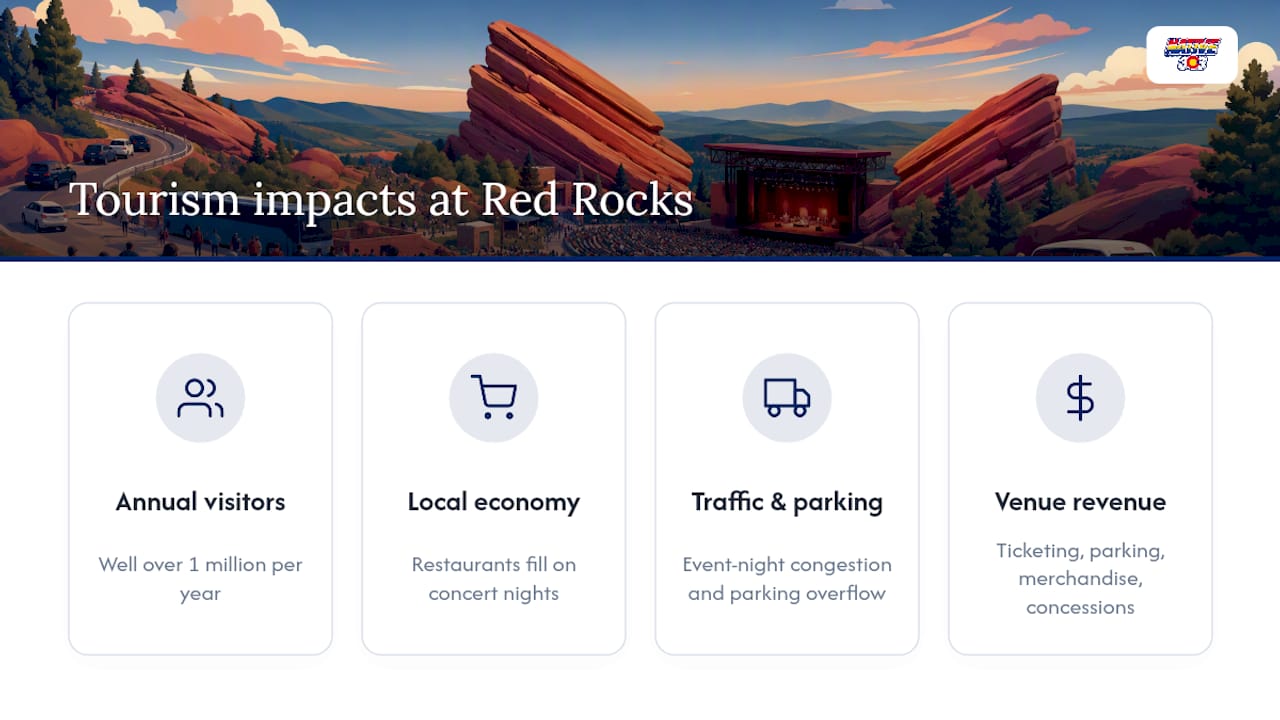
The economic upside is real. Concert nights fill local restaurants and shops, and the venue's reputation as one of America's most scenic stages draws visitors who might otherwise skip the Denver metro area entirely. That same popularity creates friction, though. Traffic congestion on event nights, strain on a two-lane access road never designed for modern concert crowds, and rising short-term rental activity in Morrison have all become recurring local concerns as the venue's national profile has grown.
Commercialization has also changed how the site functions day to day. What began as a free public park with occasional performances now operates on a heavily ticketed events calendar for much of the year, and merchandise, parking fees, and concession revenue have become central to how the venue sustains itself financially. That's a reasonable tradeoff for keeping a landmark like this maintained, but it does mean the experience of visiting Red Rocks today looks very different from the free, quiet overlook Walker promoted in 1906. The rocks haven't changed. The relationship between the public and the place around them has.
What Environmental Challenges Does Red Rocks Face?
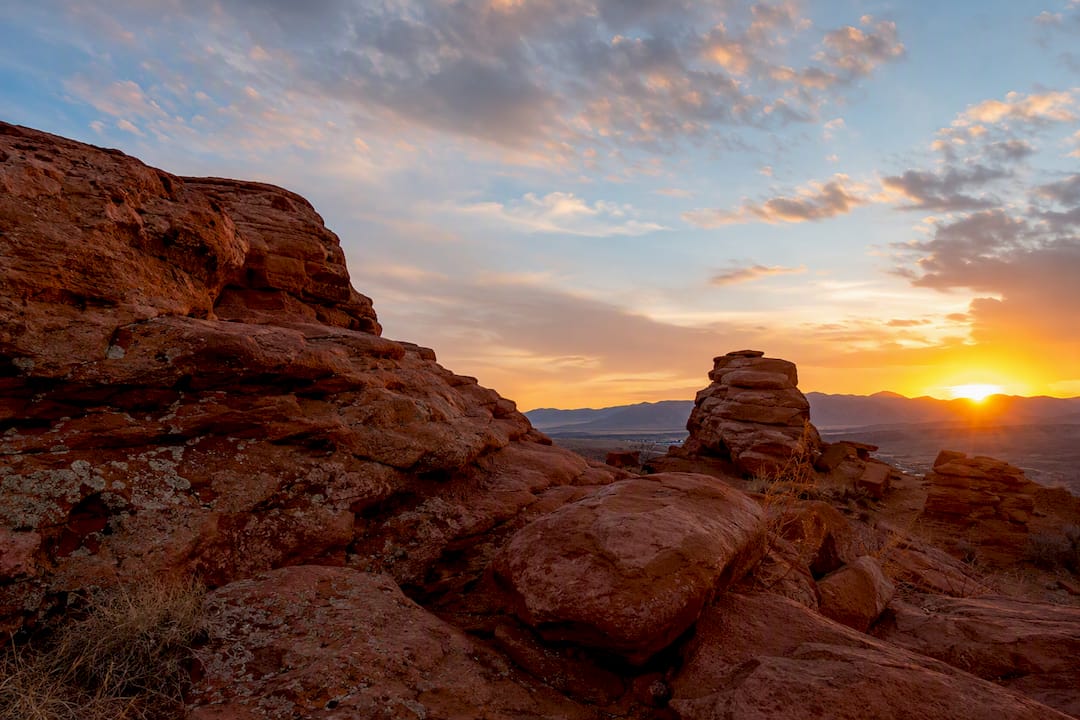
Hosting a national landmark and a major concert venue on the same fragile sandstone creates real tension. Foot traffic from over a million annual visitors accelerates erosion on trails and around the base of formations like Ship Rock and Creation Rock, and repeated freeze thaw cycles at 6,450 feet of elevation naturally stress the exposed rock faces regardless of human activity.
Noise and light management around concert nights also carries environmental weight, given the park's role as habitat within the broader Front Range ecosystem. Wildlife corridors that predate the amphitheatre by millennia now share space with amplified sound systems dozens of nights a year, a coexistence that requires ongoing coordination between event operators and park stewardship teams.
Water management adds another layer of complexity. The park sits in a semi-arid environment where runoff control matters both for erosion prevention and for protecting the sandstone itself from accelerated weathering. Denver Mountain Parks staff work to balance drainage infrastructure against the goal of keeping modern construction minimally visible against the historic landscape, a tension baked into the site's landmark status.
None of this makes Red Rocks unique among heavily visited natural landmarks, but the scale of concert-driven foot traffic combined with the site's landmark protections creates a management puzzle most outdoor performance venues never have to solve. Preservation here isn't a one-time project finished in 1941 or 2015. It's a continuous balancing act between public access and the slow, patient math of geologic time.
A Local Perspective on Red Rocks and Denver Memory
Denver's identity gets built from places like this, landmarks that outlast every business and trend built around them. That's the same instinct behind Native303apparel's blog work on local design inspiration: the belief that Colorado's landmarks deserve to live on in more than photographs. Understanding red rocks history properly, geology and all, only deepens the respect this place has earned.
— Rob
Wear a Piece of Red Rocks History
There's no substitute for standing under Ship Rock at sunset, but you can carry a piece of that Colorado pride home with you year round. Native303apparel designs Denver and Colorado nostalgia apparel, including pieces inspired by landmarks like Red Rocks, printed on shirts, hoodies, and totes meant to hold up to actual wear, not just look good on a shelf.

Authentic Colorado apparel usually shows in the details: accurate landmark proportions, colors that reflect the real sandstone rather than a generic red, and print quality that survives a season of concerts and hikes rather than cracking after a few washes. If you're picking apparel for someone with real Colorado roots, that authenticity matters more than the price tag does.
Check the size guide before ordering to get the fit right the first time, and browse the current Red Rocks and Denver-inspired designs to find something that fits how you actually want to remember this place.
Key Takeaways
Red Rocks Park and Amphitheatre earned its landmark status by combining hundreds of millions of years of Fountain Formation geology with a Depression era construction project that turned natural acoustics into a world-famous stage.
| Point | Details |
|---|---|
| Geologic origin | The Fountain Formation and the Laramide Orogeny built the tilted red sandstone slabs that shape the amphitheatre's acoustics. |
| Human history predates tourism | Ute, Cheyenne, and Arapaho peoples used the site as a travel corridor long before Walker's 1906 concert venture. |
| CCC and WPA built the venue | Depression era labor crews constructed the amphitheatre between 1936 and its June 15, 1941 dedication. |
| Concert legacy includes both triumphs and turmoil | The 1971 Jethro Tull riot briefly banned rock shows, while U2's 1983 recording cemented the venue's reputation. |
| Landmark status shapes preservation | National Historic Landmark designation guides how Denver balances over a million annual visitors against long-term conservation. |
| Carry the story home | Native303apparel offers Denver and Colorado nostalgia apparel inspired by landmarks like Red Rocks for readers who want to wear that history. |
Primary Sources and Further Reading
- HALS CO-8 (LOC): Red Rocks Park and Amphitheatre documentation for detailed construction and landmark nomination records
- RedRocksOnline: Our story — History for the venue's official timeline
- Colorado Encyclopedia: Red Rocks Park and Amphitheatre for the Walker era narrative
- Wikipedia: Red Rocks Amphitheatre for geology and performance summaries
- The Colorado Sun: Red Rocks concert history for the 1971 riot account
Readers doing deeper archival research should start with the LOC HALS PDF, which carries the most detailed nomination records behind the site's landmark status.
Sources
- HALS CO-8 (LOC): Red Rocks Park and Amphitheatre documentation
- RedRocksOnline: Our story — History
- Wikipedia: Red Rocks Amphitheatre
- The Colorado Sun: Red Rocks concert history (1971 riot coverage)