
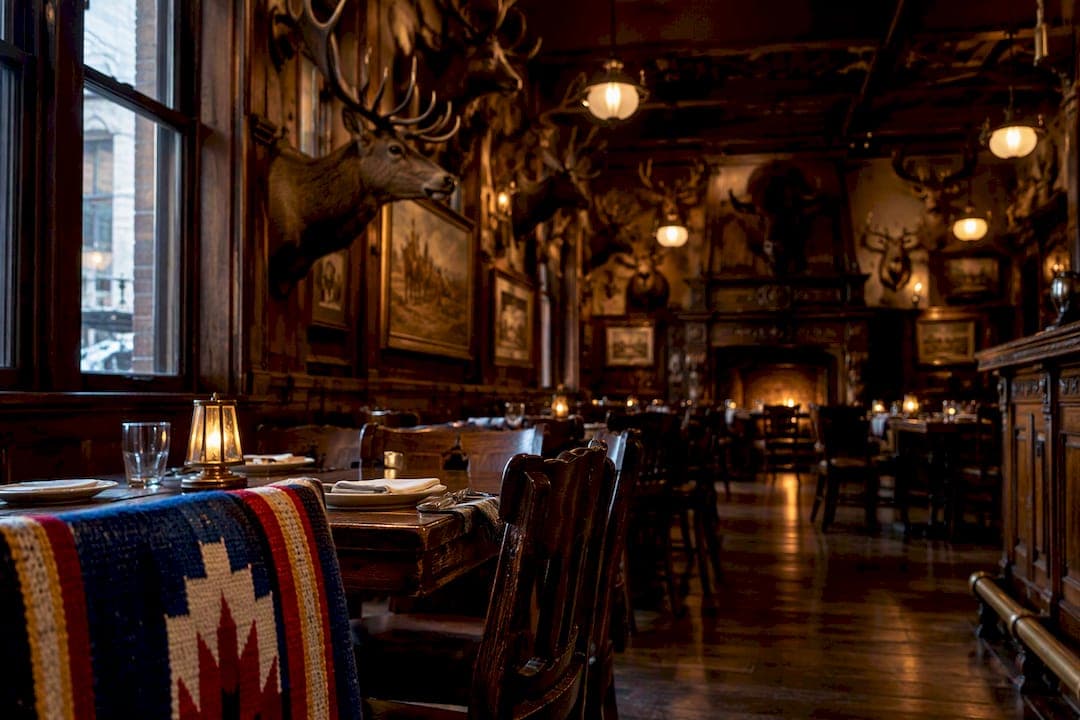
Henry H. "Shorty Scout" Zietz opened the Buckhorn Exchange on November 17, 1893, and it has fed Denver ever since, making it the city's oldest continuously operating restaurant. What began as a saloon serving railroad crews now functions as something closer to a living frontier museum, its walls carrying more than 500 taxidermy mounts alongside a bar shipped from Germany. The sections below trace how a rail-yard watering hole became one of Colorado's most protected historic sites.
TL;DR:
- The Buckhorn Exchange survived Prohibition by converting into a grocery store and was later granted Colorado Liquor License #1 upon reopening in 1933.
- Its historic fixtures, including the 1857 German bar and original poker tables, remain largely intact, with over 500 taxidermy mounts added during Zietz’s lifetime and inheritance.
- The building, constructed around 1886, retains original floors and a tin ceiling, with significant preservation efforts reflected in its landmark and national register designations.
- Its reputation derives from longstanding connections to frontier icons like Buffalo Bill and Sitting Bull, with little verifiable evidence supporting bootlegging legends.
- Visitors should focus on the place’s authentic history and preserved features, as the deliberate restoration choices have kept its old-world atmosphere mostly unchanged.
Table of Contents
- Buckhorn Exchange History: Shorty Scout Zietz and the 1893 Opening
- What the Building and Its Fixtures Reveal About the Past
- Surviving Prohibition and the Story of Liquor License No. 1
- From the Zietz Family to Buckhorn Associates: Ownership and Preservation
- Why the Buckhorn Still Matters to Denver
- Buckhorn Exchange Timeline: The Milestones That Shaped It
- Visiting the Buckhorn Exchange Today
- Why Native303apparel Pays Attention to Places Like This
- An Editorial Take on the Buckhorn's Legacy
- Wear a Piece of Denver's Frontier History
- Sources
- FAQ
Buckhorn Exchange History: Shorty Scout Zietz and the 1893 Opening
Zietz earned his nickname the hard way. He worked as a scout and hunter across the frontier West, building friendships with Buffalo Bill Cody and, according to Buckhorn lore, Sitting Bull, connections that gave the future restaurant instant credibility with anyone who cared about the Old West. The Panic of 1893 hit Denver's economy hard that year, yet Zietz used his savings to open a saloon anyway, betting on a location no one else wanted.
That location mattered more than the timing. The Buckhorn sat directly across from the Denver & Rio Grande railroad yards, and its name grew out of a practical custom rather than a marketing gimmick.
- Railroad workers would "exchange" their pay tokens or wages for a meal and a drink at the bar.
- The rail-yard proximity meant a built-in customer base of tired men getting off shift, night after night.
- Zietz's own reputation as a hunter and scout drew a second crowd entirely: curious travelers and local businessmen who wanted a taste of frontier authenticity.
What the Building and Its Fixtures Reveal About the Past
The structure itself dates to roughly 1886, seven years before Zietz opened his doors there, and the National Register nomination documents just how much of that original building survives. The hardwood floors underfoot and the decorative tin ceiling overhead are the same ones patrons have walked beneath for more than a century.
The bar tells its own story. Built in 1857 and shipped from Essen, Germany, it now sits upstairs rather than on the main floor, a relocation made during later restoration work rather than the original build. Original poker tables from the saloon's early decades remain on site as well.
The taxidermy count: the collection tops 500 mounted animals and trophy heads, the bulk of it gathered personally by Zietz and, later, his son. That scale puts the Buckhorn closer to a natural history archive than a typical restaurant wall display.
- Original hardwood floors and metal ceiling, both dated to the 1886 construction.
- The 1857 German white-oak bar, now upstairs.
- Original poker tables from the saloon era.
- Over 500 taxidermy mounts, mostly father and son sourced.
Surviving Prohibition and the Story of Liquor License No. 1
Colorado went dry statewide in 1916, four years before national Prohibition, and the Buckhorn had to adapt or close. It converted into a grocery store, selling food instead of drinks to keep the doors open through more than a decade of enforced sobriety.
- Colorado's 1916 prohibition law forced the shift away from liquor sales entirely.
- Local legend holds that bootlegging activity continued quietly on the property during those years, though the Buckhorn's own history treats these tales as color rather than documented fact.
- When repeal arrived, the Buckhorn reopened as a saloon and restaurant and received Colorado Liquor License #1, which the National Trust for Historic Preservation confirms is still displayed inside today.
Pro Tip: If a bootlegging story sounds too neat, it probably grew in the retelling. Treat hidden-tunnel legends as oral history rather than verified fact unless a source ties them to an actual record.
From the Zietz Family to Buckhorn Associates: Ownership and Preservation
The Zietz family ran the Buckhorn for more than eight decades before selling it to Buckhorn Associates in 1978. The new owners took a conservative approach: restore rather than modernize, and protect what made the place worth visiting in the first place.
- The 1978 sale kept the taxidermy collection and original fixtures intact rather than clearing them out for a redesign.
- Denver granted the building local landmark status in 1972, six years before the ownership change.
- The National Register of Historic Places added the Buckhorn to its list in 1983, locking in federal recognition of its architectural and cultural value.
Those two designations do more than decorate a plaque by the door. They create a documented incentive to preserve rather than renovate away the details that make the Buckhorn worth the trip.
Why the Buckhorn Still Matters to Denver
The Buckhorn's cultural weight comes from who walked through its doors and what it has outlasted. Buffalo Bill Cody's friendship with Zietz gave the place its frontier bona fides from day one, and secondary accounts describe visits from Theodore Roosevelt along with later mentions of presidential and royal guests, claims that circulate widely even if not every visit carries an ironclad paper trail.
- Ties to Buffalo Bill and the Sitting Bull nickname lore rooted the Buckhorn in frontier mythology from its earliest years.
- The restaurant functions as a de facto museum, a role local coverage continues to highlight decades after its founding.
- The surrounding neighborhood has changed dramatically, with the old rail yards giving way to redevelopment and a nearby light rail station, yet the Buckhorn has held its ground on Osage Street the entire time.
Buckhorn Exchange Timeline: The Milestones That Shaped It
- c.1886 — The building at 1000 Osage St. is constructed.
- 1893 — Henry Zietz opens the Buckhorn on November 17.
- 1916 — Colorado prohibition forces a conversion to a grocery store.
- 1933 — Repeal brings reopening and Colorado Liquor License #1.
- 1972 — Denver designates the building a local landmark.
- 1978 — The Zietz family sells to Buckhorn Associates.
- 1983 — The National Register of Historic Places adds the Buckhorn.
Visiting the Buckhorn Exchange Today
Walk in today and the trophy rooms, the German bar, and the original floors and ceiling are all still there to see, essentially unchanged from the restoration decades ago. It runs as a working restaurant first, but the museum-like atmosphere is impossible to miss the moment you sit down.
- Reservations are worth making ahead, especially around weekends and holiday seasons when demand climbs.
- The light rail station nearby has changed how visitors reach the neighborhood compared to decades past.
- Expect a menu still built around game meats, a tradition Colorado Encyclopedia traces back through the ownership transition of 1978.
Why Native303apparel Pays Attention to Places Like This
Native303apparel builds apparel around the vanished and enduring spaces that shaped metro Denver, and the Buckhorn sits squarely in that category as one of the few still standing. Getting a design right means digging into real dates, real fixtures, and real provenance rather than guessing at what "old Denver" should look like. That research discipline shows up in how Denver eatery designs get built, always grounded in documented history rather than a generic vintage aesthetic.

An Editorial Take on the Buckhorn's Legacy

The conventional take on the Buckhorn treats it as a novelty stop, a place to gawk at taxidermy before moving on to dinner somewhere else. That undersells what the archival record actually shows. The National Register nomination and the Colorado Encyclopedia entry both document a building that has kept its floors, its ceiling, its bar, and its ownership philosophy intact through 1916 prohibition, a 1978 sale, and a 1983 federal listing. Few Denver businesses can claim that kind of unbroken paper trail.
What gets overrated is the bootlegging lore. It is fun to repeat, but the Buckhorn's own history page treats it as legend, not fact, and readers deserve that same honesty. What deserves more attention is the deliberate restraint shown by Buckhorn Associates after 1978. They could have modernized. Instead, they moved a 1857 bar upstairs rather than removing it. That choice, more than any celebrity visit, is why the place still feels authentic instead of staged. If you visit once, go for the food. If you understand its history first, you will notice details that a casual tourist misses entirely.
— Rob
Wear a Piece of Denver's Frontier History
Native303apparel creates apparel inspired by landmarks like the Buckhorn, featuring designs that draw on historical themes rather than generic vintage motifs. Their lineup includes tees, sweatshirts, hoodies, hats, tote bags, can coolers, and frosted pint glasses, with designs inspired by historical details rather than a generic vintage style.
None of these products claim any museum affiliation with the Buckhorn Exchange itself. They are inspired by the story, not licensed by the restaurant. If you want something more personal, the custom design request page lets you work directly with the team to build a piece tied to your own memory of the place, whether that is a specific visit, a family tradition, or just a love of Denver's frontier past. Browse the full lineup at Native303apparel's shop and start there.
Sources
- History | Buckhorn Exchange in Denver, CO
- National Register of Historic Places Inventory—Nomination Form (Buckhorn Exchange)
- Buckhorn Exchange — Wikipedia
- Buckhorn Exchange — Colorado Encyclopedia
- The Buckhorn Exchange in Denver, Colorado — National Trust for Historic Preservation / Saving Places
FAQ
Are there any ghost stories tied to the Buckhorn Exchange?
Ghost stories and bootlegging legends circulate around the Buckhorn's Prohibition-era years, but they remain oral history rather than documented fact. Even the restaurant's own history page treats these tales as color, not verified record.
Is the Buckhorn Exchange a tourist trap?
It draws visitors for its taxidermy and frontier atmosphere, but the National Register nomination documents genuine, intact 19th-century architecture behind the spectacle. Locals still eat there regularly, which separates it from a pure tourist stop.
What is the oldest restaurant in Colorado?
The Buckhorn Exchange holds that title, having operated continuously since November 17, 1893. No other Colorado restaurant matches its unbroken run at the same address.
What is the origin of the name "buckhorn"?
The name reflects the frontier hunting culture Henry Zietz embodied, tying the saloon's identity to trophy game and the Old West rather than any single animal reference. The rail yard "exchange" custom, where workers traded pay for a meal, completed the full name's origin.
Does Native303apparel sell official Buckhorn Exchange merchandise?
Native303apparel designs apparel inspired by Denver landmarks like the Buckhorn, including custom pieces through its design request service, but it has no museum affiliation or licensing with the restaurant. Current designs and pricing are listed on the Native303apparel store.