
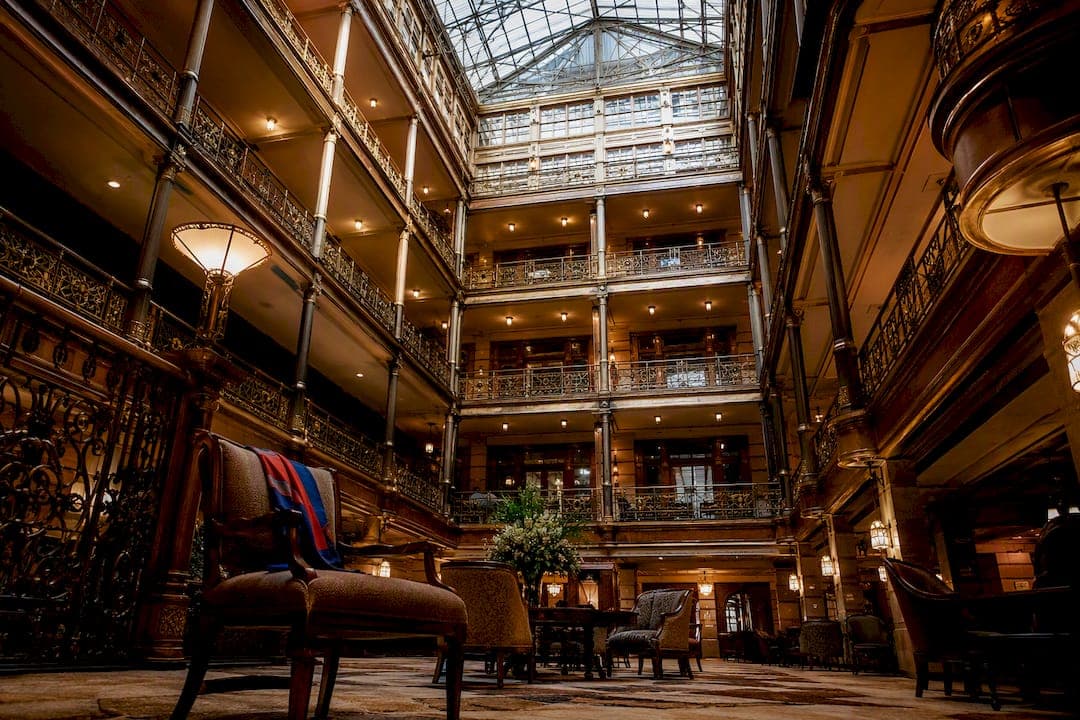
Denver's Brown Palace Hotel opened its doors on August 12, 1892, financed by cattleman and land baron Henry C. Brown and designed by architect Frank E. Edbrooke. It matters because it's one of the earliest fireproof hotels built in the United States, wrapped in a triangular footprint that turned an awkward city lot into an architectural signature. What follows traces the timeline, the engineering choices, the famous guests, and why this one building still shapes how people picture Denver's past.
TL;DR:
- The Brown Palace was built to be fireproof using iron and steel framing, allowing it to survive the numerous fires common during its time.
- Its construction involved innovative features such as a private electric plant, independent water supply, and multiple storefronts, enhancing its self-sufficiency in 1892.
- The building's unique triangular shape and the preserved eight-story atrium with onyx paneling and stained-glass ceiling make its architecture historically significant.
- The hotel has hosted numerous U.S. presidents since 1905 and the 1964 Beatles, but legendary ghost stories are unverified anecdotes rather than documented history.
- Apparel inspired by the Brown Palace often features its distinctive silhouette, atrium arches, onyx textures, and the Ship Tavern's woodwork for authentic Denver-themed designs.
Table of Contents
- Rock Island Denver Shirt History Starts With the Brown Palace Timeline
- Architecture and Innovation That Made the Brown Palace Stand Out
- Notable Guests and Local Legends Tied to the Hotel
- How the Brown Palace Shaped Denver's Social Life
- Why This History Resonates With Denver Apparel Design
- What Actually Matters About the Brown Palace's History
- Wear a Piece of Denver's Gilded Age History
- Sources
- FAQ
Rock Island Denver Shirt History Starts With the Brown Palace Timeline
The Brown Palace's story begins with a piece of land nobody else wanted. Henry C. Brown owned a wedge-shaped lot where 17th Street, Tremont Place, and Broadway meet, an odd triangular parcel that most builders would have avoided. He hired Frank E. Edbrooke, and the two turned the geometry into a selling point instead of a problem.
Here's the sequence, condensed:
- 1888 to 1889. Planning and site work begin on the triangular downtown parcel Brown had held for years.
- 1889 to 1892. Construction proceeds using iron and steel framing clad in Colorado sandstone and red granite, a deliberate choice built for fire resistance.
- August 12, 1892. The hotel opens with a large number of rooms, an atrium lobby, and public spaces built to impress a city still proving itself to the rest of the country, according to the Colorado Encyclopedia.
- Mid 1890s. The Panic of 1893 hits Colorado's silver economy hard, and the hotel's mortgage changes hands more than once during the financial fallout.
- Early 1900s. Mining magnate Winfield Scott Stratton's estate, later tied to the Myron Stratton Home charitable trust, becomes connected to the hotel's ownership chain, a detail that ties the building to Colorado's mining wealth as much as to Denver's civic identity.
- 1934. The Ship Tavern opens, adding a nautical-themed bar that still operates today and gives the hotel one of its most recognizable interior spaces.
- 1959. The Brown Palace West tower goes up, adding modern rooms without touching the original atrium structure.
- 20th century, ongoing. Ownership eventually moves to the Boettcher family and later corporate hospitality groups, each preserving the atrium while modernizing everything around it, per the Colorado Encyclopedia.
- Present day. The building holds a listing on the National Register of Historic Places and carries membership in Historic Hotels of America as part of the Autograph Collection, according to Historic Hotels of America.
What's striking about this timeline isn't any single event. It's how little the atrium itself has changed while everything around it, ownership, guests, even the surrounding skyline, has turned over completely.
Architecture and Innovation That Made the Brown Palace Stand Out
Edbrooke didn't fight the triangular lot. He built the entire design around it, wrapping the structure so every room got natural light and outside views, an unusual flex for 1892 hotel construction.
The centerpiece is the atrium, and it's worth understanding why it still draws attention:
- Eight stories of open balconies stack above the lobby floor, all visible from the ground.
- Onyx paneling lines portions of the atrium, quarried from Mexico and shipped in at real expense for the era.
- A stained-glass ceiling caps the space, filtering daylight down through all eight levels.
- Iron and steel framing under sandstone and granite cladding earned the building its reputation as one of America's first fireproof hotels, a claim contemporary press repeated at the time, according to History Colorado.
Fireproof construction in 1892 wasn't marketing fluff. Hotel fires were a real and common danger in the Gilded Age, and a building framed in metal rather than wood addressed a fear guests actually carried with them.
Beyond the atrium, the hotel opened with conveniences that read as basic now but counted as luxuries then: its own private electric plant, an artesian well supplying independent water, and elevators, a trio of features that gave the Brown Palace a kind of self-sufficiency few buildings could claim. The ground floor also held numerous storefronts, functioning almost like an indoor commercial arcade tucked inside a hotel, per Historic Hotels of America.
Notable Guests and Local Legends Tied to the Hotel
Presidential visits to the Brown Palace date back to Theodore Roosevelt in 1905, and the hotel's own account holds that nearly every sitting U.S. president since then has stayed there at some point, a claim the hotel itself promotes rather than one independently verified event by event.
A few names and stories come up again and again:
- Margaret "Molly" Brown, the Titanic survivor known locally as "the unsinkable Molly Brown," had documented ties to Denver's social scene and visited the hotel, though she is more closely associated with her own Capitol Hill residence than with permanent stays at the Brown Palace.
- The Beatles stayed at the hotel during their 1964 U.S. tour, an event locals still talk about, complete with crowds gathering outside hoping for a glimpse.
- Ghost stories circulate about certain rooms and hallways, the kind of hotel lore that spreads by word of mouth rather than documentation. Treat these as local color, not history.
The gap between documented fact and repeated legend matters here. Roosevelt's 1905 visit is recorded. The exact nature of Molly Brown's connection to the hotel itself is looser than most tourist retellings suggest.
How the Brown Palace Shaped Denver's Social Life
Before Denver had much of a downtown to speak of, the Brown Palace was already functioning as one. Its ground-floor storefronts, banquet halls, and public rooms gave the city a gathering place that doubled as proof Denver belonged among serious American cities, not just a mining outpost.
Traditions that started decades ago still run today:
- Afternoon tea in the atrium remains a signature draw, served under the same stained-glass ceiling guests admired in 1892.
- The Ship Tavern, open since 1934, still pours drinks in its original nautical-themed room.
- The Champagne Cascade and holiday events turn the atrium into a seasonal centerpiece every year.
- History tours and archival programs keep the hotel's Gilded Age story accessible to visitors who never book a room.
Pro Tip: If you're trying to picture which details actually translate well onto apparel, think in shapes and textures rather than dates. The atrium's arched balconies, the onyx paneling's pattern, and the Ship Tavern's dark woodwork read as strong visual motifs in a way that a timeline never will.
Why This History Resonates With Denver Apparel Design
Native303apparel builds its designs around the places that shaped Denver's identity, and the Brown Palace sits near the top of that list for a simple reason: it's one of the few buildings in the city where the original architecture and the original purpose still line up. That kind of continuity is rare, and it gives a designer real material to work with instead of a vague nostalgia trip.
The hotel's own historian and archivist, Debra Faulkner, has described the building's relevance as a balance between preserving its Gilded Age atrium and updating everything else around it to stay operational, a framing that lines up closely with how Native303apparel approaches era-specific graphics for Denver-themed apparel.
A few architectural details show up repeatedly in strong shirt graphics:
- The triangular building silhouette, instantly recognizable to anyone who's walked past it downtown.
- Repeating atrium balcony arches, which read well as a border or frame pattern.
- Onyx paneling textures, useful for background fill or subtle print detail.
- Ship Tavern woodwork and signage style, which fits a vintage badge or emblem format.
Readers who want a piece built around one of these specifics can start with a custom design request rather than settling for a generic silhouette.
What Actually Matters About the Brown Palace's History
Most retellings of the Brown Palace lean too hard on the ghost stories and the celebrity guest list, because those are the parts that travel well in casual conversation. That's backwards. The more interesting story is the engineering gamble: a wedge-shaped lot nobody wanted, turned into a fireproof, self-sufficient building that outlasted the mining bust that nearly killed it financially.
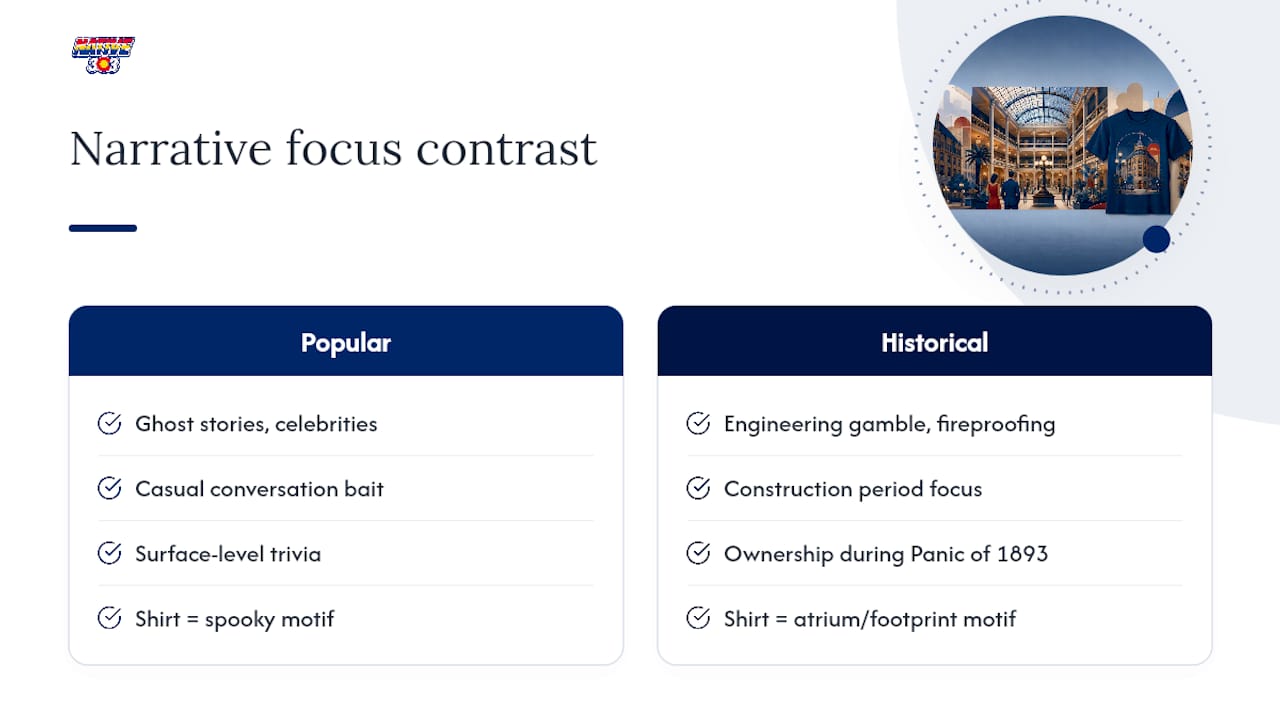
If you're researching this hotel for more than trivia, prioritize the construction period and the ownership transitions during the Panic of 1893. That's where the real tension lived, not in a haunted hallway. The atrium survived because the building was engineered to survive, not because of luck or legend.
That's also the detail worth carrying into how this history gets represented visually. A shirt that leans on the atrium's arches or the triangular footprint says more about Denver's actual Gilded Age ambition than one that just prints a ghost story onto a t-shirt. The building earned its landmark status through structural stubbornness, and that's a better story than the folklore that gets attached to it after the fact.
— Rob
Wear a Piece of Denver's Gilded Age History
For those looking for Denver history on apparel that reflects detailed local architecture rather than generic skyline silhouettes, some specialty brands offer designs capturing more authentic elements. Every design draws from the real architecture and stories behind the city's landmarks, the Brown Palace included, so what you're wearing has some substance behind it.
Product lineups often include tees, sweatshirts, hoodies, tote bags, can coolers, hats, and frosted pint glasses themed around Denver's vanished and iconic spaces. If none of the existing designs capture the specific detail you have in mind, the collaborative custom design service lets you work directly with the team to build something tied to your own memory of the city. Browse the current collection at the Native303apparel storefront and see what fits your closet, or start a custom request if you already know exactly what you want.
Sources
For readers who want primary material beyond this summary, Historic Hotels of America covers architecture and preservation status, the Colorado Encyclopedia traces ownership and founding details, History Colorado documents construction dates, and the Denver Post offers anniversary reporting with firsthand anecdotes.
- History of The Brown Palace Hotel and Spa, Autograph Collection | Historic Hotels of America
- Brown Palace Hotel | Colorado Encyclopedia
- Brown Palace Hotel | History Colorado
FAQ
Does the Brown Palace have anything to do with Molly Brown?
Margaret "Molly" Brown was a well-known figure in Denver's social scene and visited the hotel, though she's more strongly associated with her own Capitol Hill home than with the hotel itself. There's no evidence the hotel was named for her; it takes its name from founder Henry C. Brown.
Did the Beatles stay at the Brown Palace in Denver?
Yes, the Beatles stayed at the hotel during their 1964 U.S. tour, and it remains one of the most talked-about celebrity visits in the hotel's history.
What famous people have stayed at the Brown Palace?
U.S. presidents starting with Theodore Roosevelt in 1905, along with the Beatles and numerous other public figures, have stayed at the hotel over its history, according to the hotel's own account.
Is the Brown Palace hotel in Denver haunted?
Ghost stories about certain rooms and hallways circulate locally, but these are anecdotal accounts rather than documented history, so treat them as local legend rather than verified fact.
When did the Brown Palace open and who built it?
The hotel opened on August 12, 1892, financed by Henry C. Brown and designed by architect Frank E. Edbrooke on a triangular downtown lot.