
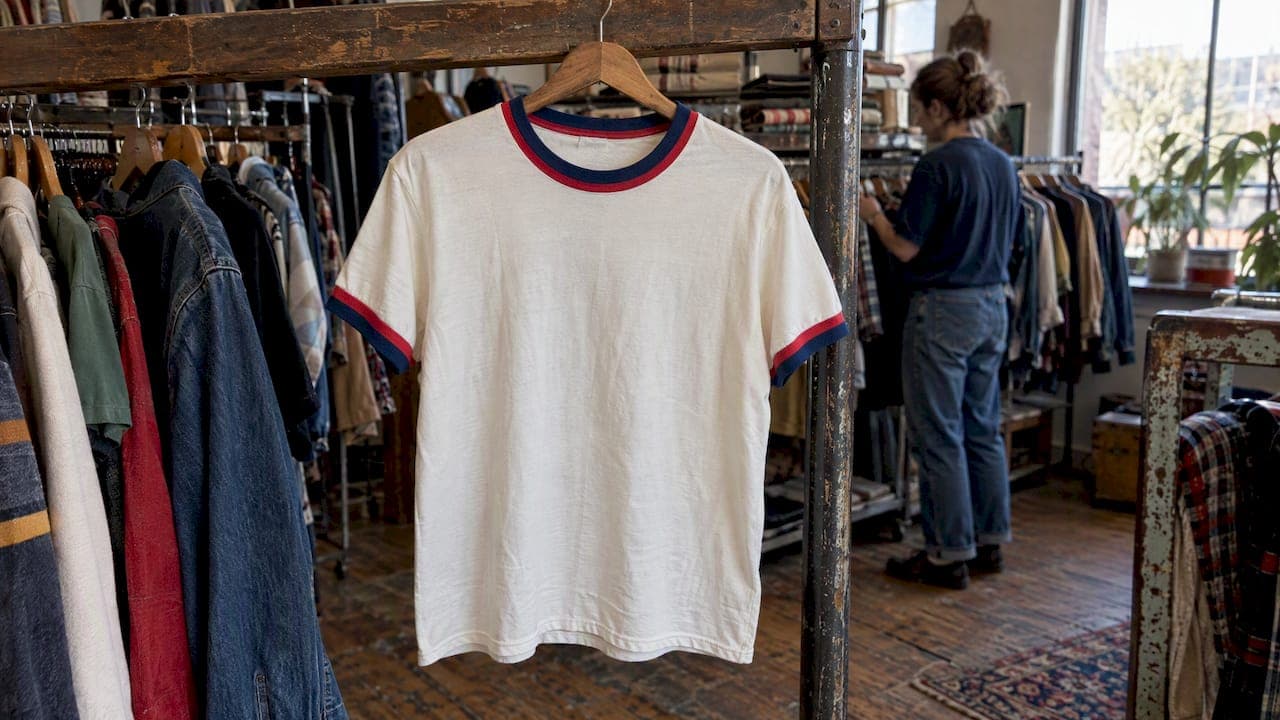
A ringer tee is a T-shirt with a single-color body set off by a contrasting ribbed band at the collar and sleeve hems, a construction detail that Merriam-Webster treats as the word's core definition. The shirt doesn't need to be old to earn the name. Vintage status is a separate question entirely.
TL;DR:
- Authentic vintage ringer tees typically feature single-stitch hems, but modern reproductions often fake the rib-knit trim with printed color blocking.
- The defining trait is contrasting rib knit bands at the collar and sleeves, with the rest of the shirt in a solid color, regardless of graphics or fabric weight.
- The style originated in 1950s and 1960s sportswear, with the term first appearing in 1965, and has cyclically reappeared across decades as a symbol of identity and nostalgia.
- To verify authenticity, check interior labels, seam details, and fabric wear, while ensuring the contrasting trim is sewn-in, not printed-on.
- Current fashion uses ringer tees to evoke youth, sports, or local history, styled simply with modern fits and minimal graphic competition to maintain their visual clarity.
Table of Contents
- Definition and key features of a ringer tee
- How do you pronounce "ringer tee"?
- Where the ringer tee comes from and how it spread
- Why the ringer tee keeps signaling youth and belonging
- Ringer tee versus single-stitch and other vintage clues
- Styling ringer tees for a current wardrobe
- Native303 maker insights on dye, finish, and authentication
- Why a clear definition matters for collectors and designers
- Find ringer-inspired and custom nostalgic tees
- FAQ
- Sources
Definition and key features of a ringer tee
The defining trait sits at two places on the garment: the crew neckline and the ends of the short sleeves. Both get a band of rib-knit fabric in a color that contrasts with the main body, usually sewn on as a separate piece rather than cut from the same cloth. Rib knit is used here because it stretches and recovers, so the trim keeps its shape around the neck opening and cuff instead of sagging after a few washes.

Classic ringer tees are built from jersey cotton or cotton blends, and the most recognizable colorway is a white body with navy or red trim, a combination borrowed from mid-century school and team uniforms. You'll also see black bodies with gray trim or pastel bodies with contrasting darker bands, but the color pairing itself doesn't change the definition. Neither does the graphic printed on the chest, the fabric weight, or which brand made it. A heavyweight blank from a small print shop and a thin vintage original are both ringer tees as long as that contrasting rib trim is present.
When you're trying to identify one in a photo or on a rack, run through a short checklist:
- Look for a ribbed collar band in a different color than the shirt body.
- Check the sleeve hems for the same contrasting rib trim.
- Confirm the rest of the shirt, front and back panels, matches in one solid color.
- Ignore the graphic, logo, or tag: none of them factor into the definition.
How do you pronounce ringer tee?
Say it the way it looks: "RING-er tee." The first syllable rhymes with "sing" and "ring," the same stress pattern as the word "singer," and "tee" is simply the letter T. Merriam-Webster lists ringer tee as a variant spelling of "ringer T-shirt," so either form is correct in writing, and both are pronounced identically.
Where the ringer tee comes from and how it spread
The ringer tee's roots are in school and team sportswear of the 1950s and 1960s, where the contrasting trim doubled as a quick visual cue for school colors on gym uniforms and athletic undershirts. Merriam-Webster dates the first known use of the term to 1965, placing the name itself squarely in that athletic-wear period, though the construction shows up on garments made both earlier and later than that citation. The date marks when the word entered print, not when any specific shirt was sewn.
A rough timeline of the style's path through fashion:
- 1950s to 1960s: Ringer construction appears on school gym shirts and athletic undershirts, prized for durability and team-color trim.
- 1965: The term "ringer T-shirt" gets its first documented use, according to Merriam-Webster.
- 1970s: The style moves into mainstream casualwear and gets adopted by music and youth subcultures, who use the contrasting trim the same way a varsity jacket uses stripes, as a marker of belonging.
- 2000s: An indie-sleaze revival brings the ringer back into rock and skate-adjacent wardrobes, pairing it with the decade's rougher, DIY aesthetic.
- 2020s: Designers and major outlets reintroduce the shape into current collections. Vogue documents the ringer tee's reappearance across ready-to-wear lines and street style, while The Guardian traces its comeback back to the same sports-and-nostalgia roots that made it popular in the first place.
The through line across every decade is that the ringer tee never fully disappears. It recedes into niche wardrobes and resurfaces whenever a subculture wants a shortcut to look lived-in and specific rather than generic.
Why the ringer tee keeps signaling youth and belonging
Fashion historian Emma McClendon ties the ringer tee's staying power to its sports-team origins, arguing that the style was built to be noticed. Her point, reported by The Guardian, is that the contrasting trim made school colors visible at a glance, turning a plain shirt into a piece of identity.
The same logic carries into every later use of the shirt. A band ringer tee signals which music scene you belong to the same way a team-colored one once signaled which school you attended, and a local-history graphic on a ringer tee today does the same job for a city or neighborhood identity. Nostalgia is widely credited as a driver of fashion's cyclical trend patterns, and the ringer tee is a clean example of that mechanism: a simple visual cue, learned early, that keeps getting reattached to new groups and new decades, as The Guardian's coverage of the style's return lays out.
Ringer tee versus single-stitch and other vintage clues
"Ringer" and "single-stitch" describe two completely different parts of a shirt, and mixing them up leads to bad listings and bad purchases. Ringer refers to the contrasting rib trim at the collar and sleeves. Single-stitch refers to the hemming method, a single line of stitching along the sleeve and bottom hems, which was common before manufacturers shifted to double-needle hems for durability. A shirt can be a ringer tee with single-stitch hems, a ringer tee with double-stitch hems, or no ringer at all with either hem type.
When you're trying to authenticate a shirt as genuinely vintage rather than a modern reproduction built in a retro style, check:
- The neck label for a brand, union tag, or care instructions consistent with its claimed era.
- The hem stitching, since single-stitch is a common vintage indicator but not proof on its own.
- The fabric for honest wear, thinning, or pilling rather than artificial distressing.
- The print for cracking or fading that matches the garment's overall age rather than looking newer than the fabric around it.
Pro Tip: Flip the shirt inside out and check whether the rib trim is sewn on as a separate piece with visible seam allowance. Reproductions sometimes fake the look with printed-on color blocking instead of actual rib-knit construction.
Styling ringer tees for a current wardrobe
A ringer tee works best when the rest of the outfit stays simple enough to let that trim detail read clearly. For everyday wear, pair one with straight-leg jeans and a denim or varsity jacket layered on top, or with cotton shorts for warmer weather when you want the trim visible without extra layers competing for attention.

Subcultural styling leans harder into specific references: an indie-sleaze look pairs a band ringer tee with slouchy trousers and scuffed sneakers, a sporty-prep combination puts it under a half-zip pullover with the collar trim peeking out, and an Americana-inspired outfit pairs it with selvedge denim and work boots.
A few quick rules keep the look current instead of costume-like:
- Keep the rest of the fit modern so the ringer tee reads as a detail, not a full throwback outfit.
- Size the shirt true to fit rather than oversized, which can hide the contrasting trim.
- Avoid pairing it with other heavily branded or graphic pieces that compete for attention.
Native303 maker insights on dye, finish, and authentication
Garment-dyed and pigment-dyed tees look similar on a hanger but feel different on skin, as explained in our guide to creating a distressed or vintage look. Garment-dyed pieces are dyed after the shirt is fully sewn, which softens the fabric and gives it a slightly faded, broken-in look from the first wear. Pigment-dyed shirts often carry a crisper hand feel initially.
When authenticating an exclusive or nostalgic-style tee, apply the same checklist from earlier:
- Confirm the rib trim is a sewn-on band, not a printed effect.
- Check the interior label for consistent branding and construction quality.
- Feel the fabric hand: a softer, worn-in texture usually points to garment dyeing or genuine age rather than a stiff, newly printed reproduction.
Why a clear definition matters for collectors and designers
Separating "ringer tee" from "vintage" matters more than it sounds. A collector who assumes every ringer tee is decades old will misprice common reproductions, and a designer who treats the ringer as a retro gimmick rather than a construction detail will miss why the style keeps returning. Some designs lean on the stories behind Denver's vanished eateries and clubs precisely because that kind of specific, local nostalgia is what gives a shirt lasting meaning, not just the trim on its collar.
— Rob
Find ringer-inspired and custom nostalgic tees
If you want a ringer-style silhouette built around a story instead of a generic graphic, some apparel providers offer tees, sweatshirts, hoodies, and more inspired by Denver's vanished eateries, clubs, and shops, each piece designed to turn a specific memory into something wearable.

For a design tied to your own memory of a specific spot or era, our custom design service works directly with you to build a one-of-a-kind piece from your own reference points. Check our size guide before ordering to get the fit right the first time.
FAQ
When were ringer tees popular?
Ringer tees trace back to school and team sportswear in the 1950s and 1960s, with the term's first known use dated to 1965. The style hit a broader mainstream peak in the 1970s before cycling back through indie and skate culture in the 2000s and designer collections in the 2020s.
Are ringer tees a 70s style?
The ringer tee became widely popular in casual and youth culture during the decades following its sportswear origins, but the construction itself predates that period by several years. Treating it as strictly a shirt of one decade misses its earlier sportswear origins and its repeated comebacks since.
How do you pronounce "ringer tee"?
Say "RING-er tee," with "ringer" rhyming with "singer" and "tee" said as the letter T. Merriam-Webster lists this pronunciation alongside "ringer T-shirt" as an accepted variant form.
Are ringer tees trendy right now?
Ringer tees have reappeared in recent designer collections and street style coverage, with Vogue and The Guardian both covering their return. The style tends to resurface in cycles tied to nostalgia rather than holding a fixed spot in current trends.
Does a ringer tee have to be vintage to count?
No, the name describes a construction detail, a contrasting rib-knit collar and sleeve band, not an age or era. A brand-new shirt with that trim is just as much a ringer tee as an original from the 1960s.
Sources
- RINGER T-SHIRT Definition & Meaning - Merriam-Webster
- ‘They remind us of youth, summer and fun’: the return of the ringer T‑shirt | The Guardian
- Why the Ringer Tee Is Making a Return—And Where to Shop Our Favorite Styles | Vogue