
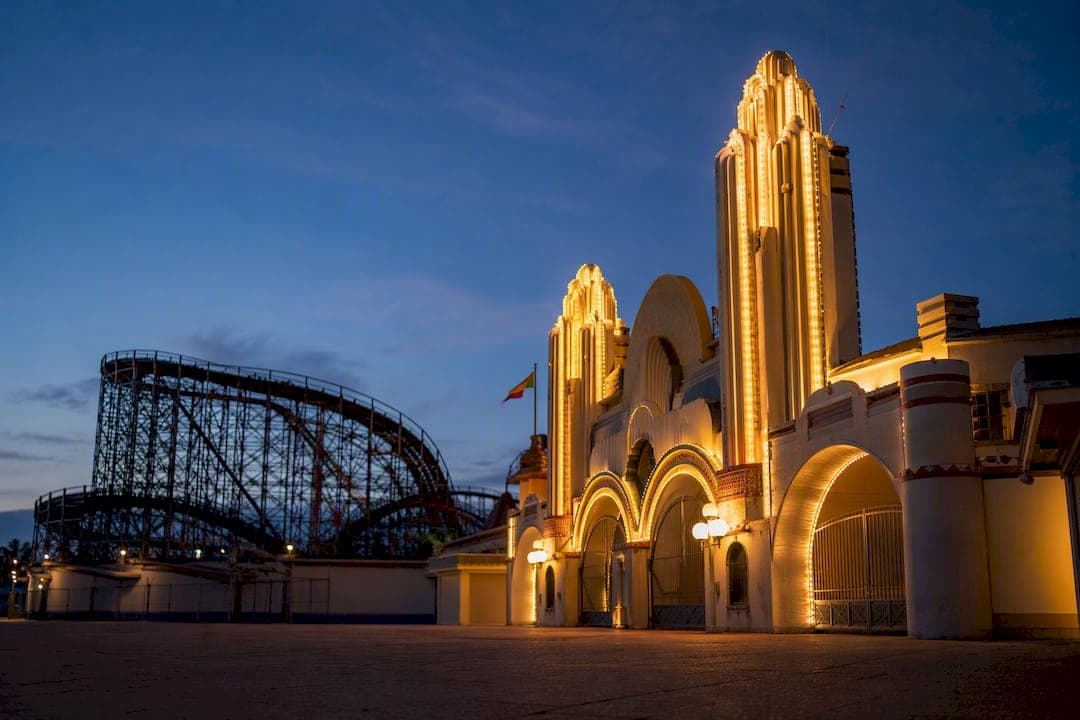
Lakeside Amusement Park opened on May 30, 1908, drew a very large crowd through its gates, and still operates today on that same patch of ground west of downtown Denver, making it the oldest amusement park in Colorado at its original location. It survived by changing hands only twice and by reinventing its look entirely, trading a "White City" of neoclassical facades for Art Deco neon under one family's decades-long stewardship.
TL;DR:
- Lakeside Park's Art Deco redesign in the 1930s replaced the original White City style, using neon lighting and streamlined curves to modernize its appearance.
- The park has remained family-owned by the Krasner family since 1935, allowing long-term decisions like preserving historic rides and resisting redevelopment threats.
- The Cyclone roller coaster, opened in 1940, continues to operate, making it one of the oldest wooden coasters in the country still in use.
- The park survived several crises, including fires, safety investigations, and legal actions, by consistently choosing reform and adaptation over closure.
- Its location historically benefited from independent transit access, shifting from streetcars to parking and regional transit, ensuring continued attendance across generations.
Table of Contents
- The Timeline Behind Lakeside Amusement Park History
- From White City Glow to Art Deco Neon
- Ownership and the Krasner Family's Long Watch
- The Rides That Defined the Park
- Fires, Investigations, and Legal Fights
- What Lakeside Says About Denver Itself
- The People Who Built It, Not Just Owned It
- Lakeside's Role in Denver's Amusement Landscape
- Getting There: Transit and Access Over the Decades
- Lakeside in Film, Photography, and Local Memory
- Surviving the Depression and Two World Wars
- A Century of Community Gatherings
- Why Lakeside Still Matters to Denver
- Wear a Piece of Lakeside's Story
- Where This History Comes From
- Sources
The Timeline Behind Lakeside Amusement Park History
Understanding lakeside amusement park history means starting a year before the gates opened, because the site itself was a legal maneuver as much as a real-estate decision. In 1907, brewing magnate Adolph Zang and his partners incorporated the town of Lakeside as its own municipality, a move that let the park sidestep Denver's blue laws and sell alcohol on Sundays. That single decision shaped everything that followed, from where the park could locate to how it operated for the next century.
The opening on May 30, 1908, was built around spectacle. Roughly 50,000 visitors walked through gates lit by 100,000 electric bulbs, a staggering number for a city still adjusting to widespread electrification. Early attractions included a casino building, a grand ballroom, a natatorium for swimming, and a Scenic Railway that gave riders a slow, theatrical tour of the grounds.
Key turning points since then:
- Early 1910s: A series of fires tore through several original wooden structures, forcing rebuilds that quietly reshaped the park's layout.
- 1935: Benjamin Krasner purchased the park, ending Zang-era ownership and beginning six decades of Krasner family control.
- Late 1930s to 1940s: The Art Deco and Art Moderne rebrand took hold, replacing White City ornamentation with streamlined, neon-lit design.
- 1940: The Cyclone wooden roller coaster opened, becoming the park's most enduring ride.
- 1972: A serious incident on the Cyclone triggered a grand jury investigation into safety and fire-code violations.
- 1988: A fatal accident at the on-site racetrack ended decades of speedway racing at Lakeside.
- 2014: A lawsuit alleging ADA violations over service-animal access brought modern accessibility law into a century-old operation.
Each of these moments forced the park to adapt or close. It never closed.
From White City Glow to Art Deco Neon
Lakeside's original architecture borrowed directly from the "White City" aesthetic popularized by the 1893 World's Columbian Exposition in Chicago, a style built on white neoclassical facades, formal symmetry, and the civic optimism of the City Beautiful movement sweeping American cities at the time. Denver wanted its own gleaming answer to that fair, and Lakeside delivered one on a smaller, permanent scale.
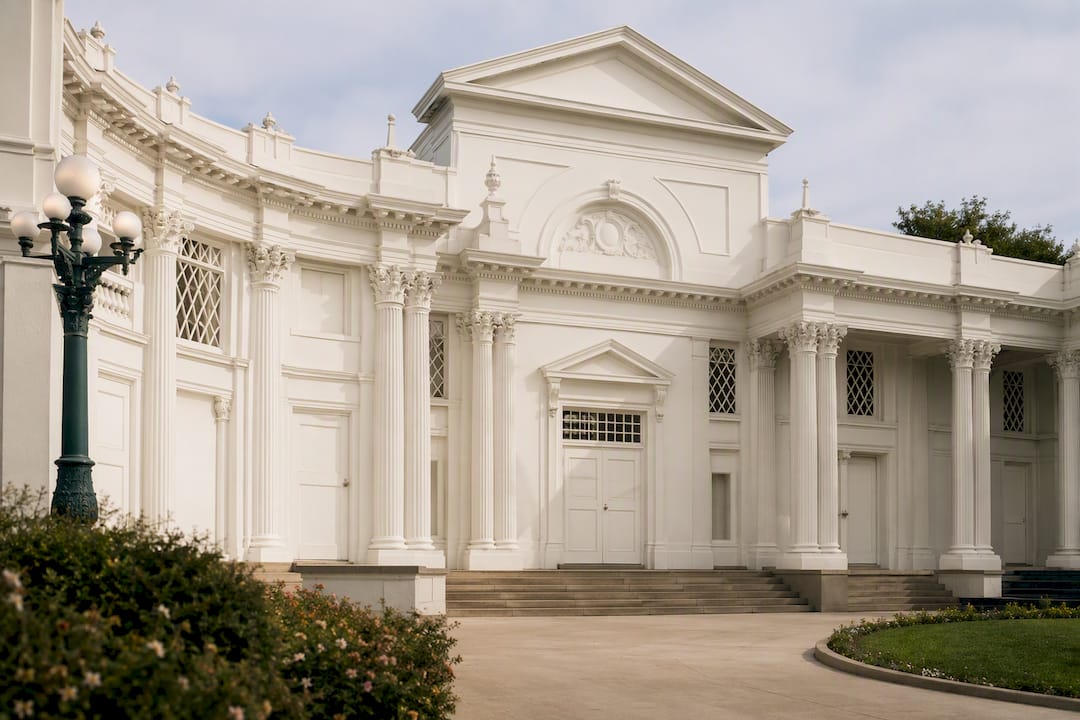
Statistic Callout: The park's original lighting scheme used 100,000 electric bulbs at a time when most American households still didn't have electric light at all. The Tower of Jewels, the park's illuminated centerpiece, became the visual anchor of that display and the image most associated with Lakeside's opening decades.
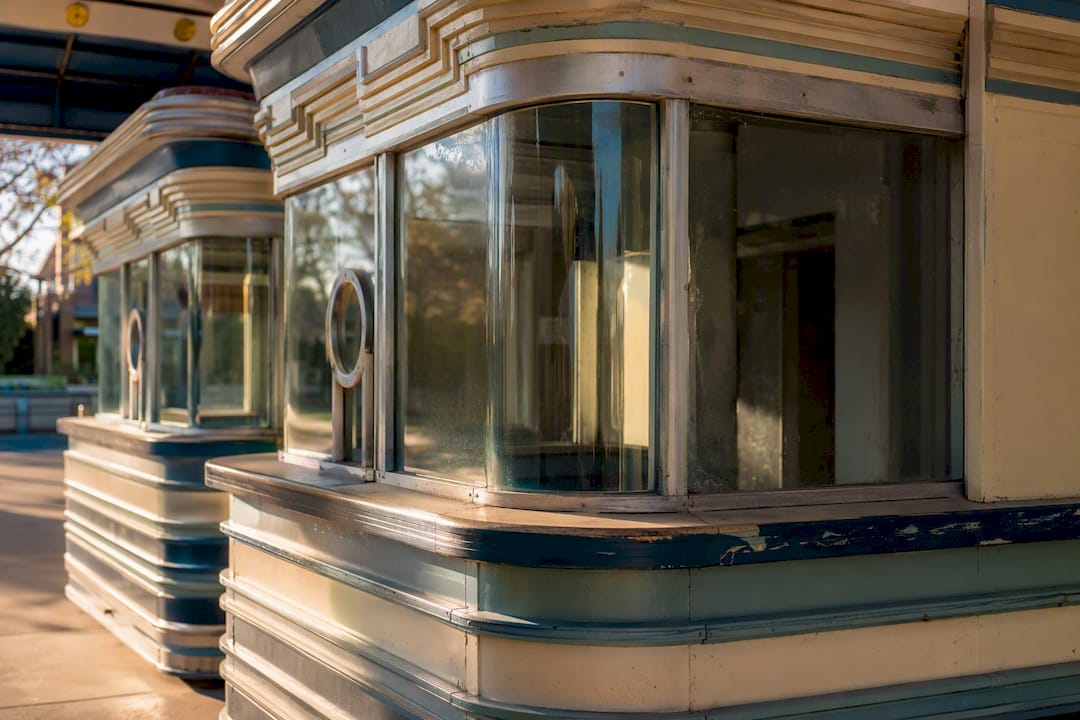
That look didn't survive the Krasner era intact, and it wasn't supposed to. Architect Richard L. Crowther redesigned ticket booths and structural elements in Art Deco and Art Moderne styling, swapping classical columns for streamlined curves and neon tubing.
- White City era: neoclassical facades, formal lighting displays, resort-style pretension.
- Art Deco/Moderne era: streamlined curves, neon accents, a friendlier, more accessible visual language.
- Surviving elements today: portions of the Tower of Jewels and several Crowther-designed structures still stand.
That shift from marble-white grandeur to glowing neon curves is exactly the kind of visual contrast that shows up in era-specific graphic design for apparel, where a single decade's typography or color palette can carry an entire design.
Ownership and the Krasner Family's Long Watch
Lakeside has changed hands only twice in more than a century, which is unusual for an American amusement park of this age. Adolph Zang's Lakeside Realty and Amusement Company built and opened the park in 1908. Benjamin Krasner bought it in 1935, and Rhoda Krasner has continued the family's ownership since.
That continuity mattered in ways a corporate owner might not have replicated. Specific stewardship decisions under the Krasners:
- Commissioning the Art Deco rebrand instead of demolishing and rebuilding from scratch.
- Investing in structural improvements after the 1972 grand jury findings rather than closing the affected rides permanently.
- Resisting redevelopment pressure that has claimed comparable urban land elsewhere in Denver.
Preservationists tend to point to this kind of single-family, multi-generational ownership as a rare stabilizing force. A publicly traded operator answering to quarterly earnings rarely keeps a wooden coaster running for 85 years out of sentiment.
The Rides That Defined the Park
Early Lakeside offered amenities built for a leisurely, all-day visit rather than a quick thrill fix: a casino for socializing, a formal ballroom, a natatorium for swimming, the Lakeshore Railroad circling the property, and the Velvet Coaster as an early thrill ride.
The Cyclone changed the park's identity. Installed in 1940, the wooden coaster became Lakeside's signature ride and remains one of the oldest continuously operating wooden coasters in the country. Its wooden structure and old-school lift hill are the kind of details that vintage-park enthusiasts drive across the state to experience.
- Still standing: the Cyclone, portions of the Tower of Jewels, several original ticket booths.
- Long gone: the natatorium and much of the original casino interior.
- Racing history: the on-site speedway hosted stock car racing for decades until the 1988 fatality ended it.
Visitors today can spot original ironwork and lighting fixtures if they know where to look, tucked among newer additions.
Fires, Investigations, and Legal Fights
Lakeside's hardest years left marks that shaped how the park operates today.
- 1911 to 1912 fires: Multiple blazes destroyed early wooden structures, forcing the park to rebuild sections of its original footprint within a few years of opening.
- 1972 Cyclone incident: An accident on the coaster prompted a grand jury investigation that uncovered multiple safety and fire-code violations, forcing park-wide reforms.
- 1988 racetrack fatality: A fatal accident at the Lakeside Speedway ended stock car racing on the property for good.
- 2014 ADA lawsuit: A dispute over service-animal access on a train ride became a federal accessibility complaint, pushing modern disability law into a facility built decades before the ADA existed.
Each crisis forced a choice between closing a ride, a section, or the whole park, and reforming it instead. Lakeside kept choosing reform.
What Lakeside Says About Denver Itself
Historian David Forsyth's research treats Lakeside as more than a ride collection. His dissertation on the park frames it as a running commentary on Denver's civic ambitions, tied directly to the City Beautiful movement championed by boosters like Mayor Robert Speer in the early 1900s.
- Founding era: an elite-leaning resort meant to prove Denver belonged among sophisticated American cities.
- Krasner era: a deliberate pivot toward affordable, broadly accessible family entertainment as Denver's population diversified.
- Present day: a living artifact that local historians and casual visitors alike treat as shared civic memory.
Pro Tip: If you want to see the White City to Art Deco shift with your own eyes, compare archival Denver Public Library photos of the original Tower of Jewels against the current structure. The bones are the same. The skin changed entirely.
That visual evolution is exactly why Denver collectors chase nostalgic apparel tied to landmarks like this one. A park that physically embodies a city's changing self-image gives designers more to work with than a generic carnival ever could.
The People Who Built It, Not Just Owned It
Ownership headlines tend to overshadow the working hands behind Lakeside's survival. Richard L. Crowther, the architect responsible for the Art Deco ticket booths and much of the neon-era rebrand, deserves recognition alongside the Krasners for giving the park a coherent visual identity that outlasted the White City phase entirely. His work turned a fading neoclassical resort into something that read as modern for its time, without tearing down the original bones.
Beyond Crowther, generations of ride mechanics, electricians, and maintenance crews kept aging wooden structures like the Cyclone running safely across the decades that followed the 1972 investigation. That kind of institutional knowledge, passed down informally rather than documented in corporate manuals, is common at family-owned parks and rarely gets credit in official histories. Ticket booth operators, ride announcers, and seasonal staff who spent entire careers at Lakeside built the kind of local familiarity that turns a park into a neighborhood fixture rather than a tourist stop.
The absence of a large corporate design or marketing department also meant decisions about signage, paint schemes, and ride placement often fell to whoever was on-site with the skills to execute them. That informality shows up in small architectural inconsistencies across the property today, a patchwork quality that historians and photographers find just as compelling as any single grand design decision.
Lakeside's Role in Denver's Amusement Landscape
Lakeside wasn't Denver's only amusement destination, but it outlasted most of its competition by a wide margin. Elitch Gardens, another well-known Denver-area park, moved locations and changed ownership multiple times over the twentieth century, while Lakeside stayed put on its original grounds through the same stretch of decades.
That stability gave Lakeside a specific kind of tourism appeal: visitors and Coloradans alike could return to the exact same location their grandparents visited, riding some of the exact same equipment. Regional competition from trolley parks and resort destinations across the Front Range came and went as transit patterns shifted, but Lakeside's independence from any single transit company protected it from the ownership churn that sank many comparable parks nationwide.
For Denver's broader tourism identity, Lakeside functioned as proof that the city could sustain a permanent entertainment destination rather than a seasonal novelty. That mattered during the decades when Denver was actively trying to position itself as a serious western metropolis rather than a frontier outpost. The park's continued operation, even through lean years, gave local boosters a tangible example to point to when arguing the city had staying power beyond mining money and railroad traffic.
Getting There: Transit and Access Over the Decades
Lakeside's location just outside Denver's western city limits was never an accident, and getting there has looked different in nearly every era of the park's operation. In the early 1900s, the Denver Tramway streetcar system carried much of the opening-day crowd and remained a primary access route for decades afterward. Unlike many amusement parks of that era that were built and owned directly by streetcar companies looking to generate weekend ridership, Lakeside operated independently of the tramway that served it, which turned out to be a crucial survival advantage.
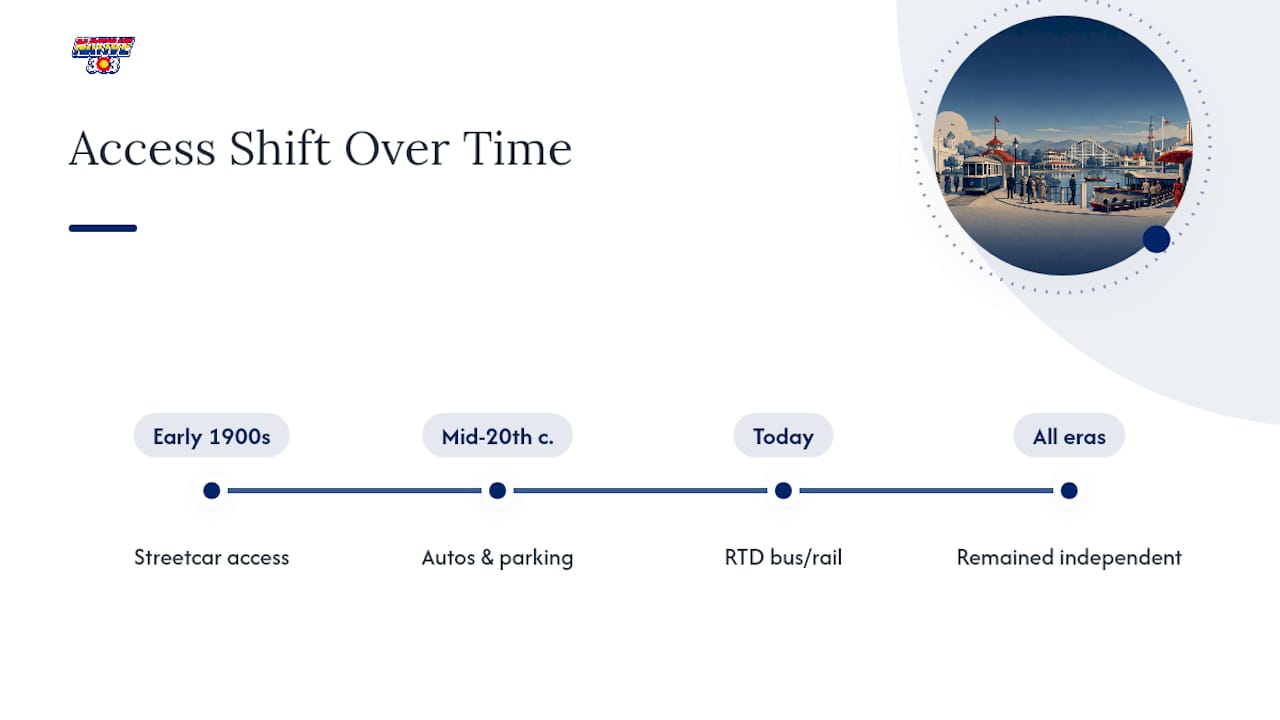
That independence meant Lakeside didn't collapse when transit ownership models changed and streetcar companies across the country shuttered the parks they had built to prop up ridership numbers. As Denver's tramway system declined through the mid-twentieth century and automobiles took over as the dominant mode of transportation, Lakeside adapted by expanding parking rather than depending on a transit link that no longer existed.
Today, visitors reach the park primarily by car, with the site sitting near major roadways on Denver's western edge. Public transit options have shifted again with the growth of the Regional Transportation District's bus and rail network, though the park's access patterns now look far more like a suburban destination than the streetcar-dependent resort it started as. That transition, from trolley stop to parking lot, tracks almost exactly with the broader story of how American cities reorganized themselves around cars over the twentieth century.
Lakeside in Film, Photography, and Local Memory
Lakeside's Art Deco neon and its wooden Cyclone silhouette have made it a recognizable backdrop well beyond ticket-holders. The park's visual distinctiveness, that particular combination of vintage signage, aging paint, and genuine mid-century architecture, has drawn photographers and filmmakers looking for authentic period texture that a modern build simply can't replicate.
Local news coverage, including retrospective features like the one Westword published on the park's 110-plus years of operation, has repeatedly returned to Lakeside as a subject precisely because it looks like almost nowhere else left in American amusement operation. Few parks anywhere retain this much unaltered mid-century signage still doing its original job.
Beyond formal media coverage, Lakeside occupies an outsized place in Denver's informal cultural memory. Generations of families have first-date stories, childhood birthday memories, and summer-job anecdotes tied to the park, the kind of accumulated personal history that turns a business into a landmark. That collective memory is part of why the park's imagery, the Tower of Jewels glow, the Cyclone's wooden frame against a sunset, resonates so strongly with people who grew up in the Denver area even if they haven't visited in years.
Surviving the Depression and Two World Wars
Lakeside opened into a period of national economic expansion, but it had to survive some of the roughest economic stretches in American history to reach its current age. The Great Depression hit discretionary entertainment spending hard nationwide, and amusement parks were among the first businesses families cut from tight budgets. Lakeside's affordable, family-oriented pricing model, reinforced by the Krasner-era shift away from elite White City pretension, positioned it better than resort-style competitors to weather years when Denver families had little spare cash.
World War II brought a different kind of pressure: gas rationing limited how far families could travel for leisure, and labor shortages made it harder to staff and maintain a large physical property. Parks that depended heavily on out-of-town tourism struggled during these years, while Lakeside's status as a local, walkable-or-tram-accessible destination for Denver residents kept a steady base of visitors even when broader travel slowed to a crawl.
That resilience through two of the most economically disruptive periods in American history reinforced a pattern that shows up throughout lakeside amusement park history: the park survived by staying relevant to ordinary Denver families rather than chasing a wealthier, more transient tourist crowd. It's a strategy that paid off again decades later when the Krasners rebranded the park's look without abandoning its accessible pricing.
A Century of Community Gatherings
Beyond the rides themselves, Lakeside has functioned as an informal community gathering space for generations of Denver-area families, hosting seasonal celebrations, school outings, and company picnics that turned the park into a recurring backdrop for local social life rather than a once-a-summer novelty. That kind of repeat, ritualized visitation is part of what separates a genuine community landmark from a tourist attraction that people visit once and forget.
The park's continued operation through more than a century of Denver's growth means multiple generations within the same families have made Lakeside part of their personal calendars, whether through birthday traditions, graduation celebrations, or simply a reliable summer evening outing. That kind of intergenerational repeat use is rare for any single business, let alone one built around aging wooden and steel equipment.
Local historians studying Denver's development, including the scholarly work connecting Lakeside to the City Beautiful movement, point to this community role as evidence that the park functioned as genuine civic infrastructure, not just private enterprise. Few Denver businesses from 1908 still serve the same recreational function for the same kind of audience today.
Why Lakeside Still Matters to Denver
Lakeside's survival isn't really a story about a lucky roller coaster. It's a story about a family that kept choosing to fix things instead of walking away, through fires, grand jury findings, a fatal accident, and a federal lawsuit. That pattern says more about Denver's relationship to its own history than any single ride does. If you care about this city's past, go see the Tower of Jewels in person, dig into the Denver Public Library's photo archive, and support the ongoing effort to keep a 1940 wooden coaster upright. Native303apparel exists partly because that kind of preserved visual memory is worth wearing, not just reading about.
— Rob
Wear a Piece of Lakeside's Story
Native303apparel creates apparel featuring visual details like the Tower of Jewels glow, vintage ticket booths, and the Cyclone's wooden silhouette, allowing you to wear a piece of Denver's history rather than just read about it in an archive. The graphics are inspired by era-specific color palettes and typography that defined Lakeside's historical aesthetic.
Browse the Native303apparel storefront for current Lakeside-inspired designs across t-shirts, hoodies, and hats, and check the size guide before you order if you're between sizes. Custom requests are welcome if you have a specific era or ride in mind that isn't already in the lineup. Orders ship within the standard processing window, and sizing exchanges are straightforward if something doesn't fit right out of the box.
Where This History Comes From
This account draws on primary and scholarly sources rather than secondhand summaries.
- The Denver Public Library's photo collection supplies opening-day imagery and ownership-timeline documentation.
- David Forsyth's dissertation on Lakeside provides the scholarly framing connecting the park to Denver's civic development.
- Westword's retrospective feature documents the Krasner-era rebrand and the park's legal founding motives.
- Colorado's historic newspaper collection preserves original opening-day press coverage.
- The park's Wikipedia entry offers a consolidated factual reference for dates and incidents.
Sources
- Lakeside Amusement Park — Wikipedia
- The History of Lakeside Amusement Park in Photos — Denver Public Library
- Lakeside Amusement Park has survived 110 years of ups and downs — Westword
- Life is a roller coaster: A history of Denver's Lakeside Amusement Park — Dissertation (David Forsyth)