
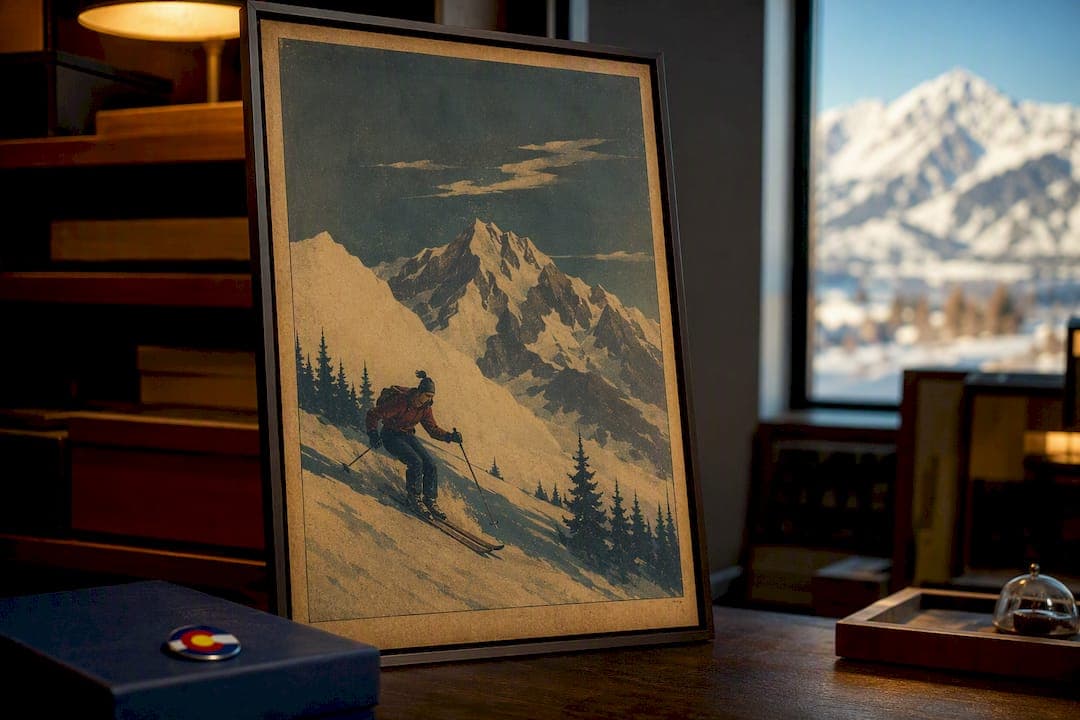
The best Colorado ski poster art comes from three types of sellers: specialist vintage dealers like Vintage Ski World and NW Cartographic for authentic originals, print marketplaces like Art.com, Amazon, and Society6 for affordable reproductions, and independent artists for original modern work. Originals run from $65 into the thousands depending on rarity and condition. Reproductions typically cost $20 to $150 and come in nearly any size. If you're on a budget or just want the look, start with reproductions. If you want a piece of resort history, go straight to a vintage specialist.
TL;DR:
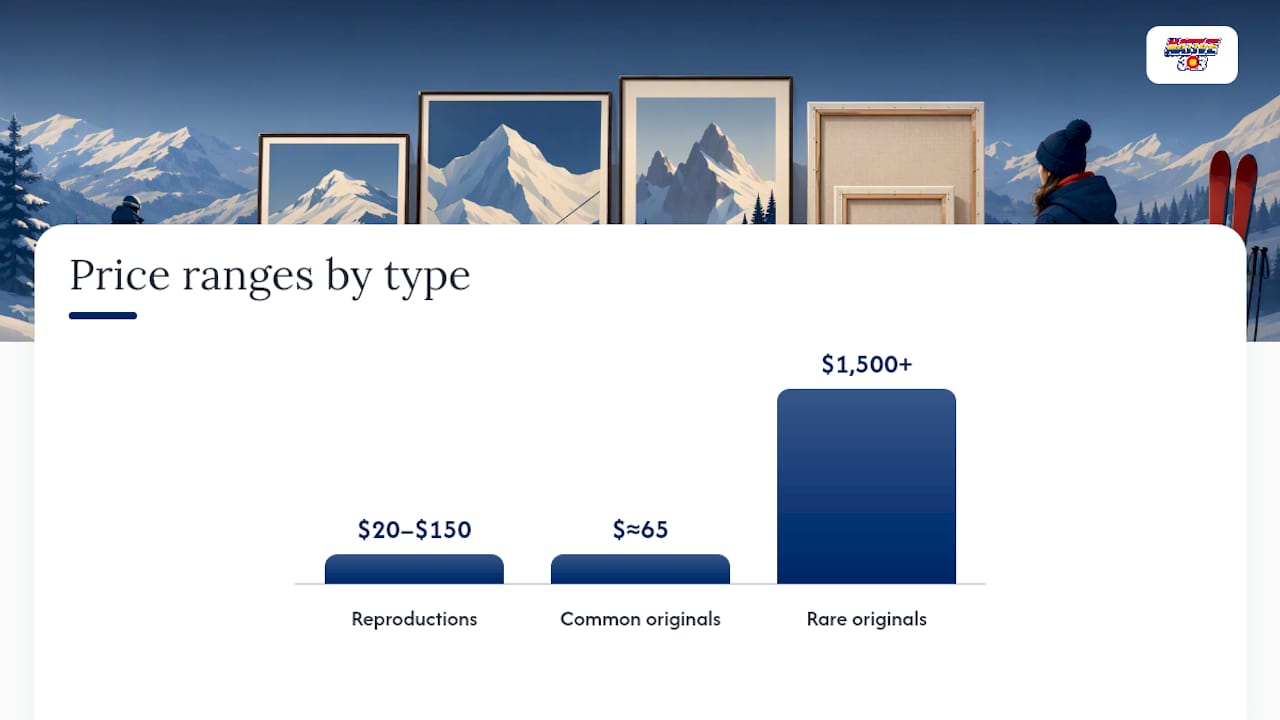
- Authentic vintage Colorado ski posters from the 1960s often come from specialized dealers like Vintage Ski World or NW Cartographic, with prices ranging from $65 to over $1,500 based on rarity and condition.
- Reproductions are widely available for $20 to $150, printed on modern presses with better color accuracy, offering a budget-friendly way to achieve the retro look.
- For original posters, verify provenance, printing marks, era-appropriate paper, and condition, and expect to budget additional costs for linen backing and archival framing to preserve them.
- Reproductions in standard sizes simplify framing and wall placement, while original posters often have odd dimensions, requiring custom framing and careful placement.
- Asking clear questions about printer details, provenance, restoration, and shipping methods helps distinguish trustworthy sellers from less reliable sources.
Table of Contents
- Finding Authentic Colorado Ski Poster Art: Where the Best Pieces Actually Are
- How Do You Choose Between an Original and a Reproduction?
- What Does It Take to Preserve a Vintage Ski Poster?
- Styling Colorado Ski Posters in Your Home
- Why Colorado Ski Posters Look the Way They Do
- What Should You Ask a Seller Before You Buy?
- What Are the Warning Signs of a Bad or Fake Poster?
- Can You Negotiate on High-Value Colorado Ski Posters?
- What This Guide Gets Right That Most Advice Misses
- Complete Your Colorado Nostalgia With Local Apparel
- Sources
- FAQ
Finding Authentic Colorado Ski Poster Art: Where the Best Pieces Actually Are
Every serious search for Colorado ski poster art eventually splits into two paths: chasing an original print from a specific era, or buying a well-made reproduction that captures the same retro travel-poster look. Both paths are legitimate. The difference is what you're actually paying for.
Original vintage posters carry a printing history. Many of the most sought-after Colorado pieces trace back to Looart Press, a mid-century printer whose 1960s runs for Aspen and Breckenridge show up regularly in collector circles. Reproductions carry no such history, but they're printed today on modern presses, often with better color accuracy than a poster that's spent 60 years in someone's basement.
Marketplaces and specialist dealers serve different needs. Vintage Ski World and NW Cartographic focus on period pieces with documented provenance. Amazon and Society6 focus on volume and speed, printing on demand so you're not stuck waiting on a single rare find. Art.com sits in between, curating a large collection that mixes styles and price points. Independent artists like Holly Thompson Art offer something else entirely: new work inspired by the old aesthetic, sold directly, often in custom sizes you won't find anywhere else.
Here's how six of the most reliable sources stack up:
A few things worth knowing before you click "buy":
- Vintage Ski World's inventory shifts constantly since original stock is finite — a poster you see today may be gone next week.
- Amazon listings for "colorado ski poster" return large volumes of results, but seller quality varies more than on curated sites.
- Society6's Vail print and similar designs are printed in the U.S. on archival paper, with straightforward returns if the color doesn't match your expectations.
- Holly Thompson Art's direct-sale model means you're often emailing the artist about custom sizing rather than clicking a dropdown menu.
How Do You Choose Between an Original and a Reproduction?
Start with what you actually want the poster to do. If it's decor for a ski condo or a gift for a Colorado transplant, a reproduction does the job for a fraction of the cost. If you're building a collection or want a piece with real history on the wall, an original is worth the hunt.
Authentication checklist. Before buying an original, check for these signs:
- Printer marks or a printer name (Looart Press is the one to know for Colorado resort posters).
- A printing date, either printed directly on the piece or documented by the seller.
- Paper type consistent with the claimed era. Older stock tends to feel thinner and shows different aging patterns than modern cardstock.
- Edition or run numbers, when the seller can provide them.
- Seller-provided provenance. A dealer who can tell you where a poster came from is worth more trust than one who can't.
Condition affects price heavily. Tears, foxing (those brown age spots), and color fading all knock value down, sometimes by half or more. Restored posters, meaning ones that have been cleaned, backed, or had color touched up, sit in a middle tier: more valuable than damaged originals, less valuable than pieces in freshly conserved condition.
Sizing matters more than people expect. Standard modern reproductions run 11x14, 18x24, and 24x36. Original vintage pieces often came in odd, non-standard dimensions, which means custom framing and a higher framing bill. Reproductions in giclée format use archival inks and heavier paper stock, putting them much closer to museum quality than a basic poster print, without the cost of an original.
On price: expect reproductions in the $20 to $150 range depending on size and print quality. Originals run from around $65 for common, later-era prints up to $1,500 or more for rare, well-documented pieces in strong condition. Anything priced far outside those bands deserves a second look.
Pro Tip: Always ask a seller for close-up photos of the poster's back and corners before buying an original. Authentic printer marks and plate lines usually show up there, and reproductions almost never replicate them.
What Does It Take to Preserve a Vintage Ski Poster?
Original posters need conservation work that reproductions don't. The industry standard is linen backing: mounting the paper poster to acid-free linen using a reversible adhesive process that stabilizes the print without permanently altering it.
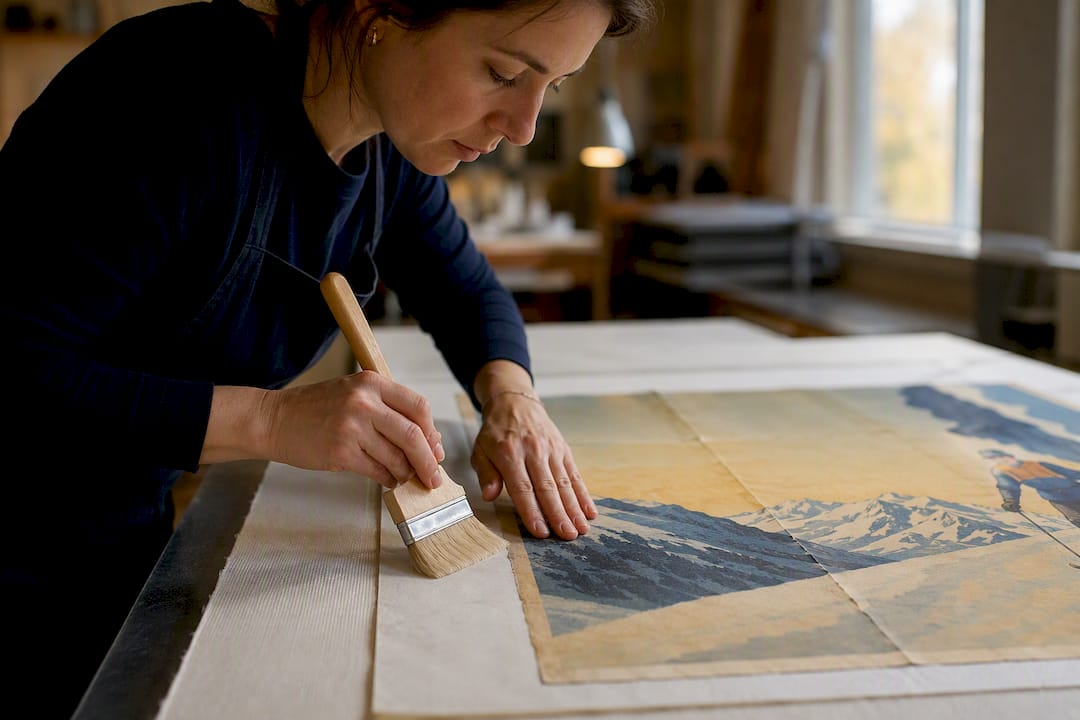
This isn't optional if you want an original to survive handling and framing. Untreated vintage paper is brittle, and a poster that's been folded or rolled for decades can crack along old fold lines the moment you try to flatten it.
Budget for it. Professional linen backing and conservation work commonly starts around $140 depending on the provider and the poster's condition, and specialized restoration work often takes six to eight weeks to complete. That timeline surprises a lot of first-time buyers who expect to hang a new purchase the same week it arrives.
Framing decisions come next:
- Archival mats prevent acid transfer from the mat board onto the poster over time.
- UV-protective glazing (glass or acrylic) slows fading from sunlight, which is the single biggest threat to a vintage poster's color.
- Custom framing for oversized or oddly sized originals costs more than standard-size framing, sometimes significantly more.
- Fragile originals should ship rolled in a sturdy tube, never folded, and insured for their appraised value.
Once framed, keep the piece out of direct sunlight, control humidity in the room (avoid bathrooms, kitchens, or uninsulated basements), and use two-point hanging hardware so the frame doesn't tilt or shift over years on the wall.
Styling Colorado Ski Posters in Your Home
A single large poster over a couch or bed needs breathing room. Hang it so the center sits around 57 to 60 inches from the floor, roughly eye level for most adults, and give it at least a foot of clear wall space on either side.

Gallery walls work differently. Grouping three or four smaller posters, mixing an Aspen piece with a Breckenridge or Vail print, creates visual rhythm that a single poster can't. Keep spacing between frames consistent, usually two to three inches, so the grouping reads as one composition rather than a scattered collection.
Frame choice matters as much as placement:
- Narrow black metal frames keep the focus on the artwork and suit almost any room style.
- Float mounts (where the poster appears to hover inside the frame with a visible border) work well for originals with irregular edges.
- Mid-century wood frames in walnut or teak tones echo the era the posters came from.
Reproductions give you an advantage here: since they come in standard sizes, they're easier to fit into an odd wall space or an existing gallery layout. Originals, with their non-standard vintage dimensions, usually mean custom framing no matter where they hang. Pair either one with vintage ski memorabilia, an old Colorado trail map, or nostalgia-driven apparel displayed nearby for a room that feels collected rather than decorated.
Why Colorado Ski Posters Look the Way They Do
The mid-century travel-poster style that defines Colorado ski art didn't happen by accident. Aspen's transformation into a destination resort owes a lot to Walter Paepcke, whose post-World War II development efforts turned a mining town into a cultural and ski destination worth promoting nationally. That promotional push is exactly why so many original posters from the era have that bold, optimistic, graphic-forward look. Resorts needed to sell a lifestyle, not just a mountain.
That same visual language, bold color blocks, simplified mountain silhouettes, confident typography, shows up today in Denver-area apparel design. An apparel brand's take on era-specific graphics draws from the same well of Colorado nostalgia that makes these posters collectible in the first place. If you're building out a full Colorado nostalgia corner of your home, a related blog covers more of this local design history, and a look at how to build a vintage graphic tee collection shows how the aesthetic translates from wall art to wardrobe.
What Should You Ask a Seller Before You Buy?
A few direct questions separate a trustworthy seller from a risky one. Ask what printer produced the poster and when, and see if the answer lines up with what you can verify independently. A seller who genuinely knows their inventory can usually name the printer without hesitation.
Ask for the return policy in writing before you pay, especially for anything over $200. Reputable dealers offer at least a short return window if the poster arrives damaged or doesn't match its description.
Ask whether the piece has been restored, linen backed, or had any color correction. This isn't a dealbreaker, restored pieces are common and often perfectly good purchases, but the price should reflect that work rather than being sold as if the poster is in untouched original condition.
For higher-value pieces, ask for provenance: where did this poster come from, and has it changed hands before? A dealer who can trace a poster's history, even loosely, is giving you real information you can't get from a photo alone.
Finally, ask about shipping method for anything fragile or oversized. A poster shipped rolled in a rigid tube with insurance is a very different experience than one folded into a flat envelope, and the second option often arrives damaged.
What Are the Warning Signs of a Bad or Fake Poster?
Watch for sellers who can't answer basic questions about printing date or printer. Vague answers like "it's definitely from the 60s" with no supporting detail usually mean the seller doesn't actually know, or is hoping you won't ask twice.
Be cautious of listings with only one low-resolution photo, especially for anything priced as an original. Legitimate sellers show the front, back, corners, and any signature or printer mark clearly, because that's exactly the proof buyers should want to see.
Watch out for pricing that's dramatically below market for a supposedly rare piece. A poster listed at $40 but described as a rare 1960s original is a mismatch worth questioning. Genuine rarity and low prices rarely go together.
Poor preservation shows up as heavy foxing, deep creases that have started to crack the paper, water stains, or colors that look washed out compared to reference images of the same design. None of these are automatic dealbreakers if the price reflects the condition, but a seller who doesn't disclose visible damage upfront is a red flag regardless of the poster's authenticity.
Finally, be skeptical of any "original" sold without a return option. Legitimate dealers in vintage art stand behind what they sell.
Can You Negotiate on High-Value Colorado Ski Posters?
Yes, more often than buyers assume, especially with independent dealers and artists rather than large marketplaces. Amazon and Society6 listings are fixed price, but specialist sellers like Vintage Ski World and independent artists often have room to move, particularly on pieces that have been listed for a while.
Ask directly if there's flexibility on price, especially when buying more than one piece from the same seller. Bundling two or three posters into a single purchase is one of the more reliable ways to get a discount, since it saves the seller separate shipping and listing effort.
Watch for seasonal timing. Ski resort merchandise, including posters, sometimes sees softer demand outside the winter season, which can mean more willingness to negotiate in late spring or summer.
For rare, high-value pieces, patience beats pressure. Dealers who specialize in vintage prints know what they have, and lowball offers on genuinely rare pieces usually go nowhere. Better to build a relationship with a specific seller over time. Buyers who return and ask thoughtful questions often get first notice on new inventory, and sometimes better pricing, before a piece ever goes public.
What This Guide Gets Right That Most Advice Misses
Most buying guides treat "vintage vs. reproduction" as a quality argument, as if originals are automatically better. They're not automatically better. They're different products solving different problems. An original earns its price through history and rarity, not through superior craftsmanship, and a well-printed giclée reproduction can look sharper on your wall than a 60-year-old poster with faded ink.
The advice that actually matters isn't originals-versus-reproductions. It's understanding your own reason for buying. Collectors chasing provenance should prioritize documentation over price. Decorators chasing a look should stop worrying about authenticity altogether and buy the reproduction that fits their wall.
Where conventional advice falls short is preservation. Buyers get excited about finding a rare Aspen or Breckenridge original and completely underestimate what it costs to keep that poster intact. Budget for linen backing and archival framing before you buy, not after. That's the step most people skip, and it's the one that determines whether your poster lasts another sixty years or falls apart in a decade.
— Rob
Complete Your Colorado Nostalgia With Local Apparel
Vintage ski poster art tells one part of Colorado's story on your wall. Nostalgia-themed apparel tells the rest of it on your back. Apparel brands inspired by local history tap that same local memory, just in wearable form.
Our designs pull from Denver's historic eateries, clubs, and shops rather than resort towns, making for a natural pairing rather than overlap: hang the ski poster in the lodge, wear the Denver nostalgia tee on the drive up. It works especially well as a coordinated gift, matching a framed print with an apparel piece for someone who grew up skiing Colorado, or as a small run of shirts for lodge staff and ski trip hosts who want something with real local roots. Browse the Native303apparel store for the current lineup, and check the size guide before you order so your gift fits right the first time.
Sources
- Vintage Ski Travel Poster: Aspen, Colorado by Looart Press, 1968 – New World Cartographic
- Ski Vail Colorado, vintage poster Art Print – Society6
FAQ
Where Is the Best Place to Buy an Original Colorado Ski Poster?
Vintage Ski World and NW Cartographic specialize in original prints with documented provenance, including pieces tied to Looart Press's 1960s runs.
How Much Should a Reproduction Ski Poster Cost?
Reproductions typically run $20 to $150 depending on size and paper quality, with giclée prints on archival paper sitting at the higher end for better color and longevity.
How Do I Know If a Vintage Poster Is Authentic?
Check for printer marks like Looart Press, a verifiable printing date, period-appropriate paper, and a seller who can document the poster's provenance.
Is Linen Backing Necessary for Every Original Poster?
It's the conservation standard for stabilizing fragile paper before framing, and most professional conservators recommend it for originals, though it adds cost and typically requires several weeks for completion.
Can I Find Colorado Nostalgia Beyond Poster Art?
Yes. Native303apparel offers Denver and Colorado nostalgia-themed apparel and accessories that pair naturally with vintage ski poster decor for a fuller local aesthetic.