
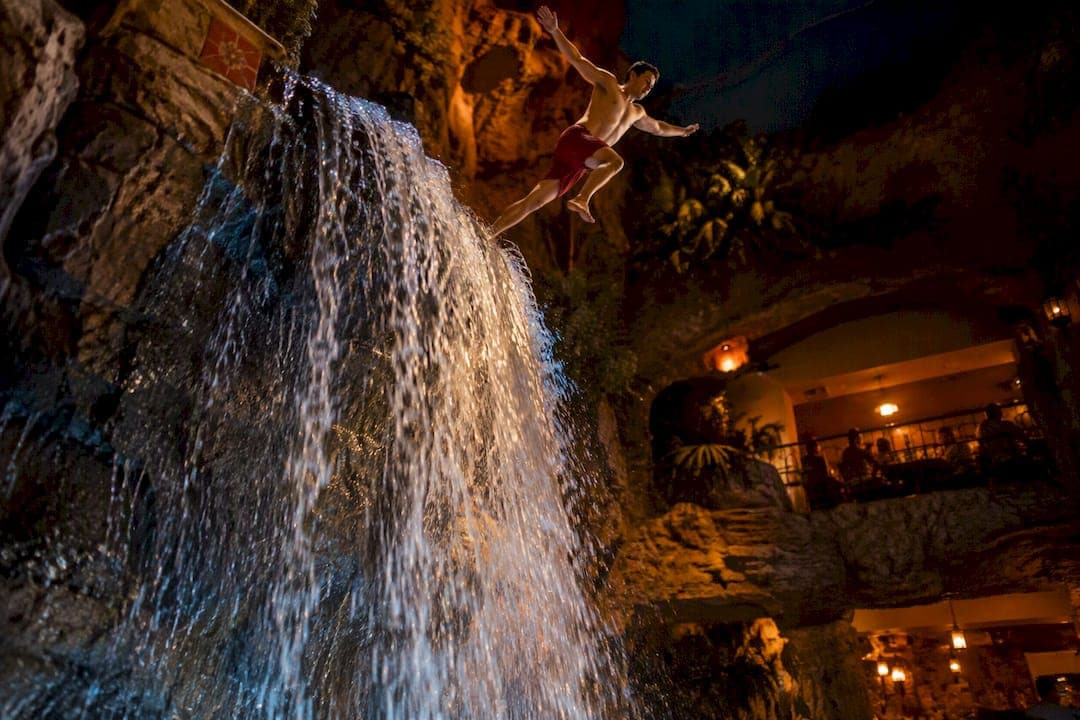
Casa Bonita is a Lakewood, Colorado Mexican restaurant known less for its food than for its cliff divers, waterfall, and cave full of animatronics, a Colorado institution since the chain's 1968 origins and its 1974 Denver-area opening. After decades as a beloved oddity, the restaurant closed during the pandemic and filed for bankruptcy, only to be bought and rebuilt by Trey Parker and Matt Stone, whose renovation preserved the spectacle while fixing what was falling apart underneath it.
TL;DR:
- Casa Bonita's survival over decades depended largely on its physical scale and iconic attractions, especially the diving pool and waterfall, rather than food quality.
- The restaurant's reputation is rooted in its entertainment, such as cliff divers, puppet shows, and themed walk-throughs, which draw visitors from across generations.
- Its financial troubles worsened during the pandemic, leading to bankruptcy in 2021, with staff issues and deferred maintenance becoming publicly visible.
- When Trey Parker and Matt Stone purchased Casa Bonita in 2021, they committed to preserving its core features and invested around 40 million dollars into rebuilding and safety upgrades.
- The restaurant remains a symbol of Colorado's cultural history, maintained through local memory and nostalgic merchandise, despite challenges from ownership changes and closure.
Table of Contents
- The founding story: from Oklahoma City to Lakewood
- What made the waterfall and cliff divers so unforgettable
- How debt and the pandemic pushed Casa Bonita to the brink
- South Park's spotlight and the Parker and Stone rescue
- Inside the $40 million restoration and the new menu
- The lawsuits, injuries, and labor disputes behind the legend
- Why Casa Bonita still matters to Colorado culture
- What Casa Bonita reveals about Colorado's disappearing landmarks
- Why I think local landmarks deserve better record-keeping
- Wear the memory: Native303's Casa Bonita-inspired designs
- Where this history comes from
- Sources
- FAQ
The founding story: from Oklahoma City to Lakewood
Casa Bonita's roots go back further than most Coloradans realize. The first Casa Bonita opened in Oklahoma City in 1968, the creation of restaurateur Bill Waugh, who built a chain of themed Mexican restaurants designed around spectacle rather than strict culinary authenticity. Waugh had already opened several Casa Bonita locations in other states before the concept reached Denver, treating each restaurant as a stage set as much as a dining room.
The Lakewood location opened on March 25, 1974, according to archival records held by the Denver Public Library. It occupied a converted department store footprint inside the Casa Bonita shopping center, a detail that explains the building's odd, oversized interior: wide-open retail bones gave Waugh's team room to build a 30-foot waterfall, a cliff-diving pool, and a warren of themed dining rooms without the structural limits of a purpose-built restaurant.
Other Casa Bonita locations opened across the country through the 1970s and 1980s, but most closed or changed hands as the chain's ownership shifted repeatedly over the following decades. The Lakewood restaurant outlasted its siblings for a specific reason: its diving pool and physical scale made it the flagship, and closing it would have meant losing the one location built to support the brand's signature stunt. Ownership passed through several corporate hands over the years, eventually landing with Star Buffet and later Summit Family Restaurants, both of which ran the restaurant as a legacy asset rather than investing heavily in upkeep.
- 1968: The first Casa Bonita opens in Oklahoma City under Bill Waugh.
- 1974: The Lakewood, Colorado location opens on March 25 inside a converted department store space.
- Following decades: Sister locations close one by one while Lakewood survives on the strength of its diving pool and scale.
- 2000s to 2010s: Ownership consolidates under corporate operators, including Star Buffet and Summit Family Restaurants.
By the time most millennial Coloradans grew up visiting Casa Bonita, it was already an outlier, a restaurant that had outlived its own chain almost entirely on the strength of one building's design.
What made the waterfall and cliff divers so unforgettable
Casa Bonita's reputation was never built on its enchiladas. The centerpiece is a 30-foot indoor waterfall feeding a pool where performers dive from platforms and rock ledges throughout the evening, timed between puppet shows, mariachi sets, and gunfight skits staged around the dining room. Guests wander through a maze of themed areas, including Black Bart's Cave, an arcade tucked behind the main floor, and a warren of stairways connecting different seating levels, an effect longtime visitors describe as walking through a Mexican village lit up at night.
The building's design supported a dining room built for scale, not intimacy. Multiple seating tiers wrapped around the central waterfall and stage area, letting hundreds of diners watch the same show from different vantage points, while side rooms and the arcade gave families somewhere to wander between courses.
- The waterfall and diving pool anchor the main dining room and drive the nightly performance schedule.
- Black Bart's Cave offers a walk-through attraction separate from the main seating areas.
- Puppet shows, magic acts, and mariachi performances rotate throughout service.
- The arcade and gift shop extend the experience beyond the meal itself.
Local archival and news coverage consistently frames Casa Bonita's history as a story about atmosphere over food, a reputation that dates back to its earliest reviews and has followed the restaurant for five decades. Locals rarely defend the cuisine, and they rarely need to. The draw was always the show, and generations of Colorado kids grew up measuring birthday parties by whether they got to see a diver hit the water.
How debt and the pandemic pushed Casa Bonita to the brink
Casa Bonita's slow decline had been building for years before COVID-19 finished the job. Under Summit Family Restaurants, the chain carried financial strain that showed up in maintenance backlogs and thinning staff, even as the Lakewood location remained the company's best-known asset. Sister restaurants under the same corporate umbrella had already closed or faded years earlier, leaving Lakewood increasingly exposed as the last major property propping up the brand.
Trouble became public in 2020, when reports surfaced of bounced payroll checks and unpaid staff during a period of pandemic-driven closures. Restaurants across Colorado were shutting dining rooms or operating at reduced capacity, and Casa Bonita's business model, built entirely around packed rooms watching live performances, had almost nothing to fall back on. A restaurant designed for spectacle cannot easily pivot to takeout.
The financial pressure came to a head in April 2021, when Summit Family Restaurants filed for Chapter 11 bankruptcy, listing the pandemic closures and years of accumulated debt as core factors. For a moment, it looked plausible that Casa Bonita, an institution that had already survived the collapse of its entire original chain, might not reopen at all.
- Summit Family Restaurants operated Casa Bonita amid mounting debt through the 2010s.
- 2020 payroll issues became public as the pandemic forced closures.
- April 2021: Summit Family Restaurants files for Chapter 11 bankruptcy.
- The bankruptcy put the Lakewood restaurant's future, and its landmark attractions, at real risk.
South Park's spotlight and the Parker and Stone rescue
Casa Bonita's leap from regional curiosity to national cult icon traces almost entirely to a single 2003 episode of "South Park," in which the show's creators mythologized the restaurant for viewers who had never set foot in Colorado. Trey Parker and Matt Stone, both Colorado natives, had grown up going to Casa Bonita, and the episode turned an already beloved local landmark into something fans across the country wanted to see for themselves.
That cultural weight mattered when the bankruptcy sale process opened up competing interest, including a local "Save Casa Bonita" push from community members hoping to keep the restaurant under local, non-corporate control. In the end, Parker and Stone won the bid. Restaurant Business reported that the pair purchased Casa Bonita in 2021 for several million dollars, a price that reflected both the distressed state of the business and the sentimental stakes involved.
Parker and Stone framed the purchase publicly as an act of preservation rather than a redevelopment play. They pledged to keep the building's core identity intact rather than convert the property into something more profitable but unrecognizable, a promise that carried real weight given how many Colorado landmarks have vanished under new ownership.
- 2003: The South Park episode built Casa Bonita's reputation into a nationwide cult phenomenon.
- 2021: The bankruptcy sale draws competing interest, including local preservation advocates.
- 2021: Trey Parker and Matt Stone purchase the restaurant for $3.1 million.
- The new owners publicly commit to restoring the building rather than repurposing it.
Inside the $40 million restoration and the new menu
Parker and Stone reportedly put tens of millions of dollars into rebuilding Casa Bonita, an investment that dwarfed the original purchase price and signaled how seriously they took the restoration. Their stated goal, repeated in interviews and press materials, was to "change nothing, improve everything," meaning the waterfall, cliff divers, and cave stayed, while the plumbing, kitchen, and safety systems behind them got rebuilt from the ground up.

Much of the work addressed problems invisible to diners: outdated electrical systems, aging structural supports, and code compliance issues that had accumulated over decades of deferred maintenance. The performance spaces were restored rather than replaced, keeping the diving platforms and cave intact while bringing the building up to current safety standards.
The most visible change came into the kitchen. Chef Dana Rodriguez partnered with the new owners to lead the culinary side of the relaunch, publicly stating her mission was to "improve everything, but change nothing." Rodriguez, a respected figure in Denver's restaurant scene, reworked the menu to raise food quality without erasing the combination platters and tableside theatrics longtime visitors expected.
- The renovation reportedly cost around $40 million, far exceeding the original $3.1 million purchase price.
- Structural, electrical, and safety systems were rebuilt while visible attractions were preserved.
- Chef Dana Rodriguez led the menu overhaul, aiming to raise food quality without losing the restaurant's identity.
Pro Tip: If you visit post-renovation, go in expecting the same divers and waterfall you remember, with noticeably better food than the restaurant's old reputation would suggest.
The lawsuits, injuries, and labor disputes behind the legend
Casa Bonita's decades of live diving performances came with real physical risk. Divers work close to shallow water and rock formations, and injuries among performers have been part of the restaurant's history, a byproduct of staging an athletic stunt show inside a restaurant several nights a week for fifty years.
Labor issues surfaced well before the 2021 bankruptcy. The 2020 reports of bounced payroll checks reflected broader strain inside the company as pandemic closures cut off revenue while fixed costs continued. Around the same period, an age-discrimination lawsuit filed in October 2020 added another layer of scrutiny to how the prior ownership treated its workforce during an already difficult year.
None of this erased the restaurant's cultural standing, but it complicates the nostalgia tied to iconic landmarks. Casa Bonita's story includes real workplace strain alongside the spectacle, and readers researching its history should hold both facts at once: a beloved landmark that also struggled, at times, to treat its own staff well.
- Diving performers have faced documented injury risk as part of the nightly show.
- 2020: Reports surfaced of bounced payroll checks tied to pandemic-era financial strain.
- October 2020: An age-discrimination lawsuit was filed against the prior ownership.
- The new ownership's public restoration pledge has not erased scrutiny of the restaurant's labor history.
Why Casa Bonita still matters to Colorado culture
Casa Bonita's landmark status runs deeper than a viral South Park reference. The restaurant has been recognized locally as a historic site, a designation that reflects decades of multigenerational visits rather than architectural grandeur. Families who took their kids there in the 1980s now bring grandkids to the same waterfall, and that repetition is part of what makes the building matter.
The South Park connection widened its audience nationally, but the restaurant's deeper significance is regional: it is one of the few Denver-area institutions that has survived corporate ownership changes, bankruptcy, and a pandemic closure while keeping its core identity recognizable. That durability, more than any single attraction, is why it keeps showing up in conversations about Colorado nostalgia and why its imagery keeps turning up on merchandise.
- Local recognition of Casa Bonita as a historic site reflects its long community role, not just its fame.
- Multigenerational visits have built loyalty that outlasted multiple ownership changes.
- South Park references introduced the restaurant to national audiences without replacing its local identity.
What Casa Bonita reveals about Colorado's disappearing landmarks
Casa Bonita fits a pattern I keep coming back to in local history: a retail building repurposed into something stranger and more memorable, staffed in part by teenagers doing a genuinely unusual job, and eventually turned into a piece of collective memory that outlives the business itself. The cliff divers were often young performers working a summer gig that became, decades later, a story people tell at parties. That combination, repurposed space, ritualized youth labor, and merchandise culture, shows up again and again in Denver's vanished and near-vanished landmarks. Readers curious about that broader pattern can find more of it covered on the Native303 blog, where similar Denver institutions get the same treatment.
Why I think local landmarks deserve better record-keeping
I write about places like Casa Bonita because Denver loses these landmarks faster than most cities notice. A restaurant survives fifty years of ownership churn and a bankruptcy filing, and the thing that actually keeps its memory alive is not a plaque, it is the people who keep talking about the waterfall and the divers decades later. That informal record matters as much as any archive.
— Rob
Wear the memory: Native303's Casa Bonita-inspired designs
Casa Bonita survived corporate neglect, a pandemic, and bankruptcy because enough people refused to let it disappear. Native303 exists for that same instinct: turning memories of Denver's vanished and iconic spaces into apparel you can actually wear. Our lineup includes tees, sweatshirts, hoodies, and tote bags built around Colorado eateries and landmarks, with a custom design service for anyone who wants a specific detail, color, or Casa Bonita-era reference brought to life.
Each run stays small and specific rather than mass-produced, which keeps the designs tied to real local memory instead of generic vintage aesthetics. If you grew up watching the divers or you inherited the story secondhand from a parent who did, there is likely a design that fits.
- Ready-made designs cover eateries, clubs, and shops with a local nostalgic theme.
- A custom design service is available to request specific colors, sizes, or landmark references.
- Limited production runs keep each design tied to specific local memories.
Native303 positions itself as offering original designs built around vanished and iconic local spaces, available both ready-made and through a custom process. Browse the full Native303 storefront or start a custom request to turn your own Casa Bonita memory into something you can wear.
Where this history comes from
- Denver Public Library Special Collections and Archives: Lakewood opening date and early reviews.
- Wikipedia: consolidated background on founding, ownership, and reopening.
- PR Newswire: official announcement of the Rodriguez culinary partnership.
- Restaurant Business: reporting on the 2021 purchase price and preservation intent.
- Westword: local reporting on landmark recognition and the restaurant's atmosphere-first reputation.
Sources
- Matt Stone and Trey Parker acquire Casa Bonita and announce culinary partnership with Chef Dana Rodriguez | PR Newswire
- South Park creators buy landmark Casa Bonita restaurant for $3.1M | Restaurant Business
- Casa Bonita — Wikipedia
FAQ
Do Trey Parker and Matt Stone still own Casa Bonita?
Yes, Trey Parker and Matt Stone own Casa Bonita, having purchased the restaurant in 2021 after its prior owner filed for bankruptcy. They funded a major renovation and have kept the restaurant under their ownership since reopening.
What's the story behind Casa Bonita?
Casa Bonita began as a themed Mexican restaurant chain founded by Bill Waugh in 1968, with the surviving Lakewood, Colorado location opening in 1974. It became a Colorado icon for its cliff divers and waterfall, closed during the pandemic, and was later bought and restored by South Park creators Trey Parker and Matt Stone.
Why did people react strongly to changes at Casa Bonita?
Public reaction centered on fear that new ownership would strip away the restaurant's identity after decades of decline and a 2021 bankruptcy filing. Parker and Stone addressed that concern directly by publicly pledging to preserve the waterfall, divers, and cave while only updating the systems behind the scenes.
What is so special about Casa Bonita, Denver?
Casa Bonita's appeal comes from its live entertainment inside a restaurant setting, including cliff divers, a 30-foot waterfall, and walk-through attractions like Black Bart's Cave. That atmosphere-first reputation, documented since its earliest reviews, has mattered more to its legacy than the food itself.