
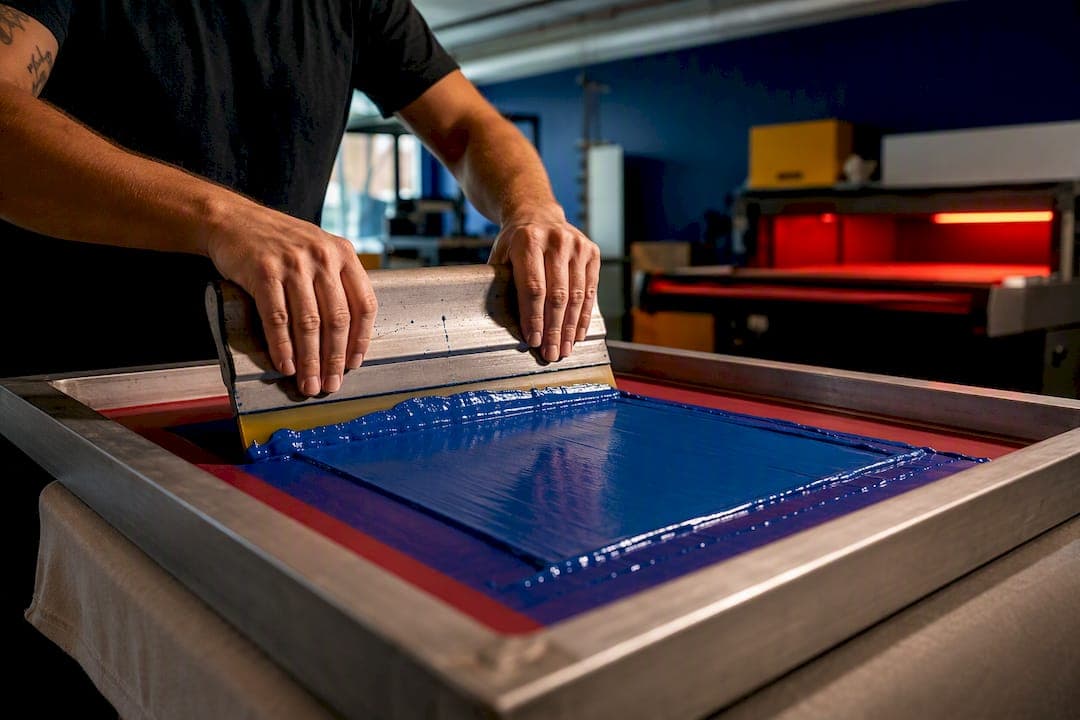
Pick water-based or discharge ink when you want soft, breathable prints on retail cotton tees. Pick plastisol when you're printing dark or synthetic fabrics, need exact color matching, or you're running a large order where reliability matters more than hand-feel. The difference comes down to how each ink sits with the fabric versus on top of it.
TL;DR:
- Water-based inks penetrate fabric fibers to create a soft, integrated feel, but require tighter shop control and longer drying times for full curing.
- Plastisol provides bright, opaque colors on dark garments and is more forgiving during long production runs due to its non-drying, heat-fused nature.
- Discharge printing chemically bleaches the garment dye to produce a soft, vintage look, but is limited to natural fibers like cotton and requires careful chemical handling.
- Additives for effects like metallics or puff are mainly compatible with plastisol, which can create raised or reflective surface textures that water-based inks cannot replicate effectively.
- The choice between inks impacts garment feel, finish, and durability, with water-based preferred for vintage, breathable designs, and plastisol for bright, high-opacity, or complex effects.
Table of Contents
- Water-Based Ink vs Plastisol Screen Printing: A Quick Comparison
- How Do Water-Based and Plastisol Inks Actually Work?
- The Real Advantages and Drawbacks of Water-Based Ink
- Why Plastisol Still Dominates Production Runs
- Matching Ink to Fabric and Use Case
- What to Ask Your Printer Before the Job Runs
- Environmental and Safety Trade-Offs Worth Knowing
- What Discharge Printing Actually Does
- A Practical Checklist Before You Place Your Order
- Texture and Finish: What the Print Actually Looks and Feels Like
- Can You Add Metallics, Puff, or Special Effects?
- Does the Ink Change How the Shirt Feels to Wear?
- Why Native303 Leans Water-Based for Vintage Tees
- See These Ink Choices on Real Denver-Inspired Apparel
- Sources
Water-Based Ink vs Plastisol Screen Printing: A Quick Comparison
The core trade-off is simple: plastisol sits on the fabric surface, water-based becomes part of it. That single fact explains almost every difference in feel, opacity, and production behavior between the two.
- Hand and breathability: Water-based prints feel soft and almost invisible to the touch because the ink penetrates fabric fibers instead of coating them. Plastisol leaves a thicker, rubbery layer that's easy to feel and see.
- Opacity and vibrancy: Plastisol wins on dark garments hands down, laying down bright, opaque color in a single pass. Water-based inks struggle with full opacity on dark cotton unless you add a discharge base or extra underbase layers.
- Fabric suitability: Water-based and discharge work best on 100% cotton. Plastisol handles cotton, blends, and polyester without much fuss.
- Production behavior: Plastisol won't dry in the screen, so long runs stay forgiving even with inexperienced operators. Water-based ink can dry and clog screens mid run, demanding tighter shop control and longer dryer dwell times.
How Do Water-Based and Plastisol Inks Actually Work?
Water-based ink uses water as its carrier. As the shirt passes through the dryer, that water evaporates and the binder cross-links with the fiber, which is why the print feels like part of the shirt rather than a layer on it. That evaporation step is also why cure temperatures and airflow matter so much. Skip a few degrees or a few seconds of dwell time and the binder never fully sets.
Plastisol is a different animal entirely. It's a PVC-based polymer suspended in liquid plasticizer, and it doesn't dry at room temperature at all. It needs a fusion cure, typically in the 320°F range, where heat melts the PVC particles into a continuous plastic film. No heat, no cure. That's also why plastisol can sit in a screen for hours without clogging.
The Real Advantages and Drawbacks of Water-Based Ink
Water-based ink earns its reputation on feel alone. Brands selling premium or vintage-style cotton tees lean on it because the print disappears into the fabric instead of sitting on top like a sticker.
- Soft hand that only gets softer with washing, since the ink becomes part of the weave rather than cracking off it
- Breathable, no plasticky barrier trapping heat against skin
- Genuinely PVC and phthalate-free in most formulations, appealing to eco-conscious buyers
- Lower opacity on dark garments without an underbase or discharge agent
- Trickier shop control: pot life is shorter, screens can dry and clog mid-run, and dryers need longer dwell time since water has to fully evaporate before the binder cures
Pro Tip: Run a test strip through your dryer at the start of every shift, not just once a week. Ambient humidity changes evaporation time enough to under-cure a whole rack of shirts without anyone noticing until the wash test fails.
Why Plastisol Still Dominates Production Runs
Plastisol became the industry default for a reason: it's forgiving. It doesn't dry in the screen, so a shop can run thousands of pieces without stopping to clean or reburn anything.
- Highly opaque, even in a single pass over black or navy fabric
- Predictable, consistent color matching from batch to batch, which matters for brand-specific Pantone colors
- Works across cotton, poly blends, and full synthetics without special prep
- Non-drying nature makes it forgiving for long runs and less experienced operators
- Heavier, plasticky hand that some customers notice immediately
- Prints tend to crack and peel over years of washing rather than fading gracefully, and the PVC base carries its own disposal and handling considerations
Matching Ink to Fabric and Use Case
The right ink depends entirely on what you're printing and who's wearing it.
- Retail fashion on 100% cotton: Go water-based or discharge. Soft hand and breathability sell better at retail than a thick plastisol block.
- Dark garments needing bright or brand-exact colors: Plastisol. You'll get true neons and consistent Pantone matches that water-based can't reliably deliver on black or navy.
- Athletic and moisture-wicking synthetics: Plastisol or a specialty performance ink. Water-based inks bond poorly to polyester because there's no natural fiber to penetrate.
- Somewhere in between: Consider high-solid acrylic (HSA) ink or soft-hand plastisol formulations, which split the difference on feel without giving up opacity entirely.
What to Ask Your Printer Before the Job Runs
Dryer setup makes or breaks either ink. Water-based needs longer dwell time and strong airflow to fully evaporate moisture before the binder sets; plastisol needs sustained heat around 320°F to fuse the PVC into a solid film. Undercure either one and it fails a wash test within a few cycles.
Ask about emulsion type, screen reclaim process, and, if discharge is involved, how they manage activator pot life since it starts degrading the moment it's mixed. A few checks are non-negotiable before any order ships: a wash test, a hand-feel inspection, and a cure-strip pull test to confirm the ink actually bonded rather than just looking dry.
Environmental and Safety Trade-Offs Worth Knowing
Water-based formulations are typically PVC and phthalate free, which is the real substance behind a "PVC-free" claim on a garment tag. That said, the extra dryer time to evaporate water burns more energy per shirt, and some formulations still rely on co-solvents that need proper ventilation.
Plastisol's PVC base comes with documented disposal and handling considerations, and shops typically need solvent-based cleaners for screens and equipment. Neither ink is inherently "green." The real difference is what you're trading: water-based costs more energy to cure, plastisol costs more to dispose of responsibly.
What Discharge Printing Actually Does
Discharge isn't a separate ink family so much as a water-based variant with a trick up its sleeve. The activator in discharge ink chemically bleaches the garment's existing dye and deposits pigment in its place, so the print ends up soft-handed and opaque at the same time, something plain water-based ink can't pull off alone on dark shirts.
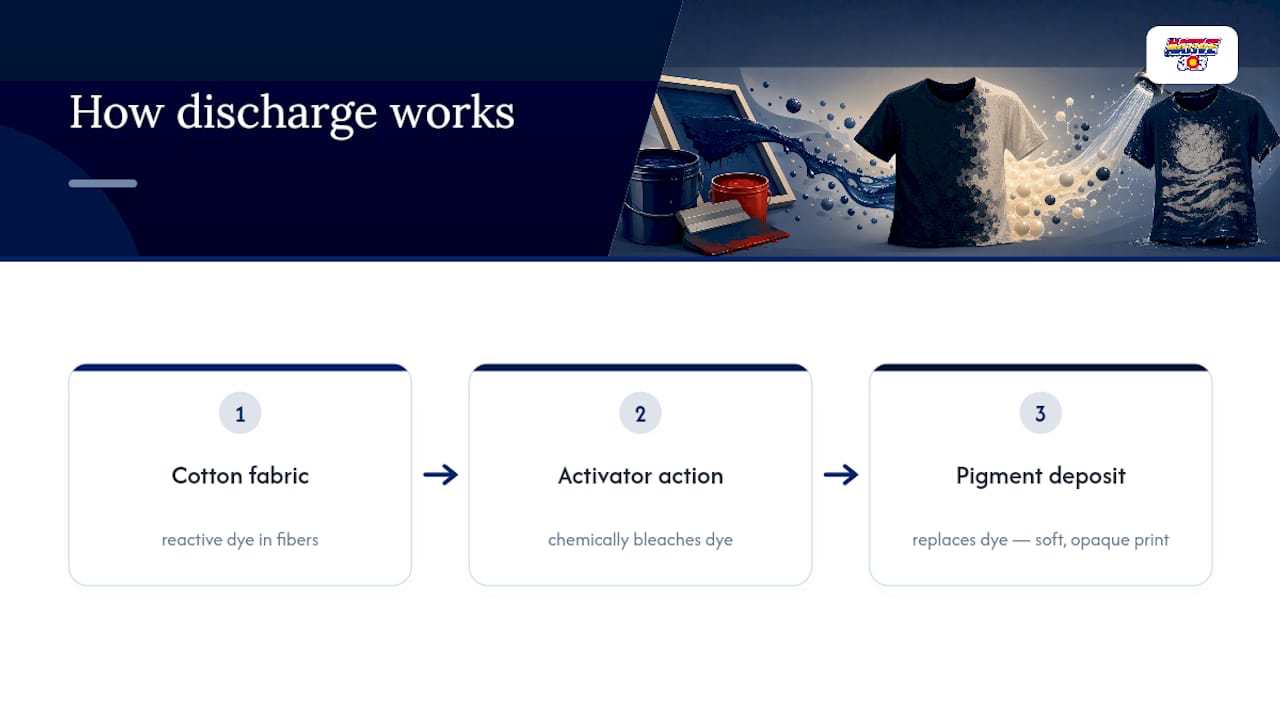
The catch: it only works reliably on natural fibers dyed with reactive dyes, mainly 100% cotton. Polyester doesn't discharge, and the activator has a limited pot life once mixed, so shops need to plan runs carefully and handle it with the same care as any reactive chemical.
A Practical Checklist Before You Place Your Order
Before briefing a printer, nail down the fabric, garment color, required opacity, order size, budget, desired hand, and whether sustainability messaging matters to your brand.
- Small direct-to-consumer run on light cotton tees → water-based or discharge
- Large promotional order on dark hoodies or jackets → plastisol
- Athletic or poly-blend performance wear → plastisol or specialty ink
- Mixed catalog with both light and dark garments → plan for both ink types rather than forcing one system to do everything
Texture and Finish: What the Print Actually Looks and Feels Like
Run your hand over a plastisol print and you'll feel a distinct ridge, almost like a thin sticker fused to the shirt. That's the ink sitting on the surface rather than in it, and it's exactly why plastisol photographs so well for bold graphics and sharp lines. The trade-off shows up over time: because the film sits on top rather than bonding into the weave, repeated flexing and washing eventually causes it to crack or flake at the edges.
Water-based prints go the opposite direction. There's little to no ridge, and on a lighter application you can barely tell the shirt was printed at all until you look closely. Discharge splits the difference in an interesting way. It's flat like water-based ink, but because it's replacing dye rather than adding a coating, it can look almost printed-from-the-factory rather than screen-printed after the fact.
Neither finish is objectively better. A streetwear brand chasing bold, poster-like graphics often wants the texture and opacity plastisol delivers. A vintage-style tee brand chasing a lived-in, already-broken-in look almost always wants the flat, integrated finish water-based or discharge provides. The finish is a design decision as much as a technical one, and it's worth deciding before you ever approve a mockup.
Can You Add Metallics, Puff, or Special Effects?
Plastisol is the more flexible base for special effects, mainly because so many additives were engineered around it first. Puff additive mixed into plastisol expands during cure to create a raised, 3D texture. Metallic and shimmer plastisol inks use suspended metallic flake that catches light in a way water-based formulations generally can't replicate at the same intensity. High-density and gel prints, which build up a thick, glossy layer, are also plastisol-based techniques almost across the board.
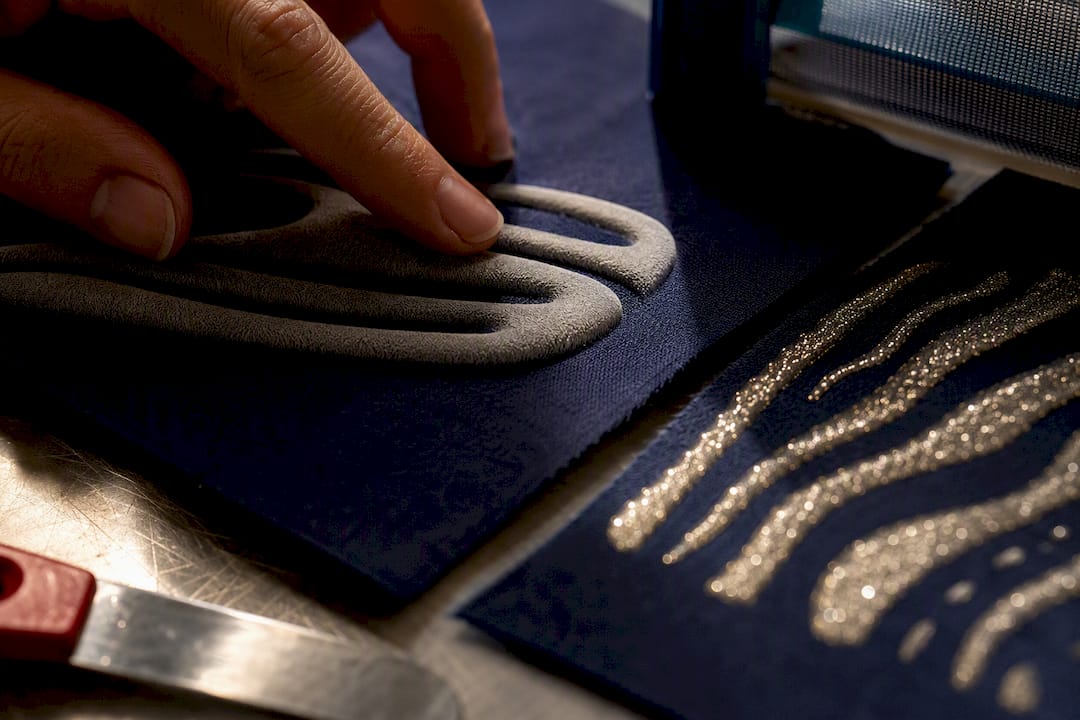
Water-based ink supports some specialty effects, but the menu is shorter. You can find water-based shimmer and pearlescent additives, and discharge can be combined with a pigment top layer for a soft-hand print that still pops with color. What you generally can't do is replicate puff or true high-density textures in a water-based system. The chemistry that makes water-based ink soft and integrated is the same chemistry that keeps it from building up into a raised, sculptural surface.
If a design calls for puff lettering, metallic foil-style shine, or heavy dimensional texture, plastisol (or a plastisol-based additive) is almost always the practical answer. If the goal is a flat, vintage, barely-there print, stick with water-based or discharge and skip the specialty additives altogether.
Does the Ink Change How the Shirt Feels to Wear?
Weight and stiffness are where the two inks diverge most physically. A heavily printed plastisol design, especially one covering a large chest or back area, adds noticeable weight and a stiff patch to the fabric. Fold a plastisol-printed shirt and you can feel exactly where the print sits because that section resists bending differently than the surrounding cotton. On a thin, budget shirt, a large plastisol print can even change how the garment drapes.
Water-based ink adds close to none of that. Because the pigment binds into the fiber structure instead of forming a separate layer, a water-based print typically doesn't change the drape or weight of the shirt in any way you'd notice while wearing it. That's a meaningful difference for anyone printing on lightweight or vintage-inspired cotton fabric, where part of the appeal is how the shirt moves and feels, not just how the graphic looks.
Discharge lands close to water-based on this front since it's chemically part of the same ink family. Over repeated washes, water-based and discharge prints tend to soften further through a process called fibrillation, giving that broken-in, vintage look brands chase deliberately. Plastisol doesn't age that way. It stays stiff until it eventually fails, usually by cracking or peeling rather than fading gracefully.
Why Native303 Leans Water-Based for Vintage Tees
Our vintage-inspired designs depend on soft, worn-in texture, so we favor water-based and discharge printing on cotton whenever the design allows it. It matches how a real Denver relic would actually feel.
— Rob
See These Ink Choices on Real Denver-Inspired Apparel
You've read the trade-offs. Now here's where they play out on actual shirts. Native303apparel builds its Denver and Colorado nostalgia designs on soft, breathable cotton whenever the graphic allows it, precisely because a print celebrating a decades-old local diner or dive bar should feel worn-in from day one, not stiff and plastic. When a design needs bold color on darker fabric, plastisol comes into play instead, so the artwork stays true to the original signage and neon it's inspired by. That's the same fabric-first decision-making covered throughout this piece, just applied to actual product instead of theory.

Browse the current lineup of tees, hoodies, and totes to see how these ink choices show up on garments inspired by metro Denver's classic eateries and clubs, or check the size guide before you order to make sure the fit matches the vintage silhouette you're after.
Sources
- Polyvinyl chloride — ChemicalSafetyFacts
- Plastisol vs Water-Based Inks - Screen Print Direct
- Screen printing ink types: plastisol vs water-based vs discharge