
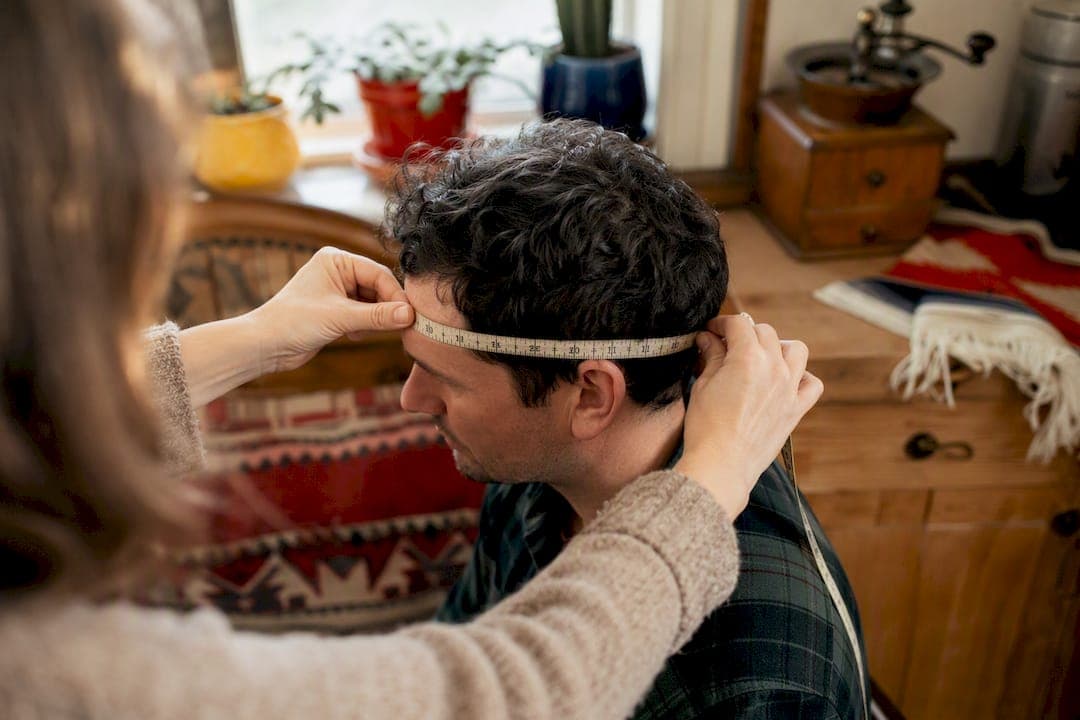
Wrap a flexible tape around your head about a half inch above your eyebrows and over the tops of your ears, take the reading in inches, then match it to a standard conversion chart to get your US numeric size or S/M/L. If your number lands between two sizes, round up rather than down; a hat sized slightly large can be padded down, but one sized too small stays too small.
TL;DR:
- Using the average of three measurements ensures accuracy, especially for fitted caps, due to the high impact of even small errors in size.
- When between two sizes, it is best to choose the larger one, as stretching can be done on loose hats but not on those too small.
- Different hat styles, like beanies, fedoras, or adjustable caps, require specific sizing considerations based on fit and head shape.
- A head circumference of 22 to 23 inches is average, with sizes above 7 5/8 considered large or extra-large, affecting fit choices.
- For children, frequent measurements are necessary since head size changes rapidly, and adjustable styles are preferable for growing heads.
Table of Contents
- How to measure your head for a hat
- Hat size conversion chart: inches, centimeters, and letter sizes
- How hat style changes what your measurement means
- What to do when your size falls between two numbers
- Why your hat still doesn't fit right
- What counts as an average or large head size
- Applying your measurement to Native303 hats
- Kids' hat sizes and how they change with age
- A quick checklist before you buy
- Find your fit in the Native303 collection
- Sources
How to measure your head for a hat
You need three things: a soft cloth tape measure (the kind used for sewing), a mirror or a second pair of hands, and five spare minutes. No cloth tape? A piece of string and a ruler work fine.
Here's the process Stetson recommends, and it's the same method most hatters use:
- Put on the hairstyle you'll actually wear under the hat. A slicked-back style versus a loose bun changes your number by a quarter inch or more.
- Wrap the tape around your head roughly a half inch above your eyebrows, keeping it level as it passes over the tops of your ears and the widest point at the back of your skull.
- Snug the tape against your scalp without cinching it. You want the same tension you'd feel from a properly fitted hat, not a blood-pressure cuff.
- Read the number, then repeat the whole process two more times.
- Average the three readings. That final number is your true head circumference.
If you're shopping for a heavy winter beanie or a hat you'll wear over a hood, add a quarter inch to a half inch to that measurement so there's room for the extra layer underneath.
Hat size conversion chart: inches, centimeters, and letter sizes
Once you have your circumference in inches, converting it to a usable size is mostly arithmetic. TailorSizeGuide breaks the process down to converting centimeters to inches, then rounding the decimal portion to the nearest usable eighth. For fitted caps, multiply the decimal by 8 and round to the closest practical fraction. A 22.44-inch head, for example, rounds to about 22 3/8 inches, which lands at a US fitted size of 7 1/8.
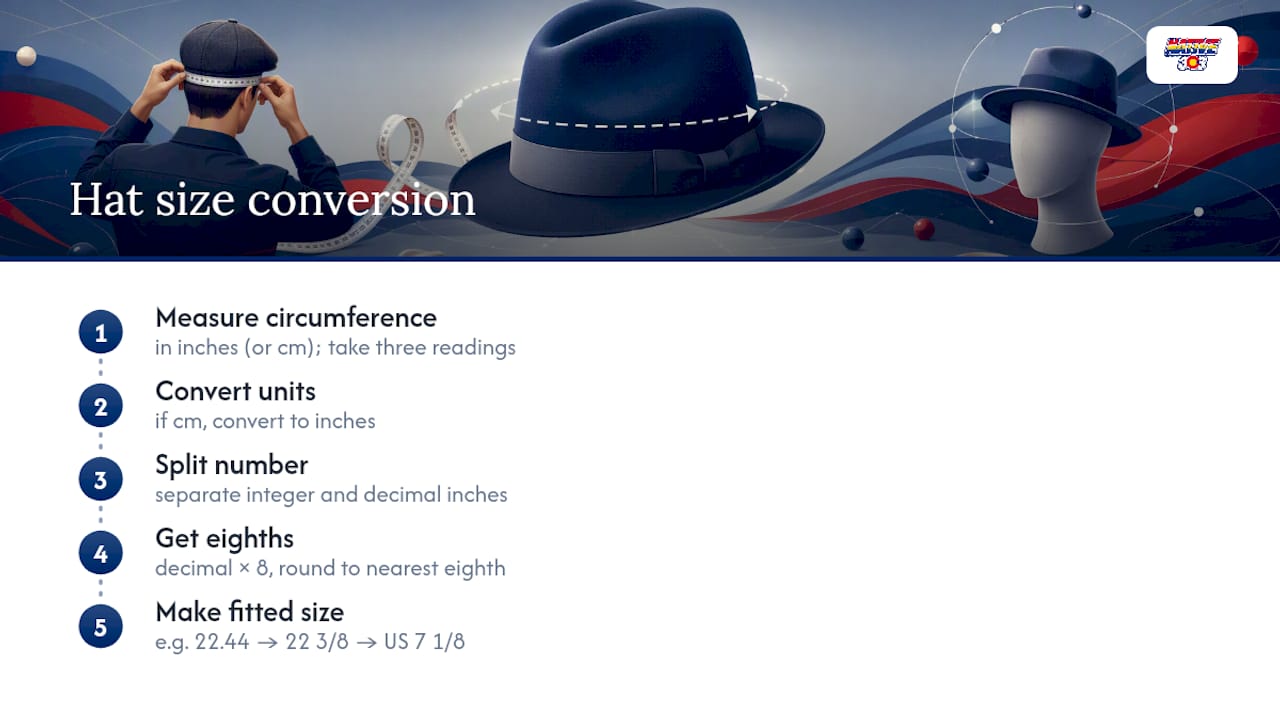
A half inch of measuring error is enough to bump a structured cap into the wrong size bracket entirely, since fitted numbers are derived directly from head diameter with no stretch to absorb a mistake. That precision is exactly why the three-reading average in the previous section matters more for fitted styles than for stretch fabric ones.
How hat style changes what your measurement means
Your circumference number does different jobs depending on what you're buying.
- Fitted, structured caps use your numeric size exactly as calculated, with no give in the band. Between two sizes? Go up, since Fitted Cap God notes fitted hats are built to be padded down, not stretched.
- Adjustable snapbacks rely on a strap range, usually covering roughly 21 to 23 inches. If your head runs bigger than that, look specifically for hats labeled XL or "big head" fit rather than assuming the standard strap will reach.
- Beanies are almost always sold as S/M/L with generous knit stretch, but "one size fits most" beanies genuinely don't fit heads over about 24 inches comfortably.
- Fedoras and cowboy hats depend on crown shape as much as circumference. A "long oval" crown fits a head shape most people have; a true "round" crown suits a smaller minority. Crown depth matters here too.
- Bucket and sun hats typically run S/M/L, and the brim should sit about an inch above your eyebrows when worn correctly.
What to do when your size falls between two numbers
Go with the bigger size. That's the standard advice across the hat trade, and the logic is simple: you can shrink a hat that's slightly loose, but you can't stretch one that's genuinely too small.
- For fitted caps, buy the larger size and add hat sizing tape or thin foam strips along the inside of the sweatband to close the gap.
- For stretch-knit beanies or unstructured caps, splitting the difference is fine; the fabric will settle to your head within a few wears.
- Reserve professional alteration, like a hat shop resizing the sweatband, for pricier structured hats (felt fedoras, wool cowboy hats) where a half size off is too noticeable to fix with tape alone.
Pro Tip: Keep a strip of self-adhesive foam sizing tape in your junk drawer. It costs a few dollars, takes thirty seconds to apply behind the sweatband, and fixes 90 percent of "almost right" fitted hats.
Why your hat still doesn't fit right
Most bad fits trace back to the same handful of errors:
- Measuring too high on the forehead or too low near the ears, which shrinks or inflates your number.
- Letting the tape angle downward in back instead of staying level all the way around.
- Pulling the tape snug enough to compress your scalp, which shaves off a quarter inch you'll miss later.
- Measuring over a thick bun, braid, or bulky hair you won't actually wear under the hat.
To check your work, measure twice on different days, then compare against a hat you already know fits well. If a new hat still slips when you nod or pinches when you turn your head, the crown depth is probably wrong for your head shape, not the circumference.
What counts as an average or large head size
Average adult head circumference runs between 22 and 23 inches, or 56 to 58 cm, with men averaging around 7 3/8 and women around 7 1/4. A 22-inch head lands at US size 7. Add three-quarters of an inch and you're at 7 1/4. Add another three-eighths and you're at 7 3/8. Most hatters consider 7 5/8 and above the threshold for "big head" or XL-labeled fits.
Applying your measurement to Native303 hats
Once you've got your number, Native303apparel's own size guide walks through the same conversion chart alongside notes specific to each hat style in the collection, from structured caps to adjustable trucker-style pieces. It's built to remove the guesswork that generic charts leave in, since brand-to-brand calibration varies even at the same stated size.
Check the product page for each hat before ordering. Some styles run true to the standard chart above; others, especially anything with a lower-profile crown, fit slightly snugger than the number suggests. If you're between sizes on a structured piece, the general sizing-up rule still applies. Native303apparel's return and exchange policy covers sizing misses, so a measurement that's slightly off doesn't have to be the end of the story.
Kids' hat sizes and how they change with age
Children's heads grow fast, and unlike adults, kids' hat sizing is usually organized by age range rather than a single stable number. A toddler between one and two years old typically measures around 18 to 19 inches, while a child between four and six years often falls between 20 and 21 inches. By age ten or eleven, many kids are already measuring close to 21.5 to 22 inches, edging into small adult territory.

Because that growth happens in bursts, measure more often than you would for an adult, roughly every four to six months for kids under eight. The same half-inch-above-the-eyebrows technique applies, but skip the "size up for room to grow" instinct with structured caps. A fitted hat that's too loose slides down over a kid's eyes and gets abandoned in a drawer. Adjustable straps and stretch-knit styles are the better call for growing heads specifically because they absorb a size or two of change without needing a replacement purchase.
Watch for gaps between a youth-sized chart and an adult one, too. Some brands jump straight from "Youth L" to "Adult S" with no overlap, leaving a preteen with a head measuring 21.5 inches stuck between two charts. When that happens, check the brand's specific youth chart rather than assuming a generic S/M/L applies, and lean toward the adult small if the child's growth has clearly plateaued.
A quick checklist before you buy
Measure your head, convert it against the chart, then try the hat on and actually move: look up, look down, turn your head side to side. If you're between sizes, size up and add foam padding rather than hoping a snug fit will loosen with wear.
Watch for pressure points at the temples and the back of the skull when you speak or laugh; that's usually the first place a wrong size announces itself. And write your number down somewhere permanent. Brands calibrate differently, and the inch measurement you took today is worth more than any single brand's labeled size next time you order something new.
— Rob
Find your fit in the Native303 collection
Once you've got your number, there's no reason to guess your way through a hat rack again. Native303apparel built its size guide around the exact conversion method above, with notes specific to each style in the lineup so a structured cap and an adjustable one don't get treated the same way.

Every hat in the Native303apparel store is worth checking against your measurement before you order, and if the fit still misses, exchanges are straightforward rather than a hassle. Pull out your tape measure, match your number against the guide, and pick the Denver-inspired piece that's actually going to sit right on your head instead of just looking good on a screen.
Sources
For deeper conversion charts and measuring technique, see Stetson's official hat sizing guide, the fitted hat size chart from Fitted Cap God, and Plaid Gorilla Golf's measuring and testing guide. Always cross-check against a brand's own chart before ordering a specific model.
- Size
- How to Determine Your Hat Size - Stetson Stories
- How to Measure Your Head for a Hat (All Brands, All Styles)
- Fitted hat size chart: New Era 59FIFTY & All Brands | Fitted Cap God