
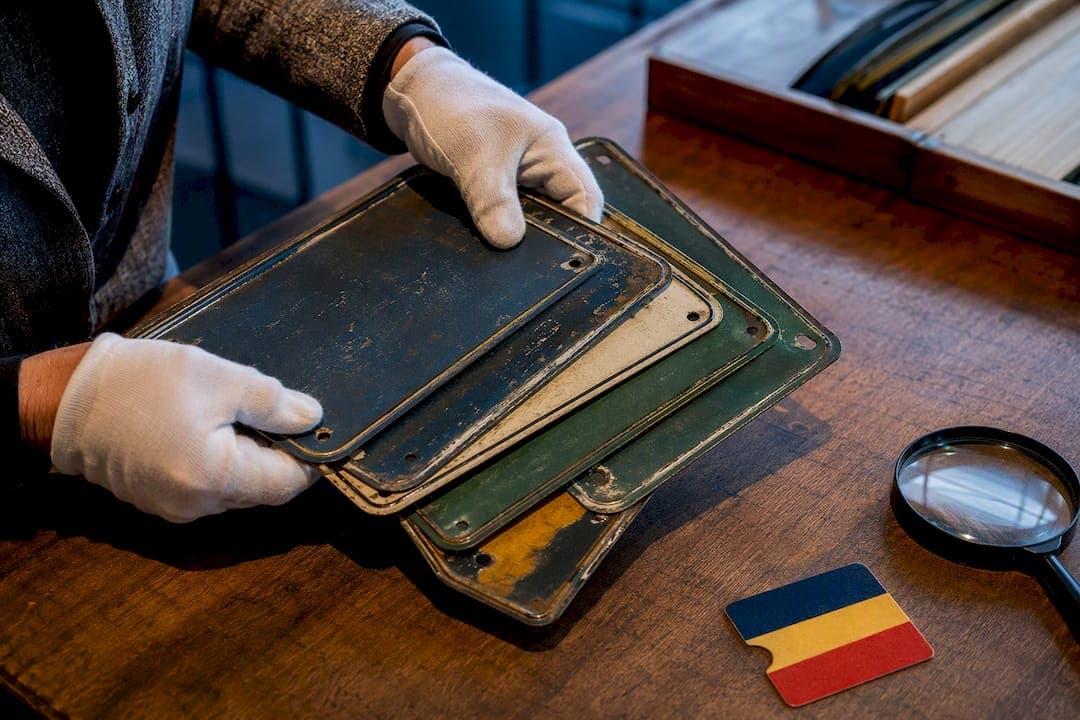
Colorado's license plate story starts on July 15, 1913, when the state took over registration from individual cities and issued its first statewide plates. The mountain-range design that Coloradans now take for granted has held since 1960, with only a handful of exceptions. County-code prefixes, first numeric in 1932 and then alphabetic in 1959, marked every plate by its home county until 2000, when the state switched to sequential serials that had nothing to do with geography.
TL;DR:
- Colorado's license plates transitioned from county coding to sequential formats in 2000 due to population growth outpacing available letter combinations.
- Retired historical plates are available for purchase, with each sale supporting the Disability Support Fund, and new specialty plates are produced via print-on-demand.
- The iconic mountain-range design has remained since 1960, with serial formats expanding from three to four characters between 2000 and 2018 to address capacity issues.
- Old county-code plates can be preserved as collectibles by following specific storage, cleaning, and authenticity verification practices.
- Despite the end of county coding, old plates continue to hold cultural and nostalgic value, inspiring apparel and memorabilia reflecting Colorado’s history.
Table of Contents
- The Early Years of Colorado License Plate History (1913 to 1959)
- How Colorado's County Coding System Worked, and Why It Disappeared
- Why the Mountain Design Survived and How Serial Formats Changed
- Retired Backgrounds, Specialty Plates, and How Print-on-Demand Works
- How to Research a Plate's History or Apply for a Year-of-Manufacture Tag
- What County-Coded Plates Mean to Colorado Collectors
- A Local's Take on Why Colorado's Old Plates Still Matter
- Wear a Piece of Colorado's Plate History
- Sources
The Early Years of Colorado License Plate History (1913 to 1959)
Before the state stepped in, cities handled their own vehicle registration, and Denver was already issuing local plates before 1913 rolled around. Once Colorado's statewide system launched, every county fell under one uniform process for the first time, and the state took over a job that had been scattered across dozens of local governments.
Those first plates looked nothing like what you'd recognize today. Early issues were made of porcelain and embossed metal, materials chosen because they held paint and survived Colorado winters better than the alternatives available at the time. Some early years required drivers to display only a single plate rather than a matching pair front and back, a practice that later became standard as enforcement needs grew.
Color changed almost every year for decades, partly to help officers spot expired registrations at a glance without needing to check paperwork.
- 1913: first statewide issuance, porcelain and embossed metal construction
- 1920s to 1930s: annual color rotations become common practice
- 1940s: metal shortages during World War II affect plate materials and production
- 1950s: color changes continue annually before the state moves toward more consistent, standardized designs
By the late 1950s, Colorado had cycled through enough color combinations that officials started looking for a more permanent visual identity. That search led directly into the two biggest structural changes in the plate's history: county coding and the mountain design.
How Colorado's County Coding System Worked, and Why It Disappeared
Colorado assigned counties numeric prefixes starting in 1932, and the order wasn't random. Counties were ranked by population from the 1930 census, so Denver's plates started with a low number and rural counties got higher digits. If you knew the numbering, you could glance at a bumper and know roughly how big the driver's home county was.
That numeric system worked fine until the state ran out of room. Counties were growing at wildly different rates, and by 1959 Colorado switched to two-letter alphabetic county codes instead, which opened up far more possible combinations per county.
Even that expansion had a shelf life. Fast-growing counties along the Front Range started burning through their available letter combinations faster than rural counties ever would, and some letter pairs were skipped entirely for practical or cultural reasons. The math simply stopped working.
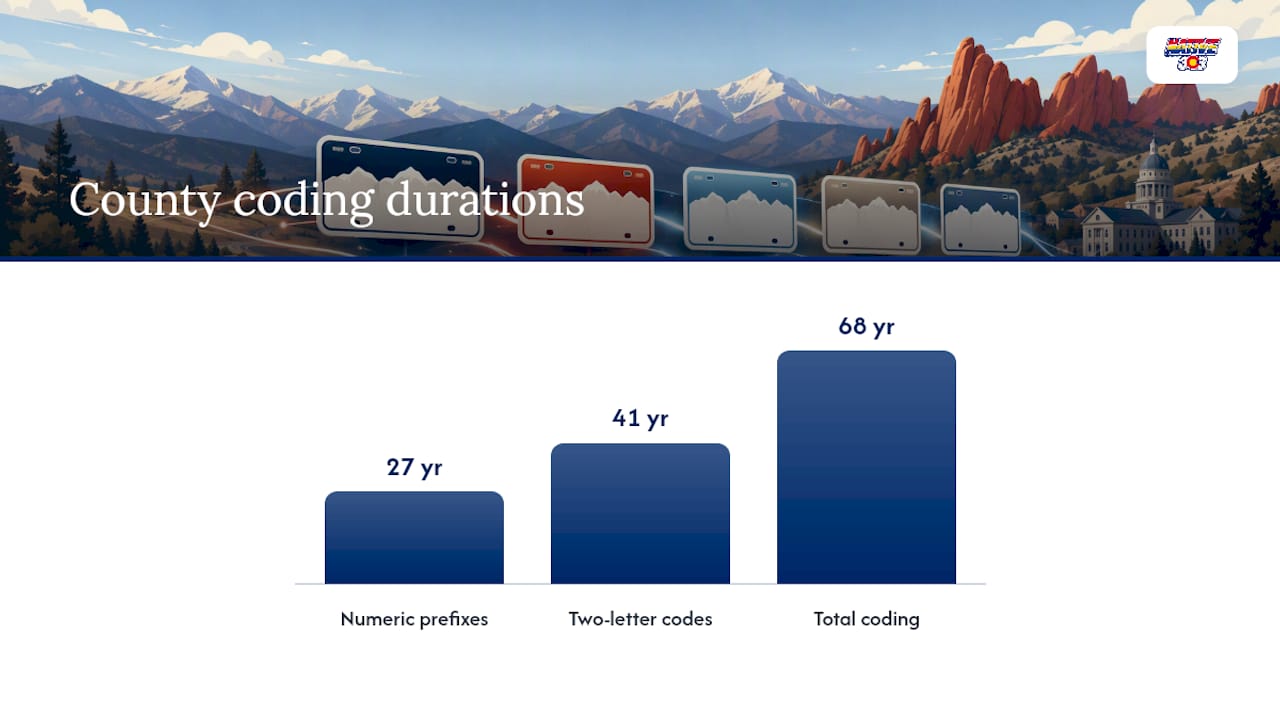
Colorado's county-coding system ran from 1932 to 2000, longer than most drivers realize when they see an old plate at a swap meet or tucked in a garage.
- 1932: numeric prefixes assigned by county population rank
- 1959: switch to two-letter alphabetic codes for more combinations
- Late 1990s: several counties approach exhaustion of available letter sequences
- 2000: state abandons county coding entirely in favor of sequential, non-county serials
The 2000 switch wasn't a design choice. It was math. Colorado's population had grown unevenly for seven decades, and a coding system tied to geography couldn't keep expanding forever without running out of letters.
Why the Mountain Design Survived and How Serial Formats Changed
The mountain-range silhouette Coloradans call the "greenie" showed up around 1960, and with brief exceptions, it has anchored every standard plate design since. That kind of design continuity is rare among states, most of which redesign their plates every decade or so for budgetary or political reasons.
A handful of years broke from the norm, usually for commemorative purposes rather than a permanent redesign. The state's 150th anniversary plates, for example, came from a public design vote rather than an internal DMV decision, treating the plate as a piece of civic art rather than pure bureaucracy.
Serial formats, unlike the artwork, changed purely out of necessity.
- 2000: county coding ends, replaced by a three-letter, three-number sequential format
- 2015 to 2018: incremental refinements as available combinations shrink
- 2018: shift to a four-letter, two-number format to expand capacity further
Every one of those changes traces back to the same problem the county system had: too many vehicles, not enough available combinations. Colorado's population growth simply outpaced whatever format came before it.
Retired Backgrounds, Specialty Plates, and How Print-on-Demand Works
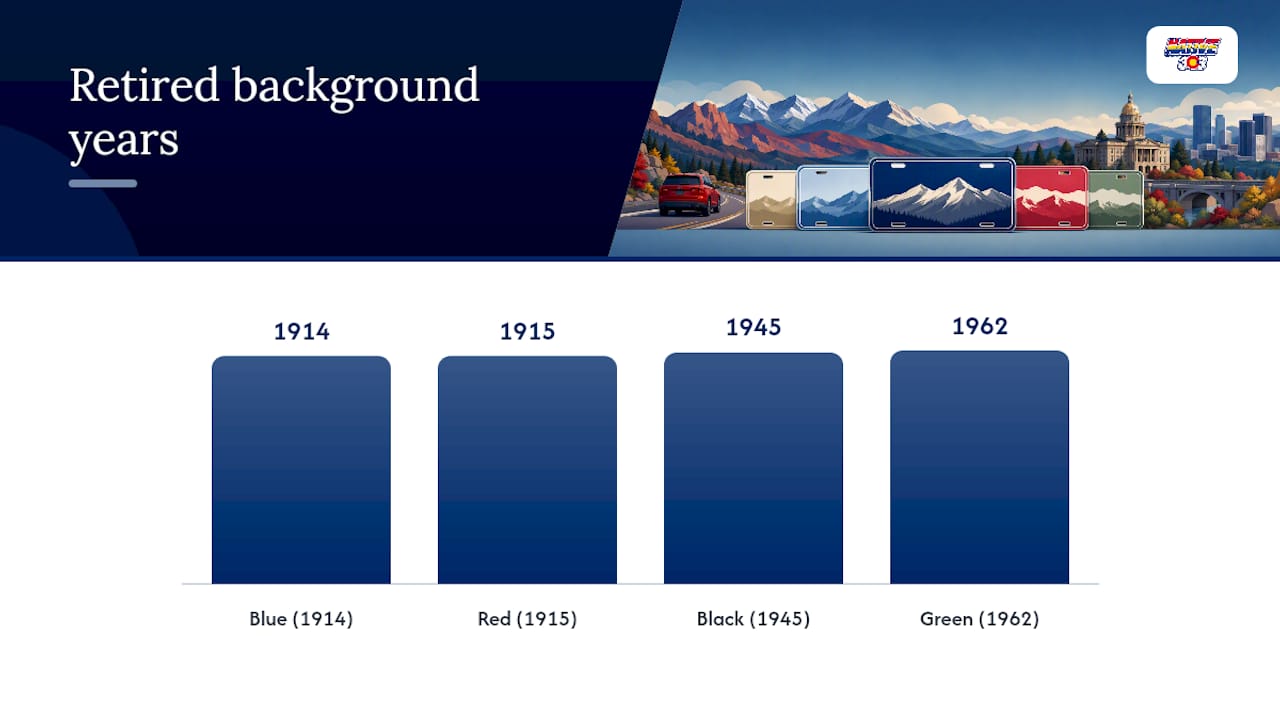
If you want a piece of Colorado plate history on your own vehicle without hunting down an original, the state actually sells retired designs. Four historical backgrounds are currently available through the Disability Support Fund program: Black (1945), Blue (1914), Red (1915 visitor), and Green (1962 to 1999).
Every retired-background plate sold sends $25 directly to the Disability Support Fund, a detail that turns a nostalgia purchase into something with a practical civic benefit attached.
- Retired backgrounds: Black 1945, Blue 1914, Red 1915 (visitor), Green 1962 to 1999
- Fee: $25 from each sale goes to the Disability Support Fund
- Personalized and specialty plates carry their own separate fee schedules beyond the base registration cost
Most specialty and low-demand plates today come out of Colorado Correctional Industries through print-on-demand production. Rather than every county office stocking every possible design, POD lets a plate get printed only when someone actually orders it, then mailed once it's finished. That system is a big part of why Colorado can offer dozens of specialty designs without every DMV counter needing a warehouse full of inventory.
How to Research a Plate's History or Apply for a Year-of-Manufacture Tag
Curious whether that plate in your garage is the real deal, or want to run an old car with period-correct tags? Here's the process.
- Start with the Colorado DMV's historic plate pages to confirm design eras, colors, and county codes against your plate.
- Check with your county motor vehicle office for local records or archived registration files tied to older plates.
- Confirm your vehicle qualifies for Year-of-Manufacture status. It generally needs to be at least 30 years old.
- Gather documentation: a clear photo of the original plate, plus a completed and signed DR 2818 declaration form.
- Submit through your county office, or handle personalized and replacement plate orders through myDMV, which typically has a processing window measured in weeks rather than days.
Pro Tip: Photograph your plate's embossing and any stamped date codes before you clean it. That documentation makes the YOM application faster and gives you a record if the plate's condition changes over time.
What County-Coded Plates Mean to Colorado Collectors
A two-letter county code used to say something about you before you ever opened your mouth. In resort towns and mountain counties especially, that little prefix carried real social weight, and losing it in 2000 genuinely stung for a lot of longtime residents who'd watched their county's letters for decades.
If you're holding onto an old plate, a few basics keep it collector-grade: clean gently with mild soap rather than abrasives, store it flat or vertically away from direct sun, and check embossed years and paint texture against known reference photos to confirm authenticity.
- Clean with mild soap and a soft cloth, never abrasive pads
- Store flat or vertically, away from humidity and direct sunlight
- Compare embossed year and font style against verified reference examples
- Keep any paperwork or provenance history with the plate itself
That same nostalgia is exactly why old plate imagery keeps showing up on local apparel and memorabilia decades after the original designs went out of circulation.
A Local's Take on Why Colorado's Old Plates Still Matter
I grew up hearing people size up strangers by their county code before they'd even said hello. That's a strange kind of pride to lose, and it's exactly why old plate designs still show up woven into local retro apparel and collector pieces today.
— Rob
Wear a Piece of Colorado's Plate History
You can't legally slap an old county-coded plate on your daily driver anymore, but you can wear that same visual history on a shirt. You can find nostalgia-themed apparel as an alternative to hunting swap meets for an original plate. You get Colorado nostalgia you can actually put on without waiting for a YOM application to clear.
Our designs pull from the same local imagery that made those old plates worth keeping in the first place: mountain silhouettes, retro color schemes, and the kind of details that mean something if you grew up here. Browse the Native303 Apparel storefront to see current designs, check the size guide before you order, and grab something that says Colorado without needing a county code to prove it.